
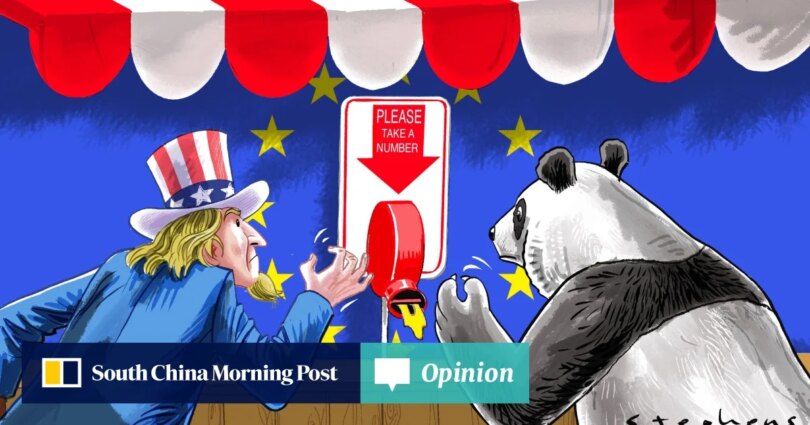
Writing in Foreign Affairs, Tsinghua University’s Da Wei argued that China wants Europe to function as an independent pole in a changing global order, but that Europe lacks “a more independent soul”. He is half right. Europe has the assets for independence. What it lacks is the strategy.
Europe and the United States face the same rival but carry different exposures. Since 2018, the US has cut its direct imports from China. Europe’s have grown harder to unwind. What appears to be decoupling is largely re-routing: Chinese value still reaches American consumers through Vietnam, Mexico and other intermediaries. The system has not separated. It has reorganised.
The European Union remains exposed. Its trade deficit with China was around €306 billion (US$359.4 billion) in 2024; that widened to €360 billion last year. The EU is being pressed to align against a partner it is heavily economically tied to. That is not a strategy. It is a transfer of leverage.
When Washington imposed tariffs on Chinese goods, Europe followed, not by coordination but by drift. Washington then imposed tariffs on Europe itself: steel, aluminium and Section 301 investigations placing the EU alongside China. The instruments change. The logic does not. Allies are markets to be disciplined, not partners to be exempt.
None of this diminishes America’s importance to Europe. Its innovation ecosystem remains unmatched. Europe should stay anchored to it through the transatlantic security alliance and shared commitments. But admiration is not subordination. Washington’s rivalry with China is real. The error is not the competition. It is the collateral taxation of allies. A security alliance does not require an identical China policy.
Europe’s China problem is not America’s. Washington and Beijing are engaged in hegemonic rivalry. Europe is not. Its challenge is industrial: overcapacity, subsidised competition and limited reciprocity – serious problems, but problems that can be negotiated, not reasons to surrender strategic flexibility.