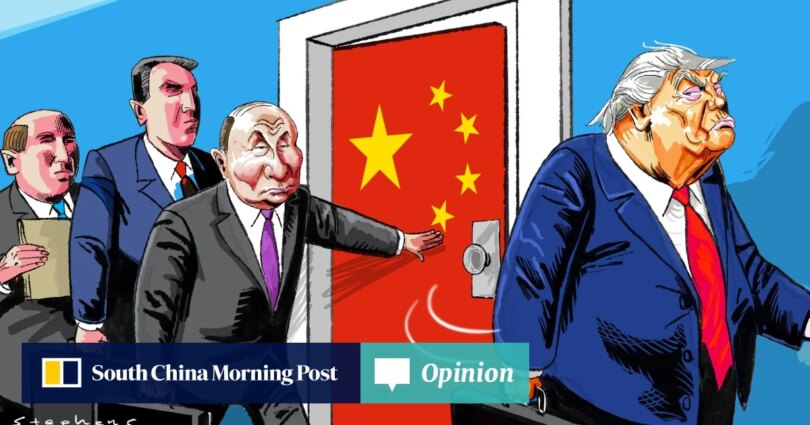
For years, analysts framed China as a power caught awkwardly between a revanchist Russia and an increasingly hostile United States. That interpretation now looks obsolete. Beijing is no longer balancing between rival poles; it is positioning itself as the axis around which those poles must rotate.
Putin’s visit, immediately following Trump’s, is no coincidence. Moscow urgently needs clarity on what transpired behind the doors of Zhongnanhai and the Great Hall of the People. Any recalibration in China-US relations – on tariffs, semiconductors, sanctions, rare earths, Taiwan or Ukraine – alters Russia’s strategic environment.
The Kremlin understands that, in a world of tightening economic blocs and technological controls, China is not merely a partner. It is Russia’s economic lifeline, diplomatic shield and strategic rear base.
But the more profound story lies elsewhere. In hosting the leaders of Washington and Moscow within a week, and doing so specifically in Beijing, Xi is staging a carefully constructed demonstration of China’s role as an indispensable broker of the emerging order.