
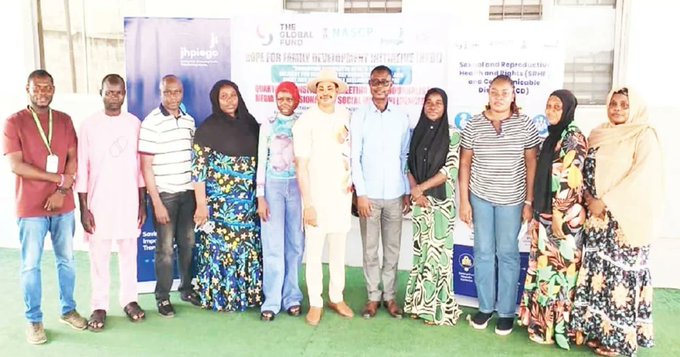
(Reps From HFDI, the Media And Officials. Photo by Punch News)
More than 15,000 residents of Kwara State have received sexual and reproductive health information under a healthcare intervention aimed at tackling stigma and improving access to quality health services for vulnerable groups.
Speaking to an online news platform in Ilorin, the Executive Director of Hope for Family Development Initiative, Dr Aremu Stephen, said stigma and discrimination remained some of the biggest obstacles preventing people from seeking healthcare.
He noted that a major challenge remains stigma and discrimination, particularly against adolescents, young people and persons living with HIV, explaining that fear of being judged, labelled or socially excluded continues to discourage many individuals from seeking healthcare services when they need them, and that delayed access to healthcare often results in worsening health conditions, interruptions in treatment and poor health outcomes for affected individuals.
He also identified gender-based vi0lence and violations of fundamental rights as factors worsening healthcare inequality, stating that many women and young people experience different forms of vi0lence, coercion and discrimination that undermine their autonomy and ability to make informed health decisions, adding that these rights violations reinforce existing inequalities and create additional barriers that prevent affected populations from fully benefiting from available health services.
Stephen said the project adopts an integrated healthcare model that combines sexual and reproductive health services with communicable disease interventions.
He disclosed that the programme covers maternal and newborn health, family planning, adolescent sexual and reproductive health, cervical cancer prevention, HIV, tuberculosis, malaria, sexually transmitted infections and viral hepatitis.
Highlighting the project’s impact, Stephen further disclosed that thousands of residents had already benefited from community awareness campaigns, noting that through community sensitisation and demand-generation activities, the project had reached 15,156 community members with accurate information on sexual and reproductive health and rights.
He added that community leaders were also being mobilised to reduce discrimination, disclosing that 167 community and religious leaders had been engaged and sensitised on stigma, discrimination, gender-based vi0lence and rights abuses so they could promote inclusion within their communities.
According to him, the project has equally strengthened the capacity of healthcare providers, with 150 healthcare workers and community-based structures trained on youth-friendly and integrated healthcare service delivery, while the programme has facilitated 2,270 completed referrals between communities and healthcare facilities.
Stephen added that feedback from beneficiaries suggested the intervention was already changing attitudes among healthcare workers, noting that feedback from beneficiary communities indicated that the attitude of healthcare workers had totally changed towards the target populations they were working with, and that the responses being received indicate that people now feel more welcomed and respected when accessing healthcare services.
Also speaking, the State Team Lead for Jhpiego, Dr Williams Awotunde, observed that the project places strong emphasis on improving the capacity of frontline healthcare workers.
He explained that one of the approaches being used is to build healthcare workers’ capacity, part of which has to do with the way they treat and attend to clients, noting that when patients are well attended to, there is a possibility that they will return next time.
He said healthcare workers were being trained to look beyond patients’ immediate complaints, explaining that one of the ways this is being done is by looking beyond what clients come for and seeing them as holistic human beings.
He stressed that this was why the services provided should be human-centred and not necessarily limited to the issue the patient came to report, noting that there could be underlying health needs, which is part of what frontline healthcare workers have been trained to identify and address.
Awotunde maintained that mechanisms had also been put in place to ensure sustainability of quality service delivery, stating that beyond capacity building, the accountability mechanism put in place includes routine supportive supervisory visits to the facilities, during which on-the-spot mentorship is provided by state mentors who are trained medical practitioners.
He disclosed that a Joint Integrated Support Supervisory Visit had just been completed across the facilities to assess how healthcare workers are applying the skills acquired during previous trainings to provide better services to patients.
The Community Engagement Officer of Jhpiego, Gabriel Sharon, said the three benefiting local government areas were selected to ensure equitable representation across Kwara’s three senatorial districts, noting that the choice of the three LGAs reflects the state’s three senatorial districts.
He expressed confidence that as a pilot project, the set goals and objectives would be achieved, after which discussions could begin on scaling up the intervention.
It was reported that the intervention is being implemented under the Advancing Integrated Health Services Delivery for Sexual and Reproductive Health and Rights and Communicable Diseases Project by Jhpiego in partnership with the HFDI and support from The Global Fund across Offa, Asa and Moro Local Government Areas.