
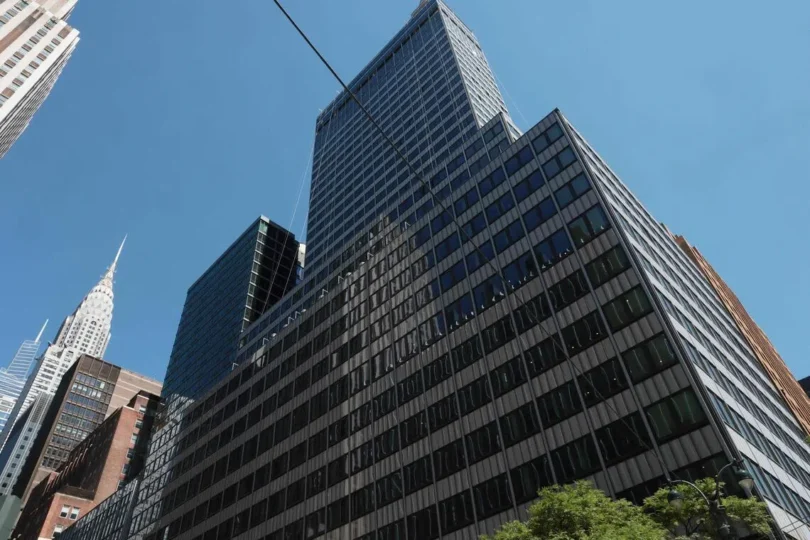
NEW YORK – The developer behind the Midtown Manhattan tower that was evacuated over structural concerns on July 7 says it has a plan to fix the issue, including reconstructing 15 floors that were added to the original building as part of its conversion into apartments.
The height of the tower’s 21st floor, which is taller than others at 235 East 42nd St, made two columns more susceptible to load, said Nathan Berman, chief executive officer of developer Metro Loft.
Those columns weren’t sufficiently reinforced, leading them to bend and causing some of the 15 cantilevered floors above to sag.
Metro Loft now plans to replace the facade, slabs and steel on those floors.
“We are prepared to rebuild that portion of the building,” Berman said in an interview. “It will be reskinned, everything will be levelled, fixed in place, and it will be brand new.”
The damage at the tower, the former headquarters of Pfizer Inc, has highlighted the engineering challenges of office conversions, a strategy embraced by developers and officials including Mayor Zohran Mamdani as a way to address New York’s housing shortage.
Concerns over the tower’s safety led to evacuations and street closures in the surrounding area on July 7, disrupting commutes and displacing residents.
Construction crews are installing temporary supports at the building, and streets reopened as city officials deemed the tower stable.
But building regulators have issued a partial stop-work order to halt all non-emergency construction at the site.
Berman said shoring and stabilisation of the building is likely to be completed in the next day or two, after which Metro Loft will wait on city officials for further instructions.
He emphasised that the structural concerns affect only about 18,000sq ft out of the entire 1.3 million-square-foot-project.
Metro Loft is planning more than 1,600 apartments at the site, one of the largest office-to-housing conversions underway in the US.
Such projects are architecturally fraught, requiring buildings designed with large office floorplates to be divided into much smaller units each requiring windows, plumbing and elevator access.
Industry experts said the issues at the damaged Midtown tower may ultimately require more extensive repair.
“Engineers rationally overestimate what they think the loads would be, underestimate how strong they think elements would be to simplify it, and therefore you would end up with a substantial margin of safety,” said James LaFave, a professor of civil engineering at the University of Illinois Urbana-Champaign.
“For something to have caused the level of buckling seen in that column there, it’s not some small perturbation from expectation that would make that happen,” he said. “It’s something substantial.”
Anil Agrawal, a professor in the civil engineering department at City College of New York, said the process to address the issue will likely be drawn out.
“A well-informed decision will require doing a very detailed analysis, very good inspection, some testing, and that might take several months,” he said.
“This is not something that can be done within days or even a month. I will say three, four, five months if people start working tomorrow.”
Berman said that construction was several months ahead of schedule, so it’s unlikely that this setback will impact the project’s original timeline of opening this year, or its US$720 million (S$930.90 million) construction loan provided by Madison Realty Capital.
A representative for Madison Realty declined to comment.
Mamdani said on July 8 that the city will conduct a full investigation into the problems at the site, but noted that the issue wasn’t necessarily a consequence of the residential conversion.
He said that he still sees such projects as part of the answer to the city’s housing crisis.
Ran Eliasaf, founder and managing partner of Northwind Group, which provided a US$135 million acquisition loan secured by the ownership in 235 East 42nd St, said the incident is unlikely to dampen enthusiasm for office conversions.
His firm is also financing the acquisition and pre-development of 675 Third Ave, another conversion by Metro Loft and David Werner Real Estate Investments, and is evaluating two additional projects.
“This shouldn’t have happened, it’s very fortunate nobody was hurt, but they will figure out what happened and fix it,” Eliasaf said. “I don’t think this has any implication on their implementation in the market.”
As Metro Loft prepares for repairs, the approval process will likely be ad hoc, according to David Bonowitz, a structural engineer.
Building codes outline the rules for designing an addition or alteration, but they don’t say much about when something goes wrong and the structure is damaged.
“If everything had gone to plan, this is not something that you’d have to figure out in the field,” he says. “Everything did not go to plan.” BLOOMBERG