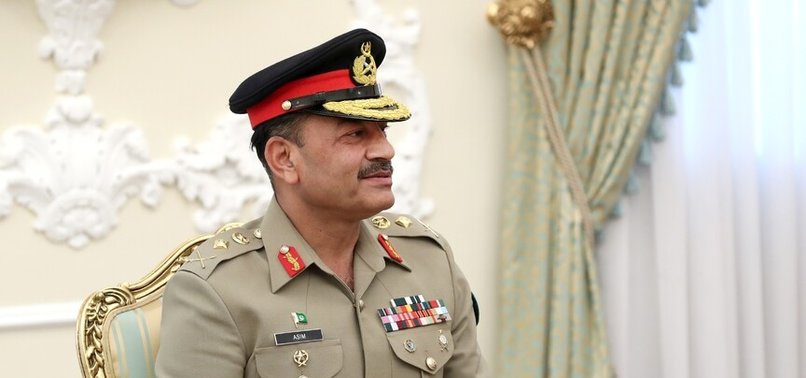
Pakistan’s army chief Field Marshal Asim Munir is expected to hold talks with the Iranian leadership on a “temporary” agreement to end the US-Iran war, during his likely visit to Tehran in the next 24 hours, Pakistani government sources close to the matter told Anadolu on Thursday.
According to the sources, Munir is likely to travel to Tehran on Thursday evening to hold “decisive” talks on the “temporary” agreement, which aims to prevent a return to conflict and pave the way for direct dialogue between the two sides on Iran’s nuclear program and the Strait of Hormuz.
There is no official confirmation of Munir’s expected visit, so far. Iranian media has reported the Pakistani army chief was expected to visit Tehran.
Munir was still in Pakistan until 1100GMT, where he presided over a ceremony in the garrison city of Rawalpindi to award military officers and soldiers, according to the army’s media wing.
Pakistan’s Interior Minister Mohsin Naqvi is already in Tehran and on Wednesday discussed the temporary arrangement details with the top Iranian leadership, including President Masoud Pezeshkian and Ahmad Vahidi, the commander-in-chief of the Iranian Revolutionary Guards, the sources added.
The temporary agreement includes the immediate reopening of the strait, an end to the US blockade of Iranian ports, and the holding of nuclear talks within the next 30 days, the sources said.
However, they added, the issues of the release of Iran’s frozen assets, lifting of international sanctions and compensation for war damages would be discussed in the direct talks between Washington and Tehran.
“If the two sides sign the agreement, a second round of direct talks between the two sides is highly expected to resume after Eid-ul-Adha in Islamabad,” a Pakistani source said.
The three-day Muslim festival of sacrifice will be observed next week, beginning Wednesday.
Regional tensions have escalated since the US and Israel launched strikes against Tehran in February, killing over 3,300 people and displacing thousands of others inside Iran.
Tehran retaliated with attacks targeting Israel as well as US allies in the Gulf, alongside the closure of the Strait of Hormuz. At least 13 US servicemen were killed and dozens of others wounded in the conflict which halted on April 8 when Pakistan secured a ceasefire.
But subsequent talks in Islamabad, held at highest level between the US and Iran since 1979, failed to produce a lasting agreement. Trump later extended the truce indefinitely.
Since then, the two sides have continued exchanging proposals and counter-proposals in an effort to resume direct talks and end the conflict.