
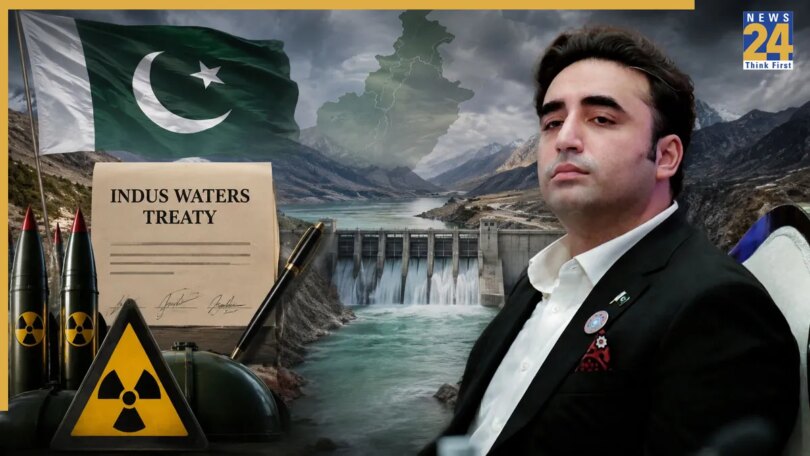
Pakistan Peoples Party (PPP) Chairman Bilawal Bhutto-Zardari has intensified Pakistan’s stance over the Indus Waters Treaty (IWT), warning that any attempt to restrict the country’s water supply should be treated as a national security threat. Speaking at an international seminar on water security, Bilawal linked the Indus water dispute with Pakistan’s nuclear doctrine and said the country would defend its water rights if they were threatened.
The remarks come as tensions between India and Pakistan continue over the future of the Indus Waters Treaty, which India placed in abeyance following the Pahalgam terror attack in 2025.
Bilawal Links Water Dispute to National Security
Addressing participants at the seminar, Bilawal Bhutto said Pakistan cannot view the Indus water issue only as an environmental or diplomatic matter. According to him, any attempt to restrict Pakistan’s access to river waters would directly affect the country’s survival and economy.
He said Pakistan’s officially stated nuclear doctrine considers threats to the country’s economy and waterways among the rare situations that could trigger a nuclear response. Bilawal argued that if water access is blocked, it should be seen as an existential challenge rather than a routine diplomatic disagreement.
He further stated that such a scenario would require Pakistan to respond collectively at the national level, describing the Indus River as the country’s lifeline.
Why The Indus Waters Treaty Is Important
The Indus Waters Treaty was signed between India and Pakistan in 1960 to regulate the sharing of water from the Indus river system. The agreement has remained one of the few long-standing treaties between the two neighbours despite several wars and periods of diplomatic tension.
Pakistan depends heavily on the Indus basin for agriculture, with nearly 80 percent of its farmland relying on water from the river system. Because of this dependence, any uncertainty surrounding the treaty has become a major concern for Islamabad.
India suspended the treaty after the Pahalgam terror attack, leading to strong reactions from Pakistan, which has repeatedly called for the agreement to remain in force.
‘Pakistan Will Defend Its Water,’ Says Bilawal
During his speech, Bilawal accused India of attempting to use water as a political pressure tool. He said Pakistan would never compromise on what it considers its legal and sovereign rights under the treaty.
He stressed that people across Pakistan, including Sindh, Punjab, Balochistan, Khyber Pakhtunkhwa, Kashmir and Gilgit-Baltistan, would stand united in defending the country’s water resources.
Bilawal also said Pakistan supports peace and dialogue but insisted that any discussions must be conducted within the framework of international law and mutual respect. According to him, the Indus River is not a bargaining chip or a weapon but a lifeline that millions of Pakistanis depend upon.
Reference To Earlier Remarks And Pakistan’s Nuclear Policy
This is not the first time Bilawal Bhutto has made strong remarks on the Indus issue. Soon after India suspended the treaty in April 2025, he warned that Pakistan would not accept any attempt to block or divert its share of water. His comments at that time also attracted attention because of their sharp tone.
Pakistan follows a policy of “credible minimum deterrence” and has developed what it describes as “full-spectrum deterrence.” Unlike India, Pakistan does not have a declared No First Use nuclear policy and reserves the option of using nuclear weapons first if it believes its national survival is under serious threat.
Bilawal’s latest comments have once again brought the Indus Waters Treaty into focus and highlighted how the long-running water-sharing dispute has become closely linked with broader security and diplomatic tensions between India and Pakistan. The developments are expected to keep the treaty at the centre of regional discussions in the coming months.
First published on: Jul 01, 2026 03:31 PM IST
Get Breaking News First and Latest Updates from India and around the world on News24. Follow News24 on Facebook, Twitter.
End of Article
About the Author
Sagar Puri
Sagar Puri is a seasoned Senior Sub-Editor with over four years of newsroom experience, bringing sharp editorial judgment and an eye for detail to every story he handles. Over the years, he has worked across a diverse range of beats, including sports, education, news desk, entertainment, and lifestyle, giving him a well-rounded understanding of the digital news ecosystem.
Read More
Related Story