
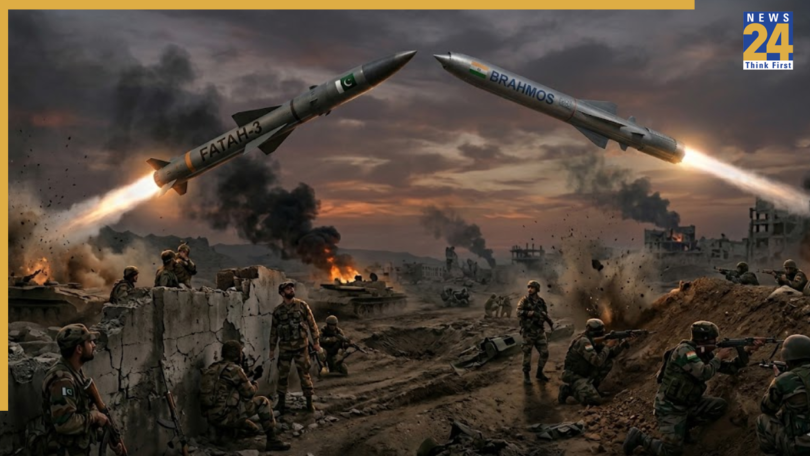
Pakistan unveiled Fatah-3, a China-backed supersonic missile seen as a rival to India’s BrahMos, boosting Islamabad’s long-range precision strike capabilities.
Pakistan Unveils New Fatah-3 Supersonic Missile

2 / 6
Pakistan has officially introduced its new Fatah-3 supersonic cruise missile, which experts believe is aimed at countering India’s BrahMos missile capability. The missile is reportedly based on China’s HD-1 missile platform and is designed for both land and naval attacks. Defence analysts say the addition of Fatah-3 significantly boosts Pakistan’s long-range strike capability.
Key Features of Fatah-3 Missile

3 / 6
Fatah-3 can reportedly travel at speeds between 3,704 kmph and 4,939 kmph, making it three to four times faster than the speed of sound. Its strike range is believed to be between 290 km and 450 km. The missile can carry a warhead weighing around 240 to 400 kilograms. It is also designed to fly close to sea level, making radar detection much more difficult during combat situations.
Road-Mobile Launcher Gives Tactical Advantage

4 / 6
One of the major advantages of the Fatah-3 system is its road-mobile launcher platform. The missile is mounted on a truck-based Twin-Canister TEL launcher, allowing two missiles to be launched from a single vehicle. This mobility makes the system easier to hide, transport, and deploy quickly during wartime. Pakistan’s military experts believe this flexibility could improve survivability during conflict scenarios.
Fatah-3 vs BrahMos Missile

5 / 6
Fatah-3 is increasingly being compared with India’s BrahMos missile system.
- Speed:
Fatah-3: Up to 4,939 kmph
BrahMos: Around Mach 3 speed - Range:
Fatah-3: 290–450 km
BrahMos: Around 290–500 km depending on variant - Origin:
Fatah-3: Based on China’s HD-1 missile
BrahMos: Jointly developed by India and Russia - Role:
Both are designed for precision strikes against land and naval targets.
Why Fatah-3 Matters for South Asia

6 / 6
The induction of Fatah-3 marks a major step in Pakistan’s missile modernisation programme. Earlier, Pakistan’s Fatah series mainly included ballistic missiles, but the addition of a supersonic cruise missile expands its military capabilities significantly. Experts believe the development could intensify the missile technology race between India and Pakistan. The missile also highlights growing defence cooperation between Pakistan and China, especially in advanced weapons technology.