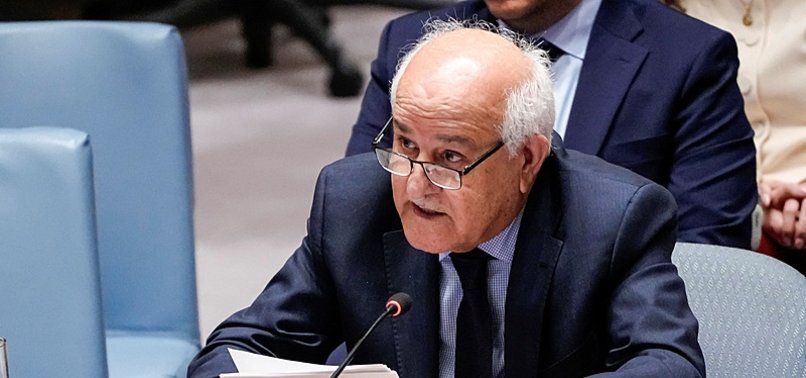
Palestine‘s UN envoy Riyad Mansour on Thursday said that Israel continues to unleash violence against Palestinian civilians through both military and occupiers, warning the world must not grow “accustomed to seeing Palestinians killed.”
“Nothing can justify collective punishment against over 2 million Palestinians,” Mansour said at the UN Security Council, adding: “Humanitarian aid is neither conditional nor can it serve as leverage nor be utilized as a weapon of war. The crossings must … remain open, and aid must flow at scale, including desperately needed shelters, medicine, and food.”
Mansour acknowledged the global efforts towards a ceasefire despite its shortcomings, but said: “We recognize that the ceasefire agreement has saved thousands of lives, but Israel killed over 870 Palestinians.”
He further asked the council: “Imagine if 800 Israelis had been killed, or, for that matter, if 80 had been killed. What would be the reactions? Would anyone still consider that we were successful in upholding the ceasefire agreement?”
“We have a duty to ensure the world does not get accustomed to seeing Palestinians killed,” he added.
Mansour said that Tel Aviv systematically targets Palestinian civilians, and added: “Israel continues to unleash, incite, and enable violence against Palestinian civilians, whether by its occupation forces or by Israeli settlers,” adding that Israel was taking “blatant steps towards the destruction of the Palestinian state and the two-state solution.”
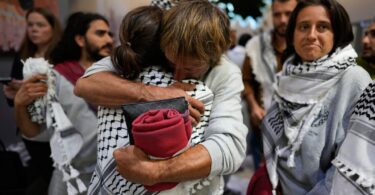
Pointing to the conditions inside Israeli detention facilities, Mansour described the video posted by Israeli National Security Minister Itamar Ben-Gvir, showing Gaza-bound Global Sumud Flotilla activists zip-tied and forced to kneel after being detained by Israeli forces in international waters, as “barely a glimpse of the treatment reserved to Palestinian prisoners.”
“Over 100 of them died in custody under torture or due to starvation and medical neglect in the last two years. They are subjected to inhumane and degrading treatment, assault, sexual abuse, and rape,” he said.
He further rejected any scenario in which Gaza is separated from Palestinian governance, insisting that “Gaza is an integral part of Palestine. It must be reunified with the West Bank under the Palestinian national authority. The principle of one state, one government, one law, and one gun must be fully upheld, and Israel must fully withdraw from the Gaza Strip. No occupation, no displacement, no annexation.”
Calling on all parties to honor their commitments, Mansour urged decisive action.
“We must seize the opportunity offered by the ceasefire agreement to take decisive steps to end the suffering, the occupation, and the conflict and ensure freedom for the Palestinian people and peace, security and prosperity for Palestinians, Israelis, and the wider region.”
Also addressing the council virtually, Rami Hijjo, director of humanitarian projects in the Gaza Strip for the Palestine Red Crescent Society, said that despite the ceasefire, suffering in Gaza had not stopped.
“Continued Israeli attacks have continued reaping souls indiscriminately. Many of those killed were in displacement sites, people who had already fled, already lost everything, already been displaced multiple times, and who thought they had survived all of it just to be killed after the ceasefire was announced,” he said.
Hijjo, who said he had been displaced at least six times himself, also called for protection of humanitarian workers, sharing a message from the sole survivor of what he described as a massacre.
“He calls on the entire world to provide protection and immunity to all humanitarian medical relief institutions, including PRCs, so that he can fulfill their humanitarian duty and reach out to affected communities and return home to their families safe and unharmed,” Hijjo said, adding that “impunity is not an option, it is a catalyst for further atrocities in this harsh reality.”