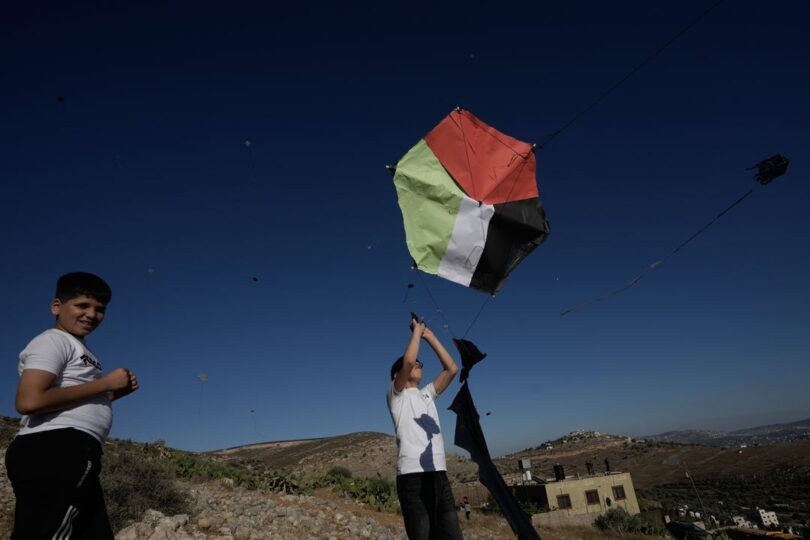
As brightly coloured kites climb above Burin, a Palestinian village in the occupied West Bank, children race across a sun-baked hillside, watching their creations soar into the sky.
Behind them, the red-roofed houses of Har Bracha, an illegal Israeli settlement, overlook the village below.
Established in 1983, the settlement, illegal under international law, is one of several that encircle Burin, a village of a few thousand people.
Every summer since 2009, residents have gathered on this hill for a kite festival on land they say has been partially lost after being confiscated by settlers.
“We want to tell the settlers that this is our land, this is our sky. If we can’t reach those lands anymore, our kites can,” Ghassan Najjar, one of the festival’s organisers, told AFP.
While the festival is primarily for children, it also carries a “political message,” he says.
In Burin, conversations rarely drift far from settler attacks or the steady spread of illegal Israeli settlements across the Palestinian territory.
As early as 2008, the United Nations Office for the Coordination of Humanitarian Affairs (OCHA) had warned of settler attacks in the area, citing shootings targeting Burin residents and the uprooting of their olive trees.
Since the start of the Gaza genocide in October 2023, the United Nations has reported a sharp increase in violence attributed to Israeli settlers in the West Bank, while several Israeli ministers have continued to call for the annexation of all or part of the territory.
‘Roots in land’
For a few hours, however, the hillside takes on the air of a village fair.
A clown paints children’s faces, and music fills the air, and families spread picnic carpets across the grass.