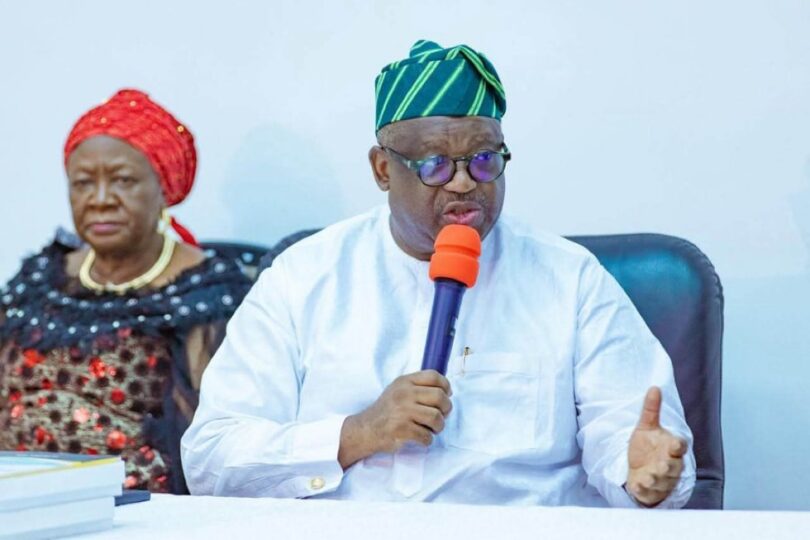
Plateau State Governor, Caleb Mutfwang, has described the state government’s sponsorship of Muslim pilgrims to the annual Hajj as an investment in peace and religious harmony, rather than political patronage. Mutfwang stated this on Thursday, September 3, 2026, while receiving the report of the 2026 Hajj operation at the New……
Plateau State Governor, Caleb Mutfwang, has described the state government’s sponsorship of Muslim pilgrims to the annual Hajj as an investment in peace and religious harmony, rather than political patronage.
Mutfwang stated this on Thursday, September 3, 2026, while receiving the report of the 2026 Hajj operation at the New Government House, Rayfield, Jos.
According to a statement by the Governor’s Director of Press and Public Affairs, Gyang Bere, the governor said the policy was part of his administration’s commitment to inclusive governance and peaceful coexistence among residents of different faiths and political affiliations.
Mutfwang said government’s responsibility went beyond providing infrastructure and economic opportunities to creating an environment where citizens could live together peacefully and respect one another.
He explained that pilgrimage should not be seen merely as a journey to the holy land but as an opportunity for spiritual reflection, moral renewal and a deeper understanding of human equality.
“For me, sponsoring pilgrims to Hajj or Jerusalem is to deepen the fear of God in the hearts of our people, so that we will know that when the chips are down, we are all human beings before God. None of us is superior to the other,” he said.
The governor also called for an end to the promotion of religious divisions in Plateau State, saying such narratives had hindered efforts to achieve lasting peace and development.
“For too long, people have promoted the Muslim-Christian divide on the Plateau, and it hasn’t helped us,” he said.
Mutfwang urged residents to embrace unity and shared responsibility, recalling the popular admonition that people must learn to live together as brothers or perish as fools.
“There is no foolish man on the Plateau. We will continue to live as brothers,” he said.
The governor cited the appointment of former House of Representatives Speaker, Ahmed Idris Wase, as Amirul Hajj as an example of his administration’s commitment to inclusion and bipartisanship.
He noted that despite belonging to different political camps, Wase was appointed based on the broader interest of Plateau State.
“We thought that we must demonstrate our commitment to bipartisanship, our commitment to inclusion and our commitment to making sure that Plateau people are seen as one,” Mutfwang said.
He commended Wase for justifying the confidence reposed in him through his leadership of the 2026 Hajj delegation, describing him as a man committed to the progress of the state.
Mutfwang also defended government expenditure on the pilgrimage, urging residents to consider its contribution to peace and social stability.
“For us, it is an investment in peace and stability of our state,” he said.
The governor further highlighted the moral benefits of pilgrimage, recalling the case of a Plateau woman who found money belonging to another pilgrim during the 2025 Hajj and returned it to the owner.
According to him, such acts of honesty and integrity represent some of the values the government seeks to promote through the pilgrimage programme.
He also commended the Muslim Pilgrims Welfare Board for improving its processes and closing loopholes that previously allowed individuals to manipulate or sell Hajj slots for personal gain.
Earlier, the Amirul Hajj, Wase, presented the 2026 Hajj report and commended the Mutfwang administration for its support for Plateau pilgrims.
Wase disclosed that the state sponsored more than half of the 1,334 pilgrims who participated in the 2026 Hajj, in addition to providing operational and logistical support to the Muslim Pilgrims Welfare Board.
He said Plateau State was recognised by the National Hajj Commission of Nigeria for its performance and support to pilgrims, with Mutfwang receiving an award.
Wase attributed the successful operation to collaboration among the Board, Ulamas and other stakeholders, as well as improved religious orientation and mobilisation across the state’s senatorial districts and local government areas.
The 2026 Hajj operation, the statement said, further reinforced the administration’s position that “development on the Plateau cannot be sustained through religious or political exclusion.”
It added that the government’s support for citizens across religious and political divides was aimed at making inclusion, peace and social cohesion key pillars of Plateau State’s development agenda.