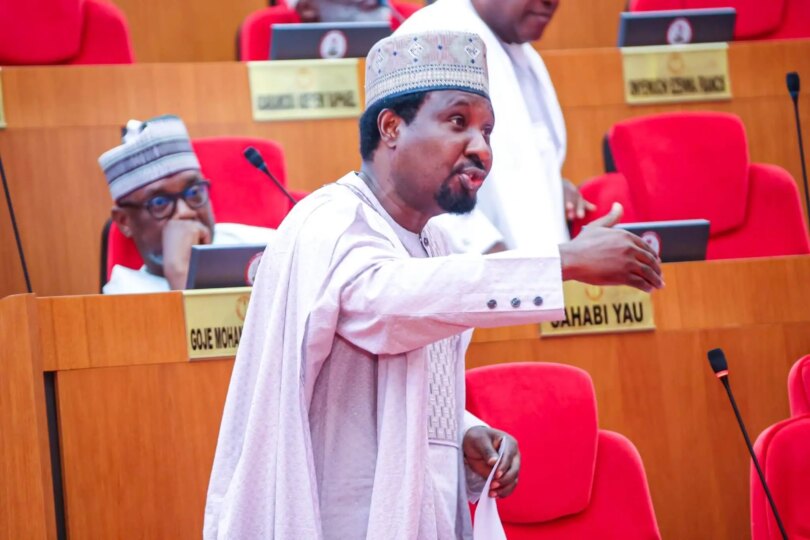
The Deputy Senate President, Barau Jibrin, has said the proposed state police framework contains constitutional safeguards that empower the President to intervene when governors misuse the security outfit.
Barau, who chairs the Senate Committee on Constitution Review, said the provisions were designed to address concerns that state police could be deployed for political intimidation, ethnic persecution or other unlawful purposes.
He spoke on Saturday during Hannu Da Yawa, a live Hausa programme aired on Radio Nigeria Kaduna.
The Senate passed a constitutional amendment bill last month seeking to establish state police and introduce a dual policing structure across the country.
Under the proposed arrangement, the Nigeria Police Force (NPF) and state police services would operate concurrently, with clearly defined responsibilities and conditions for federal intervention.
Barau described President Bola Tinubu’s support for state police as a “masterstroke” capable of addressing Nigeria’s persistent security challenges.
He said the proposed framework was developed after consultations involving the Presidency, National Assembly, Inspector-General of Police (IGP), retired police officers, security experts, governors, civil society organisations and members of the public.
According to him, public hearings were also held across the six geopolitical zones and the Federal Capital Territory (FCT).
Barau said, “President Tinubu carefully studied the situation and discovered that while many Nigerians support state police, there are fears that it could be abused or misused for political or ethnic purposes.
“That is why safeguards have been built into the system.”
The Deputy Senate President said the constitutional amendment clearly outlined the circumstances under which the Federal Government could intervene in the operations of a state police service.
“If state police are used for intimidation or actions that threaten lives and property, the President has the constitutional authority to intervene and direct the federal police to take over,” he said.
Barau explained that the proposed state police would complement the Nigeria Police Force rather than replace it.
He said officers recruited from local communities would have a better understanding of their environment, residents and criminal networks.
He further stated, “State police operatives, who will be recruited from local communities, know the people, the terrain and even the criminals.
“This will significantly improve our response to banditry, kidnapping and other crimes.”
Barau expressed optimism that the proposed policing structure would strengthen the fight against insecurity, particularly in northern communities affected by kidnapping and banditry.
“The North stands to benefit significantly. This initiative is designed to bring lasting peace to the worst-hit areas,” he added.
He said the NPF would retain responsibility for national security matters, including terrorism, cybercrime and other offences with implications beyond individual states.
State police services, according to him, would concentrate on internal security, public order and crimes within their respective jurisdictions.
The lawmaker said state police commandants would be appointed through a rigorous process and protected by law from undue interference by governors and other political officeholders.
He acknowledged concerns over the funding, training and operational capacity of state police services.
Barau said appropriate financial and administrative frameworks would be developed as the constitutional amendment process progressed.
He also expressed confidence that state Houses of Assembly would approve the proposal when it was transmitted to them for consideration.
Barau added, “We must re-engineer our security architecture to better protect lives and property while guarding against abuse.