The 16th Fulani Emir of Kano, Muhammadu Sanusi II, has urged ECOWAS leaders to prioritise economic realities and institutional readiness before adopting the proposed ECO currency.
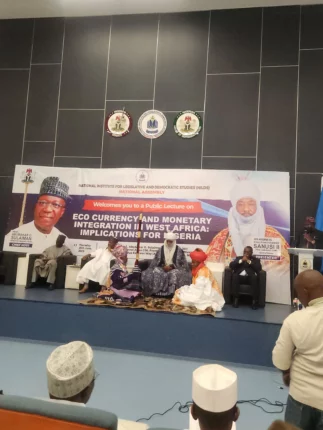
Sanusi stated this on Thursday in Abuja during a public lecture organised by National Institute for Legislative and Democratic Studies (NILDS).
The News Agency of Nigeria NAN reports that the lecture, entitled “ECO Currency and Monetary Integration in West Africa: Implications for Nigeria,” examined opportunities, challenges and prospects for regional monetary integration.
The former Central Bank of Nigeria governor said pursuing a common currency remained commendable but warned that ambitions without practical implementation plans risk failure.
According to him, economists often appear skeptical because they focus on feasibility, stressing that development objectives must rest on realistic assessments, not rhetoric.
Sanusi noted that Nigeria contributed about 60 per cent of regional GDP and nearly 70 per cent of the population, making its performance crucial to ECOWAS.
“If Nigeria gets it right, West Africa gets it right. If the Nigerian economy performs poorly, ECOWAS will struggle to achieve objectives,” he said.
Read Also:2023: Khalifa Muhammadu Sanusi II urges Nigerians to elect competent leaders
The royal father described the ECO project as a long-term goal, noting that many African Central Bank governors had previously expressed reservations about implementations.
He noted that West Africa possesses enormous potential, with an estimated population of 450 million people and an economy exceeding 900 billion dollars.
Sanusi emphasised the need for regional integration, as multiple currencies, trade barriers and payment inefficiencies increased business costs and reduced competitiveness.
According to him, successful monetary unions require political commitment, fiscal discipline, trade integration, institutional credibility and sustained macroeconomic convergence before implementation.
Drawing lessons from the Eurozone, Sanusi said countries, including Germany and France, achieved convergence targets before introducing the Euro, while others joined later.
Read Also:Cardoso unveils CBN Naira Ambassadors Club to promote respect for national currency
He cautioned that West Africa remained distant from comparable standards, citing disparities in inflation rates, fiscal deficits and overall economic performance.
The former CBN governor explained that intra-regional trade within ECOWAS remained between 10 and 12 pe rcent, significantly below levels recorded across Europe and Asia.
He said that smaller economies could benefit substantially from a common currency but would remain vulnerable if Nigeria experienced prolonged economic instability.
The emir urged governments to strengthen Central Bank’s independence, improve infrastructure, enhance security, deepen trade integration and maintain fiscal discipline.
The ultimate measure of success, he said, should not be in launching a common currency but in building a prosperous, resilient and competitive region.
Earlier, the NILDS Director-General, Prof. Abubakar Sulaiman, described the proposed ECO currency as a critical issue shaping West Africa’s economic future.
Sulaiman said that the quest for a common ECOWAS currency extended beyond technical considerations, carrying implications for sovereignty, stability and prosperity.
Read Also:ECOWAS Court orders Nigeria to release man detained for 16yrs without trial
He noted that Nigeria, as the sub-region’s largest economy, must undertake rigorous evidence-based assessments of monetary integration and national development implications.
Sulaiman said that the dialogue sought to move beyond theory by examining practical realities, policy implications and strategic considerations surrounding integration.
He reaffirmed the institute’s commitment to providing research-driven insights that would guide lawmakers and policymakers while safeguarding Nigeria’s interests.(NAN)