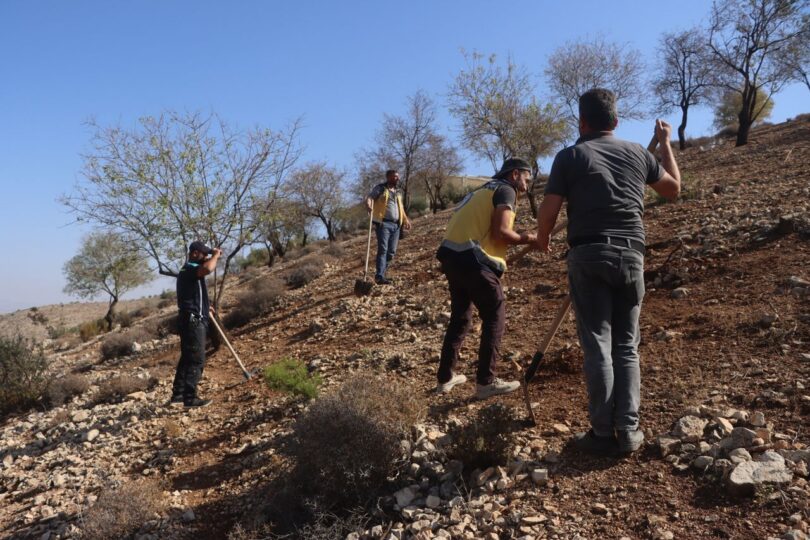
When Omar Al-Sayyah first arrived over a year ago at a hillside in the northern countryside of Idlib, there was little greenery left.
Years of logging had stripped the area of much of its vegetation, leaving behind eroded soil and a degraded landscape. Today, however, young saplings are beginning to take root as part of a community-led effort to restore the region’s forests.
“The land was entirely stripped of its greenery,” Al-Sayyah tells TRT World.
“Today, holding these saplings, I feel a deep sense of pride.”
His work as a volunteer is part of a broader reforestation campaign aimed at reversing environmental damage and rebuilding Syria’s shrinking green spaces.
Years of conflict took a heavy toll on Syria’s vegetation cover.
Forests and woodlands suffered damage from drought, illegal logging, wildfires, overgrazing, military activity, and years of neglect.
However, since the previous regime fell in 2024, volunteer-led reforestation efforts have started in various regions, uniting local residents, students, civil society groups, and aid organisations to help restore green spaces affected by war and climate change.
One such initiative is the “Together to Make Idlib Green Again” campaign, organised by the Ministry of Agriculture and the Idlib Governorate.
The project has mobilised local residents, schoolchildren, the Syrian Civil Defense (White Helmets) and volunteer groups to plant trees and rehabilitate damaged land.
For 29-year-old volunteer Walid Al-Hassan, the work carries a significance that extends beyond the environment.
“Planting trees has become a ‘message of hope’ for me, reflecting the deeply rooted desire of Syrians to rebuild their community and environment,” Al-Hassan tells TRT World.
“Reforestation days have turned into social gatherings, bringing youth and families together in volunteer activities with a profound national and humanitarian purpose.”
Al-Hassan says the campaign has focused on city entrances, public parks, roadsides and forestry areas, while also running awareness programmes in schools and local communities.
As part of the initiative, 200,000 olive saplings have been distributed to help restore agricultural land damaged by years of logging.
“These campaigns go beyond environmental restoration,” he tells TRT World.
“They are vital in fostering a sense of belonging and collective action among Syrian youth, especially after enduring a protracted war that left massive environmental scars.”
Preserve and expand native species
Similar efforts are underway in other parts of Syria.
In the western and northern countryside of Hama, authorities have launched a reforestation campaign to plant 30,000 saplings across more than 50 hectares.
“The organisation has initiated this forestry campaign in Hama’s countryside to expand vegetation cover and rehabilitate areas damaged by wildfires and illegal logging,” says Engineer Abdul Aziz Al-Qassem, Director General of the General Organization for the Management and Development of Al-Ghab.
According to Al-Qassem, the project covers five locations — Hayalin, Al-Karakat, Mirdash, Kanfo and Al-Mashel — and includes a mix of conifers, eucalyptus and Syrian ash trees.
The latter have been included to help preserve and expand the population of the rare native species.
He adds that the reforestation of the Hayalin woodland will be carried out in two phases, beginning with land preparation before planting begins.
In Latakia’s countryside, similar initiatives are drawing support from volunteers eager to help restore forests damaged during years of conflict.
Among them is 33-year-old Ismail Al-Hawas, a volunteer with the Ministry of Defense, who recently took part in a tree-planting campaign under the slogan “A Tree for Every Soldier”.
The initiative forms part of wider efforts to restore ecological balance in areas where forests and woodlands were damaged by years of fighting and bombardment.
”Protecting the land and contributing to its rebuilding is not confined to the battlefield,” Al-Hawas tells TRT World.
“It extends to being an active partner in all forms of public service, as we are an army born from the people and dedicated to them.”
Al-Hawas says the campaign began in the Kabina area of northern Latakia, a location chosen for both its environmental and symbolic significance.
He describes Kabina as a strategic area that witnessed intense fighting during the Syrian conflict due to its elevated position overlooking parts of Idlib, Hama and the Al-Ghab Plain.