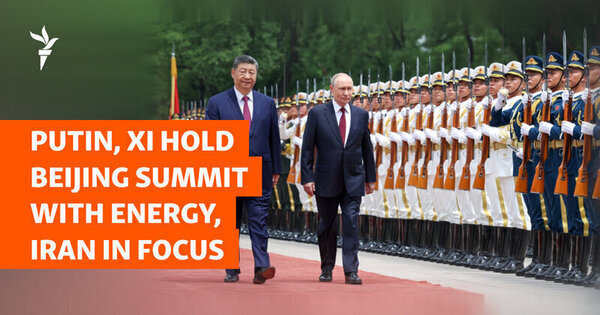
Russian President Vladimir Putin met Chinese leader Xi Jinping in Beijing on May 20 for talks centered on deepening energy ties and presenting a united front against what both leaders cast as a Western-dominated global order.
Speaking at the start of meetings at the Great Hall of the People, Xi said China and Russia should continue to support each others development and revitalization, while Putin described bilateral ties as being at an unprecedented level and said Russia remained a reliable energy supplier amid the war in Iran and closure of the Strait of Hormuz, which has affected global flows and prices for oil and gas.
SEE ALSO:
Putin Heads To Beijing Seeking Energy Deals, Show of Solidarity
The summitcomes as Russia seeks to lock in new long-term energy deals with China, including progress on the long-delayedPower of Siberia-2 gas pipeline, a project Moscow sees as crucial to replacing lost European gas markets after the invasion of Ukraine.
So far, China has been dragging its feet, but that could change at this meeting, Henrik Wachtmeister, a researcher at the Swedish Institute of International Affairs China center, told RFE/RL.
Xi, Putin Expected To Sign 21 New Agreements
The war in Iran and the disruption of shipping through the Strait of Hormuz have added urgency to those talks by raising fears in Beijing over energy security and renewed volatility in global oil markets.
Analysts say the crisis has sharpened Moscows pitch that overland Russian energy supplies can help China reduce its dependence on vulnerable maritime routes, even as Beijing remains cautious about becoming too reliant on Russia.
China And Russia Sign Deal To Build New Pipeline
Russia needs the revenue from trade much more than China needs Russian energy specifically, Wachtmeister said. Russia has few alternative buyers and sells its oil at discounts due to sanctions. China has multiple suppliers and is overall a much larger economy.
Putins trip, which comes just four days after US President Donald Trump departed Beijing following his own summit with Xi, also highlights the increasingly uneven nature of the China-Russia partnership.
SEE ALSO:
Trump-Xi Summit Reveals China’s Careful Balancing Act On Iran
As Russias economy struggles under Western sanctions and the prolonged war in Ukraine, Moscow has grown increasinglydependent on Chinafor trade, technology and energy revenues.
Xi and Putin first held a closed-door narrow format meeting, typically reserved for more sensitive discussions, before convening broader talks with their respective delegations. Russian Foreign Minister Sergei Lavrov was also scheduled to meet Wang Yi, his Chinese counterpart.
According to the Kremlin, the two leaders are expected to oversee the signing of 21 agreements later on May 20, including a joint statement on strengthening their comprehensive partnership and strategic interaction and another declaration promoting a multipolar world and a new type of international relations.