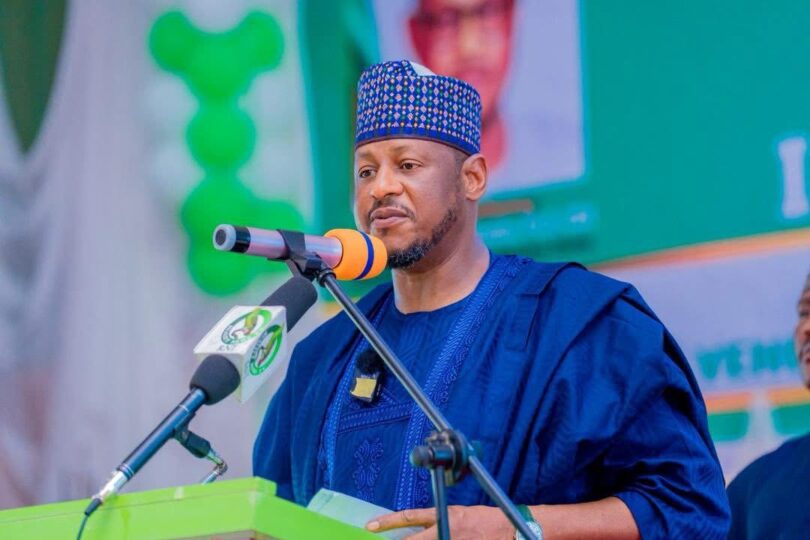
Katsina State Governor, Dikko Radda, has presented a proposed N828.64 billion budget for 2027 to the state House of Assembly, with capital projects accounting for more than three-quarters of the total expenditure.
The proposal, tagged “Building Your Future IV”, sets aside N637.91 billion, representing 76.98 per cent, for capital expenditure, while N190.73 billion, or 23.02 per cent, is earmarked for recurrent spending.
The 2027 proposal is N69.23 billion below the state’s approved 2026 budget, with Radda attributing the reduction to a more conservative assessment of available revenue and projected expenditure.
Presenting the appropriation bill on Tuesday, the governor said his administration had subjected spending proposals from ministries, departments and agencies to stricter scrutiny to ensure that projected expenditure remained within realistic revenue expectations.
“We took a pragmatic, disciplined and realistic view of both revenue and expenditure. We reviewed every available funding source to ensure fiscal balance, strengthen implementation and reduce the risk of shortfalls,” Radda said.
He said the budget was also informed by consultations conducted across all 361 wards in the state, through which residents identified and prioritised projects they considered most important to their communities.
According to him, every ward will benefit from a special project chosen through the consultation exercise, while the data gathered will inform government interventions in areas including agriculture, small businesses, water and sanitation, women’s empowerment, environmental protection and security.
“Our people named their needs, weighed them and ranked them. This budget therefore answers the real and pressing needs of our communities, not assumptions made from afar,” he said.
The Social Sector received the largest sectoral allocation of N317.73 billion, representing 38.34 per cent of the budget. It is followed by the Economic Sector with N303.17 billion, or 36.59 per cent, while N198.55 billion is allocated to Administration and N9.19 billion to Law and Justice.
Of the capital expenditure, five priority areas will receive a combined N325.45 billion. Basic and Higher Education is allocated N83.82 billion, Works and Housing N71.60 billion, Agriculture and Livestock N65.88 billion, Health N53.64 billion and Rural Development N50.51 billion.
Radda said the spending priorities were aimed at expanding educational infrastructure, strengthening healthcare services, boosting agricultural production, improving roads and housing, and extending infrastructure to rural communities.
The governor also reviewed the implementation of the 2026 budget, saying total expenditure stood at N295.19 billion as of August 28, representing 32.88 per cent of the approved appropriation. Capital expenditure accounted for N193.02 billion of the spending.
He expressed optimism that implementation would improve before the end of the year as several ongoing projects approach completion.
“We expect this figure to close much higher in our third and fourth quarterly reports for 2026,” Radda said.
On education, the governor disclosed that N13.03 billion had been spent on school rehabilitation under the TESS programme, while N10.53 billion was committed through AGILE and N5.88 billion to primary school interventions under UBEC. The state also spent N2.07 billion on examination fees and N1.26 billion on scholarships.
In the health sector, Radda said N4.71 billion had gone into the State Emergency Medical Service and Ambulance System Programme. He added that more than N9.59 billion had been invested since 2025 in equipping the Medical Imaging Centre at the General Amadi Rimi Specialist Hospital for its conversion into a cancer and imaging centre.
The government, he added, committed N21.43 billion to fertiliser procurement and spent N3.11 billion on rural access roads intended to ease the movement of farm produce.
On security, Radda said more than N7.5 billion had been spent in 2026 on security equipment, allowances and operations. While acknowledging persistent security challenges in some frontline communities, he said improved conditions had allowed some farmers to return to their farmlands.
He, however, identified shortages of personnel and learning materials, pressure on healthcare services, inadequate access to potable water, sanitation challenges and infrastructure deficits as some of the major issues still confronting the state.
Radda thanked the lawmakers for their cooperation and urged them to expedite consideration and passage of the 2027 budget.
“The constructive relationship between the Executive and the Legislature remains vital to good governance,” he said.
In his response, the Speaker of the House of Assembly, Nasir Yahaya Daura, commended the governor for what he described as his administration’s achievements across infrastructure, security, education, healthcare, agriculture and human capital development.
Daura said the eighth Assembly had passed more than 50 bills and promised that lawmakers would give the 2027 budget proposal prompt consideration.
The Speaker also declared support for Radda’s second-term bid, as well as President Bola Tinubu and other APC candidates ahead of the 2027 elections.
Daura disclosed that the budget presentation would be his final one as Speaker, expressing his intention to seek another legislative position.