Advertisement
Advertisement
By Cecilia Ologunagba/ NAN —
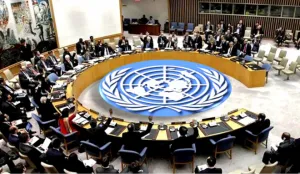
The quest for Africa’s permanent representation in the UN Security Council (UNSC) was accentuated at the General Debate of the 81st session of the UN General Assembly (UNGA).
Born from the post-World War II settlement, the UNSC was created because the older League of Nations had failed to stop the war due to its lack of real enforcement power.
The new council was given the power to issue binding resolutions, impose economic sanctions, and authorise military force.
Under the arrangement, five major powers, China, France, Soviet Union, United Kingdom and United States were given permanent membership.
The arrangement reflected the geopolitical realities of 1945, when the United Nations had 50 members and much of Africa and Asia remained under colonial rule.
The Council originally had 11 members, but was expanded to 15 in 1965, while the five permanent members retained their veto over substantive decisions.
Eight decades later, the United Nations has 193 members, representing a profoundly different international system from that which existed when the Security Council was established.
Africa now has 54 UN member states, making it the largest regional grouping in the organisation, yet the continent has no permanent Security Council representation.
The Council possesses significant authority, including determining threats to international peace, imposing sanctions, authorising peacekeeping operations and, in certain circumstances, approving military action.
Its decisions have frequently concerned African conflicts and security challenges, making Africa a major focus of the Council’s peace and security responsibilities.
Consequently, African countries are often directly affected by decisions taken by a body in which the continent has no permanent voice or veto.
Observers say this creates a representation gap: African states participate in implementing decisions affecting their security, sovereignty and societies, while possessing no permanent seat in making those decisions.
Most African leaders and world leaders, who spoke at the 81st session of UNGA, described the continent’s continued exclusion as indefensible, unjust and unfair.
In his opening address, the UN Secretary-General Antonio Guterres called for Security Council reform, saying that the continued absence of permanent African representation on the body was “unjust and indefensible.”
He said the 15-member Security Council’s composition no longer reflected the current geopolitical realities and repeated his call for reform.
Similarly, the President of the General Assembly’s 81st session, Khalilur Rahman, said the UN’s survival for 80 years was not, by itself, proof of success; hence, the institution must confront painful truths if it hoped to rebuild public trust.
Rahman said the UN had grown from 50 member states in 1945 to 193, but survival alone was not evidence of success.
The assembly president, then, renewed his call for fairer representation at the Security Council.
“Africa remains without a permanent Security Council seat after eight decades, which must change as a matter of fairness, justice and credibility.
“When the Security Council works, the United Nations works.”
Rahman further called for action, noting that after eight decades without a permanent African seat in spite of the continent’s central role in peacekeeping operations,
“Africa needs a seat at the table, not to be on the menu,” he said.
In the same vein, Vice President of Nigeria, Kashim Shettima, while delivering Nigeria statement to the Assembly, said Africa could not keep filling the Security Council’s agenda while remaining absent from its permanent membership.
Shettima said the reform of the institution must begin with the reconstitution of the Security Council, noting that the world of 2026 cannot remain captive to the distribution of power in 1945.
“Nigeria demands, in accordance with the Ezulwini Consensus and the Sirte Declaration, at least two permanent seats for Africa, with all the rights and responsibilities of permanent membership, including the veto for as long as it exists, and five non-permanent seats in total.
“The authority to speak for humanity carries an obligation to represent it,’’ he said.
Both the Ezulwini Consensus and the Sirte Declaration, adopted by the African Union in 2005, collectively outline and reinforce Africa’s unified demand for comprehensive UN reform to correct its historical under-representation in the permanent category of the Security Council
In his submission, the President of Liberia, Joseph Boakai, the Chair of the African Group at the UN, reaffirmed his country’s support for the Common African Position to include the continent representation at the Security Council.
According to him, Africa remains without a permanent Security Council seat after eight decades, which must change as a matter of fairness and justice.
“Although Africa is home to 1.5 billion people and accounts for nearly one-third of UN membership and 80 per cent of Security Council mandates concern African peace and security.
“Africa remains without a single permanent seat on the organ responsible for global peace; this historical injustice is no longer tenable,” he said.
Boakai said Africa demanded no fewer than two permanent seats, with all accompanying rights and responsibilities, including the veto so long as it existed, as well as additional non-permanent seats.
Sharing similar sentiments, Evariste Ndayishimiye, President of Burundi called for Africa’s permanent inclusion at the Security Council, saying inclusion would build trust between Africa and other continents.
Ndayishimiye highlighted his country’ position as the Chair of the African Union for 2026 and emphasised the call of inclusion to the world leaders.
“We are here to convey a conviction: Africa must be listened to more, it must be better represented and more closely involved in the decisions that shape the future of our planet,” he said.
Also, Kenyan President William Ruto, demanded Africa’s inclusion as a permanent member of the UN Security Council, saying the continent was “permanently discussed, yet permanently excluded.”
Ruto said although every UN member state had one vote in the General Assembly, five countries held permanent power on issues of war and peace through their permanent seats and veto rights in the Security Council.
He said the five permanent members had powers on questions of war and peace that the other 188 member states did not have, adding that the principle of equality proclaimed by the UN ended “at the doors of the Security Council”.
Ruto said Africa’s 54 member states, representing more than a quarter of the UN membership, had no permanent seat on the Council.
Likewise, the Ghanaian President, John Mahama, called for a permanent seat for Africa in the UN Security Council saying this would demonstrate equality and fairness in the UN.
According to him, Security Council reform is not a favour to Africa; it is an imperative for the legitimacy, credibility, and survival of the United Nations.
Mahama said the continued exclusion of the continent was unacceptable.
“Africa does not seek charity. Africa seeks equal partnership anchored in mutual respect.
“Africa’s exclusion from permanent membership of the Security Council is fundamentally unacceptable in the 21st century,’’ he said.
The president, therefore, called for permanent representation of Africa with full rights and veto powers.
More so, South Africa’s National Statement, Minister Ronald Lamola, said restoring trust in multilateralism would not happen without meaningful reform of global governance, principally the UN Security Council.
“African citizens are growing weary of their continent being consigned to the periphery of global governance.
“Africa is home to nearly one-fifth of the world’s population and African countries together account for more than a quarter of UN member states.
“Yet over the past decade, 70 per cent of UN Security Council resolutions have concerned conflicts on the African continent.”
“South Africa therefore reaffirms its support for the Ezulwini Consensus and its call to end Africa’s relegation to the margins of global decision-making.
“Permanent seats for Africa in the Security Council, with all the prerogatives of permanent membership, are long overdue,’’ Lamola said.
Equally, King Mswati III of Eswatini called for greater African representation on the UN Security Council and stronger support for African-led peace initiatives.
“Since the Ezulwini consensus was adopted in 2005, sadly Africa still has no permanent seat on the UN Security Council. And yet the continent remains a global strategic partner in the world stage,’’ he said.
He said Africa was being deprived of an opportunity to contribute fully to discussions on international security despite the continent’s growing strategic importance.
Stakeholders argue that Africa’s demand for permanent representation is therefore presented not simply as a quest for status, but as an argument for fairness, participation and greater legitimacy.
Ultimately, political and foreign affairs analysts hold that the solution to this ongoing cycle relies on executing the Ezulwini Consensus, pushing forward the African group’s proposed reforms, and capitalising on the momentum generated by Guterres’ call for permanent African seats.
NANFeatures