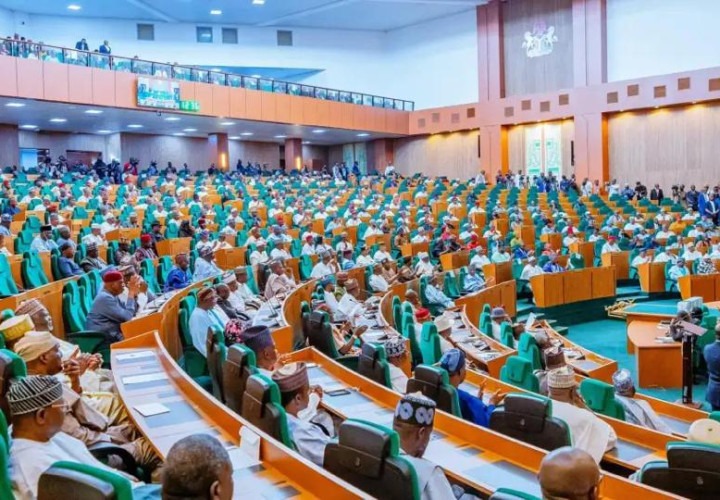
The House of Representatives is set to begin voting on a constitutional amendment bill seeking to establish state police on Thursday, marking a significant legislative effort to address Nigeria’s growing security challenges.
Deputy Speaker of the House and Chairman of the House Committee on Constitution Review, Benjamin Kalu, disclosed this on Wednesday while briefing journalists at the National Assembly Complex in Abuja.
The proposed legislation comes amid increasing cases of terrorism, banditry, kidnapping and other violent crimes across the country, which have intensified calls for the decentralisation of Nigeria’s policing system.
Sponsored by Kalu and 14 other lawmakers, the bill passed second reading on February 20, 2024. It seeks to move policing from the Exclusive Legislative List to the Concurrent Legislative List, enabling states to establish and manage their own police forces.
The bill proposes amendments to several sections of the 1999 Constitution, including Sections 197, 214 and 215, to provide a legal framework for state policing.
Speaking on the proposal, Kalu said the responsibility of securing lives and property rests on all arms of government, not just the executive.
He noted that the legislature must utilise its constitutional powers to contribute meaningfully to resolving the country’s security challenges.
According to him, lawmakers have concluded that the existing centralised policing structure is inadequate to effectively tackle the nation’s security threats.
“We have discovered that leaving the law as it is will not give us the expectation that all Nigerians have placed in the expectation basket with regard to curing the issue of insecurity,” he said.
Kalu explained that the House is prioritising reforms aimed at strengthening security responses through legislative action focused on policing.
He also revealed that the proposal has received support from key stakeholders, including the Presidency, state governors and the leadership of the Nigeria Police Force.
“The Speaker has asked us to assure Nigerians that hope is coming and that nothing is stopping the progress of state police,” he said.
“By tomorrow, state police will make it into our constitutional amendment. We expect that after the National Assembly concludes its work, the proposal will be transmitted to the states for consideration.”
Kalu expressed confidence that state governors and their respective Houses of Assembly would support the amendment and expedite its passage.
The debate over state police has remained one of Nigeria’s most controversial constitutional reform issues. Supporters argue that state-controlled police forces would enhance intelligence gathering, improve crime response and strengthen community policing.
Opponents, however, have raised concerns that governors could abuse such powers to intimidate political opponents and suppress dissent.
Despite the reservations, support for state police has continued to gain momentum as security challenges increasingly strain the capacity of the centrally controlled Nigeria Police Force.
If approved by the National Assembly and endorsed by at least 24 state Houses of Assembly, the amendment would represent one of the most far-reaching reforms to Nigeria’s security architecture since the return to democratic rule in 1999.