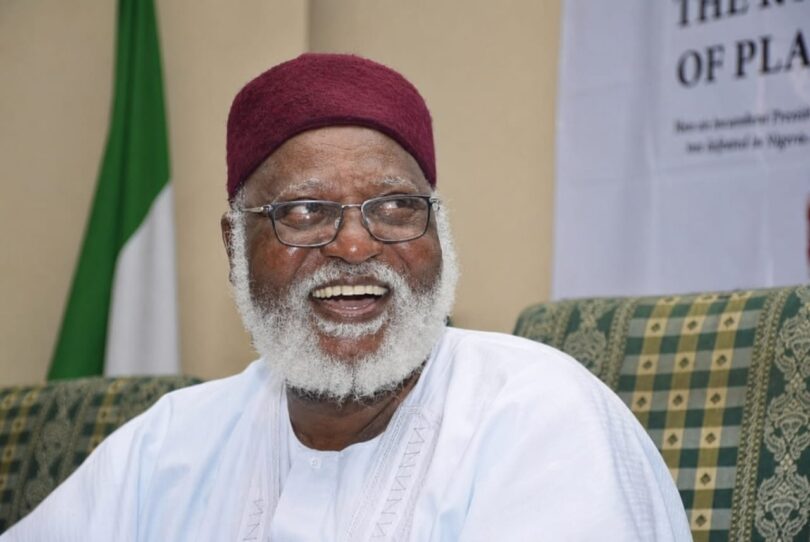
‘Call to Duty’ gives an account of significant events in `the life of General Abdulsalami A. Abubakar GCFR. It covers both private and public happenings from the perspectives of the writer in a narrative manner.
The book is dedicated “To all the fallen heroes who gave their lives for the peace and unity of Nigeria”
The 274-page book is divided into SEVEN SECTIONS with TWENTY-SEVEN CHAPTERS. The presentation is linear with some digressions for connectivity and convenience. The last Section comprising three chapters and named UP CLOSE AND PERSONAL is deeply personal and revealing. There are also historical pictures in the book.
For the purpose of this review, I have collapsed the sections into FOUR:
1. Childhood, family and Education
2. Military Training and Service
3. Heading the Nation
4. Personal
Before I get into the review, I must mention that the Foreword of the book was written by no other personality than General Ibrahim Badamasi Babangida, a friend, a brother, a classmate, a colleague and a confidante of the writer.
Gen Babangida wrote:
General Abubakar has lived a very fulfilling and fascinating life…
He alluded to the “unseen hand of God” in the parenthood, birth, marriage and career switch of General Abubakar culminating in him becoming Head of State. That was at the time when the NATION was experiencing tensions from the polity, international boycott, civil strife, deaths of General Sani Abacha and Chief M.K.O Abiola.
Gen Babangida added that the book “fills an important gap in the narratives on nation-building in Nigeria. “
Chapters 1 to 4 mainly covered his childhood, family and education. Gen Abubakar wrote that he was born in Minna on 13th June 1942. He is the eldest among 12 siblings living with many other relatives. He gave a long narration on the tradition of naming children at that time and how he got his names. There is a long piece in the book on his roots in Kano and Nguru (Yobe).
He recounted an interesting incidence when Sallah clothes were provided for other children by his father but not the biological children. The disciplinary treatment and the lessons he got are in the book. He reported that it was much later that he got to know that it was his stepmother that took care of him while his biological mother was still in the house. This was the norm then. He gave account of household chores like feeding animals, cleaning, farming etc. In the book, you will come to know why and how he has Fatima as mother, Fatima as stepmother, Fatima as wife, Fatima as sister, Fatima as daughter and still counting more Fatimas as granddaughters!
There is a part on his primary schooling detailing his adventures along with his mates like General Babangida, Prof. Adeyemi, Senator Idris Kuta, Alh Yahaya Imam and others. An incidence on plucking mangoes stood out. The designated ‘climber’ was abandoned on the tree when they saw a big snake under the tree. The CLIMBER survived and is still around. His name is in the book!
He wrote that he went to school with no shoes (like many others at that time) even though his father was a top employee of Native Authority as Sarkin Kasuwa (Chief Market scribe). He portrayed Minna as a happy, cosmopolitan and melting town because of the railway and the artisan miners coming from all over the country and beyond.
He gave account of his days at the Provincial Secondary School Bida, the school that produced two Heads of State and many Generals. They had teachers from all over the country as well as foreigners. There are many interesting incidences in the school narrated in the book. One encounter deserves mention. During their final year, there was a tense incidence that brought to the school four eminent Northern leaders (Ahmadu Bello, Ahmadu Ribadu, Usman Sarki and Tako Galadima). All of blessed memory. The outcome of the visit involved Transfers, twenty pounds (£20), a cow and caution. Who got what? It is in the book!
Chapters 5 to 15 of the book relate to his military training and service.
He was briefly at Technical College Kaduna (now Kaduna Polytechnic) before joining the Nigeria Military Training College (now NDA) in 1963. Among his mates are Generals Abacha, Babangida, Mamman Vatsa, Sani Sami, Mohammed Magoro, Garba Duba, Sani Bello and many others.
When the Nigeria Air Force was established, General Abubakar switched to the Air-force in October 1963 and was sent to Germany for training. There are details of the training and other adventures in the book. Unfortunately, he had to drop out at the last leg of the training.
He titled Chapter 6 Depression and Destiny. He shared an honest and deeply personal account of the incidence. He wrote:
“For reason I cannot pinpoint till today, I lapsed into depression. …….. By the time I was discharged, I had lost time. I was informed I could no longer continue the training with the rest of the class.”
“I would say God used the depression to shape my destiny.
“I ended up as Head of State, HOS”
He rejoined Nigerian Army in 1967 as Second Lieutenant and thus his mates that enlisted in same year (1963) with him became his seniors.
The book has details of his postings and training, both within and outside Nigeria. He gave some highlights on the process of promotions in the military and his role in the civil war. Suffice it to mention that he still carries scars of surgery as a result of gun wound. He wrote that he served under Generals Murtala Mohammed, Shehu Yar’ Adua and others. There are details of ambushes and injuries while fighting the opponents and interesting encounters with his own colleagues.
He indicated that he has served in almost all parts of the country (Benin, Owode, Enugu, Kano, Ogoja, Kaduna, Lagos, Sokoto, and Jos). He has also served the United Nations in Lebanon. There are very interesting events in the book. One out of ordinary incidence is his friendship with a mad man in Enugu that involved visits and gifts. When Gen Abubakar was transferred to Kaduna as GOC, the mad man somehow knew and promised to visit the Gen in his new place and he did!
You will also read about his narrow escape from court-martial (not related to coup). There are also interesting stories of how he managed the transportation and feeding of his men during his services in Lebanon.
Given his relationship with other top officers in the military, most people believe that Gen Abubakar was involved in the coups in Nigeria. He gave details of his whereabouts during all the coups. He gave an instance when he was interrogated because he was passing through the same town where some officers were meeting on change of government. He wrote:
“Bloody coups often leave sour taste and never good………officers who are friends kill one another “
In the book, you will read about the tension in the country because of the annulment of June 12 elections with politicians playing multiple roles. This led to the establishment of the Interim National Government (ING). General Abacha retained his posts of Chief of Defense Staff and Minister of Defense. This, according to Gen Abubakar, may be to ensure the support of the military and stabilize the goverment. He added that Gen Abacha had the command and respect of the military and had experience in government. With more tensions and sanctions, the Military peacefully took over.
Chapters 16 to 24 cover the period of” Heading the Nation.”
Let me remind us that the three Generals (Babangida, Abacha and Abubakar) enrolled in the military service the same year. Gen Abubakar became their junior because of his adventure in the Air Force. Generals Abubakar and Abacha fought in the same Brigade during the Civil war. Gen Abubakar attended same Primary and secondary schools with Gen Babangida.
After the takeover of the Interim Government and many skirmishes, face offs, silent treatments and confrontations, Gen Abubakar was appointed Chief of Defense Staff CDS. The initial rumor was that he was to be the Chief of Army Staff COAS. The book has more interesting details that unravel real and perceived situations.
Gen Abubakar wrote that the skirmishes continued because of the determination of some people around Gen Abacha to get rid of some Officers. He described how he tried to mediate and dialogue with those against the government like NADECO. Despite his direct approach, Gen Abubakar knew when to retreat as he realized when he raised with Gen Abacha the issue concerning Generals Obasanjo, Yar’ Adua and Diya. The book tells more!
The writer indicated that even though he was not in the KITCHEN CABINET, Gen Abacha consulted him whenever he needed.
Gen Abubakar had kind words for Gen Abacha. For instance, he said
“Abacha was loyal to his friends”
What do you think about this?
Drop your opinion in the comment section.
FOLLOW US & Share this with someone who needs to see this.