
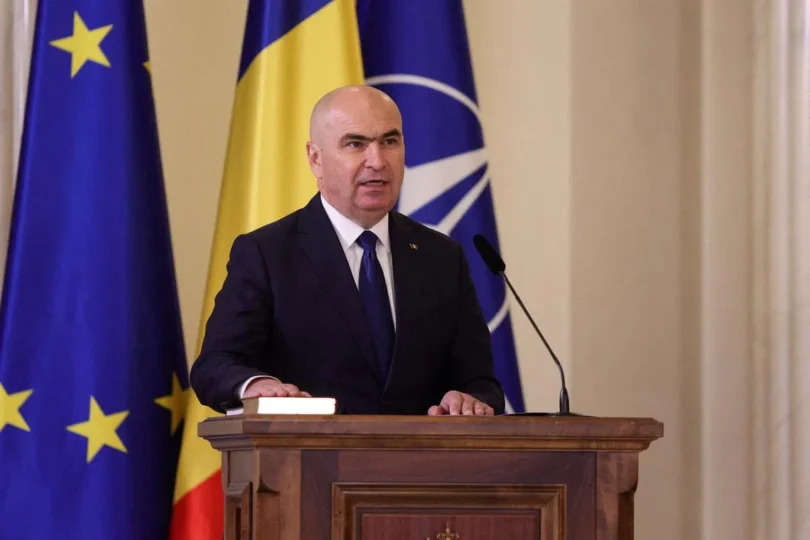
BUCHAREST, May 5 – Romania’s parliament is likely to oust Prime Minister Ilie Bolojan’s minority government on Tuesday after it debates a no-confidence motion put forward by the two largest parties, potentially leading to a policy deadlock that endangers the country’s sovereign debt ratings, access to EU funds and its leu currency.
Bolojan has led a minority government since late April when the leftist Social Democrats – parliament’s largest party – called for his resignation and then walked out of the coalition of four pro-European parties and teamed up with the far-right opposition to file a no-confidence vote.
The Social Democrats (PSD) have repeatedly clashed with Bolojan as his austerity measures hit their voters and patronage networks while their popular support bled away to the far right. They have also said his governing style was dismissive of coalition partners. Opinion surveys show Bolojan is the most popular politician in the ruling coalition.
The leu has sunk to a record low and debt costs have increased as political instability threatens Romania’s ability to enforce the reforms it must pass to tap some 10 billion euros worth of European Union funds before an August cutoff date.
Analysts have said Bolojan’s minority administration is likely to collapse on Tuesday, although infighting among parties could see the motion fail to garner the required 233 votes to pass.
“While several scenarios are possible, the risk of credit-rating downgrades, financial stability concerns and adverse growth impacts is likely to narrow the room for political manoeuvre,” Unicredit said in a research note.
If Bolojan were to survive, he would still need to return to parliament by early June – when the mandate of the interim replacements for the PSD ministers who have quit expires – and win a vote of confidence for a new cabinet lineup.
If the government collapses, centrist president Nicusor Dan, who nominates the prime minister, will attempt to rebuild the four-party pro-EU coalition with a different Liberal or a technocrat as prime minister.
The PSD, without whom a pro-EU majority cannot be attained, have repeatedly said they would rejoin the same coalition under a different prime minister, but Bolojan’s Liberals have so far stuck by him and ruled out collaborating with the leftists again.
The PSD’s leader has said the party would not form a coalition with the hard-right Alliance for Uniting Romanians, the second-largest party but the leader in public opinion surveys.
“Problems will arise if the motion passes — very big problems, in my opinion,” said 57-year-old Viorel, who declined to give his last name, in downtown Bucharest on Tuesday.
“I will certainly be much more careful when voting, and I will certainly not vote the way I voted before.” REUTERS