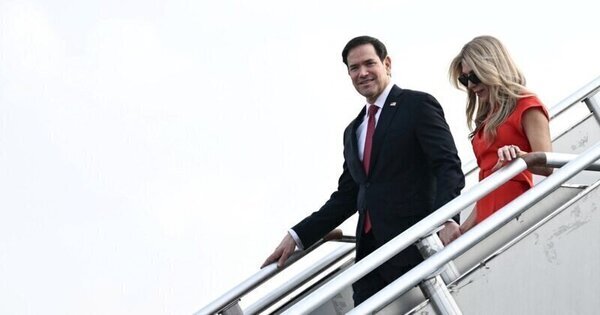
MANILA — US Secretary of State Marco Rubio arrived in Manila on July 21 for his first visit to the Philippines as America’s top diplomat, joining an Association of Southeast Asian Nations (ASEAN) ministerial gathering overshadowed by renewed conflict with Iran and rising tensions in the South China Sea.
The visit comes as Washington seeks to reinforce its Indo-Pacific strategy and reassure regional allies amid crises stretching from the Middle East to Russia’s war against Ukraine.
Rubio said he was open to meeting both Chinese Foreign Minister Wang Yi and Russian Foreign Minister Sergei Lavrov on the sidelines of ASEAN meetings, though no formal discussions had been confirmed before his arrival.
“I would never tell you guys in a press conference what we would raise in meetings like that. Those are delicate matters,” Rubio said before departing for Manila.
Shortly after Rubio landed, the US State Department underscored Washington’s focus on the South China Sea, issuing a sharply worded statement calling on Beijing to “immediately cease its destabilizing conduct.”
The statement condemned China’s “dangerous and aggressive actions” against Philippine Navy personnel at Second Thomas Shoal, a disputed reef where a confrontation between the China Coast Guard and Philippine sailors on July 20 left a Philippine serviceman injured.
Energy Security
While Washington’s agenda will likely center on China and the escalating conflict with Iran, the meetings are also taking place against the backdrop of other global crises, including Russia’s war on Ukraine.
Analysts interviewed by RFE/RL say Southeast Asian governments increasingly view those geopolitical challenges through the lens of energy security rather than military competition alone.
“The region is not choosing sides, it is diversifying its exposure,” Peter Cockcroft, director of the Asia-Pacific Net-Zero Institute and former strategic adviser to Philippine presidents, told RFE/RL. A chokepoint crisis a thousand miles away has done more to concentrate ASEAN minds on energy security than a decade of US-China rivalry rhetoric.
SEE ALSO:
Could The US-Iran Battle For Hormuz Be A Win For Russia And China?
Cockcroft said that although Taiwan, the South China Sea, and military alliances remain important, governments across Southeast Asia are increasingly preoccupied with fuel prices, electricity costs, shipping routes, inflation, currency pressures, and domestic political stability.
“Energy security is becoming a decisive part of Southeast Asia’s strategic security,” he said. The region is usually discussed through the lens of China, the South China Sea, Taiwan, military alliances, and freedom of navigation. Those issues remain important. However, Southeast Asian governments are equally concerned with fuel prices, electricity costs, shipping routes, foreign-exchange pressure, subsidies, inflation, and domestic political stability.
That shift could complicate Rubios message in Manila.
While Washington is expected to reassure allies on security, many ASEAN governments are increasingly judging strategic partners by their ability to deliver energy affordability, resilient supply chains, and economic stability.
Iran Conflict Reshapes Strategic Calculations
The Iran conflict has become a defining factor in Southeast Asia’s strategic outlook, analysts say, exposing the region’s dependence on Middle Eastern energy and vulnerable shipping routes through the Strait of Hormuz.
The Hormuz crisis did not create ASEAN’s energy vulnerability — it exposed it,” Cockcroft said. “The real question for finance ministries is not who they prefer strategically, it is who can guarantee fuel and fertilizer keep arriving.
SEE ALSO:
Reopening Hormuz Strait Easier Than Restoring Confidence, Naval Analyst Tallis Says
According to Cockcroft, the crisis is encouraging countries to diversify rather than forcing governments to choose between Washington and Beijing — seeking discounted Russian and Iranian energy where possible, expanding energy ties with China, and accelerating domestic energy development.
“ASEAN may discuss the crisis collectively, but each country absorbs and manages the consequences separately,” he said.
Before leaving for Manila, Rubio said that the US remained open to diplomacy with Tehran despite continued military operations. “Their behavior has to change in order for ours to change,” Rubio said, while emphasizing that Washington remained willing to negotiate.
Rubio also said that protecting global shipping should not fall solely on the US.
It was not the United States’ job to protect shipping for the entire planet forever,” he said, urging other countries to contribute more resources toward maritime security.
Hedging Between Washington And Beijing
For some regional analysts, however, the Iran conflict is accelerating longer-term shifts already underway in Southeast Asia’s foreign policy.
Amid what he calls the onslaught of fragmented globalization, Chester Cabalza, founder and president of the Manila-based International Development and Security Cooperation think tank, argues that the Iran crisis has accelerated ASEAN’s hedging between Washington and Beijing.
The region survived the US-China trade war, only to be paralyzed by total resource warfare, he said, arguing that China’s sustained infrastructure investment through the Belt and Road Initiative has strengthened Beijing’s economic position while Washington has struggled to regain momentum.
“Washington’s delayed economic entry gave Beijing the perfect window to integrate regional markets, leaving the US to play a frantic game of catch up,” he said.
SEE ALSO:
Hormuz Crisis Has Supercharged The Middle Corridor Trade Route
Cabalza added that energy security could ultimately override Western geopolitical priorities in the region, saying that fuel over foreign policy will force Southeast Asian countries to realign with non-Western energy powers, including cheap Russian and Iranian energy as a political necessity.
Similarly, Cockcroft said he expects ASEAN governments to show limited enthusiasm for expanding sanctions on Russian or Iranian energy, instead favoring pragmatic approaches aimed at protecting domestic economies, including alternative payment mechanisms and diversified energy supplies.
Possible Russia Talks
Russia’s war against Ukraine may also be discussed at ASEAN meetings, particularly as Rubio indicated he would be prepared to meet Russian Foreign Minister Sergei Lavrov in Manila if schedules allow.
The Kremlin has publicly welcomed the possibility of contact between the two diplomats during the gathering.
As ASEAN foreign ministers convene in Manila, analysts say the success of Rubio’s visit may depend not only on Washington’s security commitments but also on whether it can offer credible answers to Southeast Asia’s concerns over energy costs, inflation, supply-chain resilience, and economic stability.
Rubio Attends ASEAN As Iran War Fuels Energy Security Fears
Share
Copy link
Facebook
X (Twitter)
LinkedIn
Email
Share
Share
Copy link
Facebook
X (Twitter)
LinkedIn
Email
Share
Follow us
Facebook
X (Twitter)
Youtube
Instagram
Follow us