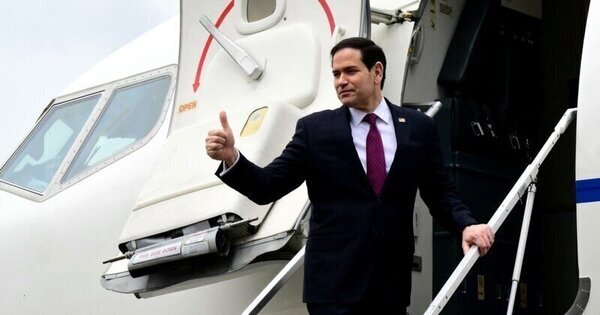
ROME — US Secretary of State Marco Rubio concluded a high-stakes, two-day diplomatic mission to Rome and the Vatican City on May 8, a visit defined by efforts to recalibrate a longstanding relationship with Italy following weeks of heightened friction over Iran.
Even as he sought to steady the alliance, Rubio firmly defended Washingtons military posture in the Middle East and issued sharp warnings against what he described as Irans attempt to assert control over the Strait of Hormuz.
The visit unfolded against a backdrop of growing strain in Washington-Rome ties.
Italian Prime Minister Giorgia Meloni, once regarded as one of President Donald Trumps closest European allies, has increasingly distanced herself from Washingtons strategy on Iran. Meloni publicly signaled opposition to deeper involvement in the conflict and criticized attacks by Trump on Pope Leo XIV.
Rubio held consultations with Meloni and Italian Foreign Minister Antonio Tajani on May 8, with discussions focusing on regional security challenges, including the Middle East and Ukraine, as well as continued transatlantic collaboration, according to State Department spokesperson Tommy Pigott.
Italian officials also sought to emphasize broader ties between the two countries. During Rubios meeting with Tajani, the Italian delegation presented the US secretary of state with genealogical records tracing his Italian ancestry, while Tajani later said that Italy and the United States are united by an indissoluble bond.
Pragmatism Over Politics At The Vatican
A central part of Rubios itinerary was his audience with Pope Leo XIV on May 7, held against the backdrop of Trumps repeated criticism of the pontiff over the Iran war and migration issues.
Trump has repeatedlyrebuked the pontiffin recent weeks after Pope Leo called for restraint in the Middle East conflict and condemned mass deportation policies affecting migrants and refugees. The Vatican has also voiced concern over the humanitarian impact of the fighting in Iran and the wider region.
Rubio sought to frame the meeting in diplomatic rather than ideological terms.
The church is an important global institution and has a presence all over the world, Rubio told reporters before departing Rome. Its important to share our points of view and an explanation and an understanding of where were coming from. And I thought it was very positive.
The secretary of state described the Vatican as an influential diplomatic channel, citing the Catholic Churchs role across Africa, Latin America, Lebanon, and Cuba.
In some cases, in the past, the church has been an important interlocutor, not just with governments, but with societies, Rubio said, adding that Washington could continue to maintain a very productive and fruitful and important relationship with the church.
NATO Strains And European Frustrations
Beyond the Vatican, Rubio was pressed on the future of the US military presence in Europe after Washington announced plans to withdraw thousands of troops from Europe and Trump threatened broader reductions tied to European responses during the Iran conflict.
Italian Prime Minister Giorgia Meloni (right) welcomes US Secretary of State Marco Rubio at the Palazzo Chigi in Rome on May 8.
Rubio said no decisions had been made regarding troop withdrawals from Italy or the broader US role in NATO.
We didnt discuss any specifics like that, Rubio said after meeting Meloni.
One of the advantages of being in NATO is that it allows us to have forces deployed in Europe and bases that give us the logistical ability to project power, he said. But we had a contingency, and some countries in Europe, like Spain, for example, denied us the use of those bases for a very important contingency.
Rubio added that such refusals created some unnecessary dangers for US operations and suggested the issue would need to be examined further by the administration.
At the same time, he sought to downplay immediate concerns over troop reductions in Germany, saying the move represented less than 14 percent of the US force presence there and largely returned deployments to pre-2022 levels.
Rubio Warns Against ‘Normalizing’ Iranian Control
Throughout the visit, Rubio repeatedly defended the Trump administrations approach to Iran, arguing there was broad agreement that Tehran should not obtain a nuclear weapon.
Every American president says they cant have a nuclear weapon, Rubio said. This is the first American president actually trying to do something concrete about it.
Rubio was particularly forceful regarding the Strait of Hormuz, a critical global shipping route through which much of the worlds energy supplies pass.
The normalizing of their control of an international waterway is both illegal and simply unacceptable, Rubio said.
He warned that accepting Iranian claims over the waterway would create a dangerous international precedent.
If the answer is no, we dont want to normalize it, then you better have something more than just strongly worded statements to back it up, he said.
‘We Didnt Fire. They Fired On Us’
Rubio also strongly defended recent US military action in and around the Strait of Hormuz following clashes between American and Iranian forces.
What you saw yesterday was US destroyers moving through international waters being fired upon by the Iranians, and the US responded defensively to protect itself, he told RFE/RLs correspondent on May 8. We didnt fire. They fired on us.
SEE ALSO:
Tehran Reviews Latest US Proposal Amid Trump Optimism — And Threats
Asked whether the continued exchanges undermined administration claims that Operation Epic Fury had ended, Rubio insisted the original offensive mission had concluded after degrading Irans missile launch capabilities, naval assets, air force, and military factories.
What if you fire a drone or a missile at our destroyer? What are we supposed to do? Let it hit it? Rubio said.
Only stupid countries dont shoot back when youre shot at. And were not a stupid country.
Ukraine Mediation Efforts ‘Stagnated’
Asked by RFE/RL about the current state of Ukraine peace talks — including recent Russian strikes on civilian targets after Moscow had advocated for a cease-fire — Rubio said the US had attempted to serve as a mediator between Moscow and Kyiv, though so far it has not led to a fruitful outcome.
We remain prepared to play that role if it can be productive, he said, adding that Washington did not want to waste time and energy on efforts that were not moving negotiations forward.
Rubio added that Washington would continue looking for opportunities to help bring both sides closer to a peace agreement.
Our position at the end of the day is that this war is a tragedy, he said. Both sides are paying a very heavy price for it, both economically and, obviously, at a human level. Its destructive. Were against it.
As for strikes on civilians, Rubio said such attacks underscored the urgency of ending the war through diplomacy.
Every time I hear about these things, it just reminds us why this war needs to end, he said. Were prepared to play whatever role we can to help bring about a peaceful diplomatic resolution.
Still, Rubio acknowledged that current diplomatic efforts had stagnated, while emphasizing that Washington remained ready to reengage if circumstances changed.
Rubio Wraps Up Rome Visit With Sharp Warning To Iran Over Hormuz
Share
Share
Copy link
Facebook
X (Twitter)
LinkedIn
Email
Share
Share
Copy link
Facebook
X (Twitter)
LinkedIn
Email