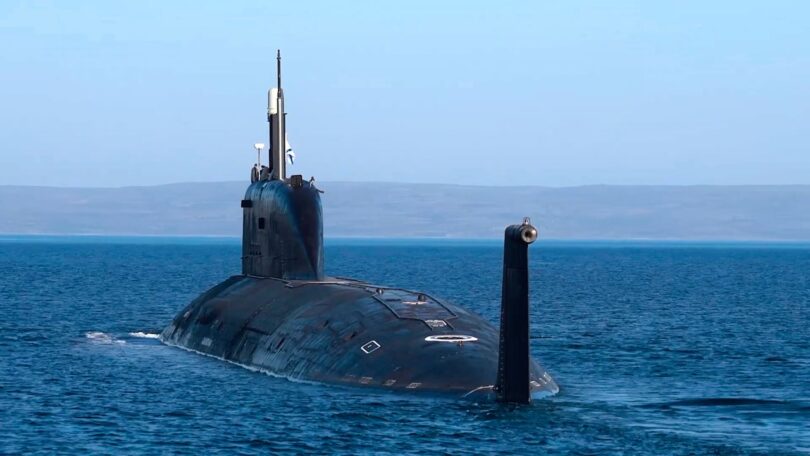
Russia and Belarus recently staged a joint military exercise involving tactical and strategic nuclear weapons, prompting renewed concerns in Europe over what message Moscow intends to send.
The drill comes as Russia’s influence is tested in the former Soviet space. The Ukraine war has weakened Moscow’s standing in Eastern Europe, and political events in countries like Armenia highlight growing challenges to Russia’s traditional sphere.
Russian leader Vladimir Putin and Belarusian President Alexander Lukashenko personally oversaw the drills as Moscow showcased its nuclear capabilities from the territory of a key ally in Eastern Europe, fuelling debate over whether the exercises reflect a genuine escalation or are primarily intended to project strength and deter the West.
“Russia has clearly intensified nuclear signalling through Belarus,” Linas Kojala, CEO of the Geopolitics and Security Studies Centre in Lithuania, tells TRT World.
Belarus played a key role in the early stages of Russia’s war in Ukraine, allowing Moscow to use its territory as a staging ground for the failed assault on Kiev.
Although Russian forces ultimately withdrew from northern Ukraine, Minsk has continued to host Russian troops and to support Moscow’s military posture, including by deploying Russian nuclear weapons on Belarusian soil.
Related
Despite Russian nuclear signalling, which indicated strengthening ties between the two states and heightened fears that Minsk could escalate its involvement in the Ukraine war, Kojala offers caution.
“We should be precise: there is no independently verified public count proving a new permanent increase in actual nuclear warheads in Belarus. Russia wants ambiguity. That ambiguity itself is part of the political effect,” Kojala tells TRT World.
According to Kojala, Russia’s nuclear messaging is aimed less at demonstrating new military capabilities than at exerting “political coercion” by intimidating NATO, discouraging further Western support for Ukraine, and reinforcing Belarus’s dependence on Moscow.
It also serves as a reminder that Russia can position nuclear-capable systems closer to NATO’s eastern flank.
Other analysts share that assessment, arguing that there is little operational need for a major expansion of Russia’s nuclear presence in Belarus and that such a move would create unnecessary logistical and security risks.
“There is, really, no need for it: first, the number of warheads is limited by the number of delivery vehicles and, second, any possible nuclear use from Belarus will be limited, so there is no operational need to have a large stockpile,” Nikolai Sokov, a senior fellow at the Vienna Centre for Disarmament and Non-Proliferation, tells TRT World.
Belarus-Russia ties matter
Russian analysts offer a very different interpretation of Moscow’s nuclear deployment in Belarus.
Rather than viewing it as a threat to Europe, they argue that the move is intended to strengthen the defence of a close ally under growing pressure from NATO and neighbouring states.
“Russia deployed nuclear weaponry to Belarus because Moscow was asked to do so,” Sergei Markov, a Russian academic and a former advisor to Putin, tells TRT World.
Belarus’s relationship with the West has deteriorated sharply since the disputed 2020 presidential election, when President Alexander Lukashenko faced mass anti-government protests.
The government responded with a crackdown on the opposition, prompting many activists and opposition figures, including Sviatlana Tsikhanouskaya, to continue their political activities from abroad.

Related
Since then, Belarus has moved even closer to Russia politically and militarily. Following Russia’s invasion of Ukraine, Minsk openly supported Moscow’s war effort, while Belarusian opposition figures aligned with Kiev.
Minsk is “afraid of Poland”, a neighbouring country that is four times larger than Belarus and which occupied the western parts of the Russian ally state between the two world wars, reflecting the difficult historical relations between the two states, according to Markov.
“Belarus fears that it could face aggression from Poland,” Markov says.
According to Markov, “Polish elites want to recover their old empire”, the Polish-Lithuanian Commonwealth, which included the territories of Poland, Ukraine, all of Belarus, Lithuania, and Latvia, as well as parts of Estonia and western Russia.
From this perspective, Russia is a defender not only of Belarus but also of Ukraine and other non-Polish states.
During the 2020-21 protests, “Polish intelligence service organised a failed coup against Lukashenko government similar to Ukraine’s 2014 Maidan uprising, which Markov claims was engineered by American intelligence, leading then-President Viktor Yanukovych to flee Kiev for Russia”.
According to Markov, because Polish “aggression” against Belarus has continued since then, Minsk has asked Russia to deploy nuclear weapons on its territory to defend itself against Polish and European threats.
But Western experts reject that assessment.
“Talking about an imaginary threat from Poland is a classic Russian framing: militarise first, then describe NATO’s response as a threat. Poland is strengthening defence because of Russia’s war against Ukraine and Belarus’s role in enabling it – not the other way around,” Kojala says.
While Moscow has made its nuclear presence more visible in Belarus and in Kaliningrad, a Russian enclave in the Baltic region with no direct connection to the Russian mainland, NATO is also considering deploying nuclear weapons in Poland and the Baltic states, according to US officials.
Poland has long demanded such a deployment from the US.
“The US and some European states want to deploy middle-range rocket missiles with nuclear warheads in territories of Eastern European countries like Poland, Romania and Baltic countries to threaten Russia, which is another reason why Moscow deployed its nuclear weapons to Belarus,” says Markov.
Markov argues that such proposals would violate the spirit of the 1997 NATO-Russia Founding Act, under which NATO stated it had no intention of permanently deploying nuclear weapons in new member states, while Russia made commitments regarding its military posture in Europe.