By Ipole AMAJAMA
On April 26, 2026, the desert winds carried more than dust across the ancient city of Kidal. They carried betrayal. In the dead of night, the Africa Corps—Russia’s expeditionary force in Mali—slipped away after secret negotiations with the Azawad Liberation Front (FLA). The withdrawal left the Malian Armed Forces (FAMa) exposed and bewildered, watching as rebels reclaimed the city. A senior Malian official, his voice heavy with disbelief, called it “treason.” The word hung in the air like a curse, a reminder that alliances forged in desperation often end in humiliation.
Kidal has long been a contested space, a symbol of fragility in Mali’s sovereignty. For years, foreign powers have treated it as a chessboard square, moving pieces with little regard for the human lives caught in the crossfire. The Africa Corps’ withdrawal was not a tactical redeployment—it was a calculated abandonment. Negotiated directly with the FLA, it bypassed Mali’s own government, stripping the FAMa of agency and dignity.
The rebels, emboldened, marched back into Kidal with the confidence of men who had been handed victory on a platter. For the Malian soldiers, the retreat was more than a military setback; it was much more: betrayal. They had been told they were fighting alongside a powerful ally. Instead, they discovered that their ally’s loyalty was conditional, its commitment mercenary, its promises hollow.
In the aftermath, Russian media wasted no time in shaping the story. Outlets like RYBAR AFRICA painted the FAMa as incompetent, plagued by “command failures, low morale, and lack of coordination.” The message was clear: Mali’s army was the problem, not Russia’s withdrawal. But what they denied is what it is.
This propaganda served two purposes. First, it deflected blame from Moscow, presenting the Africa Corps as disciplined professionals forced to operate alongside inept partners. Second, it reinforced Mali’s dependence. By portraying the FAMa as incapable, Russia positioned itself as indispensable—even as it humiliated its supposed ally.
The irony is bitter. Mali, isolated from Western partners and estranged from regional allies, has tethered its security to Moscow. Each humiliation deepens the dependency; each insult tightens the chain. The partnership, advertised as “win-win,” has proven to be a trap: Mali provides legitimacy and access, Russia provides conditional support and relentless propaganda, and Kidal has shown exactly that.
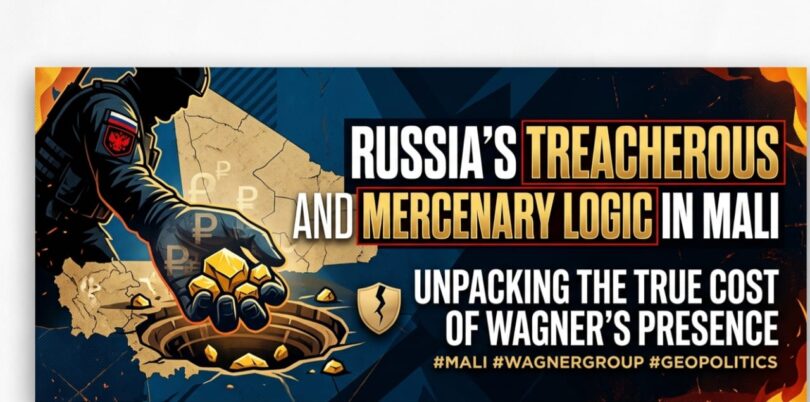
The withdrawal from Kidal confirmed what many suspected: Russia’s Africa Corps operates with a mercenary mindset. Its priorities are not Mali’s sovereignty or stability, but Russia’s own geopolitical and economic interests.
The evacuation was carefully staged to secure Russian personnel and equipment, not Malian positions. The negotiations with the FLA ensured safe passage for the Africa Corps, while leaving the FAMa exposed. In the propaganda war, Russia emphasised its own professionalism while denigrating its ally.
This pattern is not new. Across Africa, Russia has marketed itself as a partner offering security without lectures, weapons without conditions. But beneath the rhetoric lies a transactional logic. Moscow’s forces fight where it suits them, withdraw when it benefits them, and spin narratives to protect their image. Allies are tools, not partners; their suffering is collateral, not concern.
The events in Kidal shattered the illusion of mutual benefit. Mali’s leaders, like those of Niger and Burkina Faso, had embraced Russia as an alternative to Western partners, hoping for respect and solidarity. What they received was contempt disguised as cooperation.
The “win-win” slogan was always a mirage. For Russia, the wins are geopolitical influence, access to resources, and propaganda victories. For Mali, the supposed win is survival—but survival under constant humiliation, survival without sovereignty, survival dependent on a partner who abandons cities in the night.
The desert remembers betrayals. Kidal now stands as a monument to the dangers of mistaking mercenaries for allies, of confusing propaganda for partnership. Will those in Niger and Burkina Faso learn from this?
Beyond the geopolitics lies the human cost. Malian soldiers, already stretched thin, faced the rebels without the support they had been promised. Their morale, already fragile, collapsed further under the weight of abandonment. Citizens of Kidal, caught between armies and insurgents, saw once again that their fate is decided in distant capitals, not in their own streets.
The Africa Corps’ withdrawal was not just a military manoeuvre—it was a message. It told Malians that their lives are secondary, their sovereignty negotiable, their sacrifices expendable. It told the rebels that foreign powers would deal with them directly, bypassing the state. It told the world that Russia’s commitment is conditional, its loyalty mercenary, its rhetoric hollow.
April 26, 2026, will be remembered as the day Mali’s illusions about its partnership with Russia dissolved in the desert air. The treacherous withdrawal, the propaganda campaign, and the mercenary logic revealed the true nature of the alliance. For Mali, the lesson is painful but necessary: dependence on a partner who prioritises its own interests leads to perpetual humiliation. For Africa, the warning is clear: foreign powers may promise solidarity, but their actions reveal contempt.
In the words of the Malian official who called the withdrawal “treason,” the betrayal was not just of a city, but of trust itself. Kidal is lost, but the deeper loss is the belief that Mali’s sovereignty could be safeguarded by those who see it only as a bargaining chip.
If anything, the time for the African Union to show its face is now. The Constitutive Act gives the AU the right to intervene in a Member-State in grave circumstances, namely war crimes, genocide and crimes against humanity. The situation in Mali is grave. Kidal is a witness to this. The question is: Where is the African Standby Force (ASF)? Article 13 of the Protocol Relating to the Establishment of the Peace and Security Council of the African Union, the ASF is based on standby arrangements with Africa’s five sub-regions. If Moscow has shown its hand as it is wont to do, what of the AU?
Amajama, a social commentator, writes from Abuja and can be reached via [email protected]