
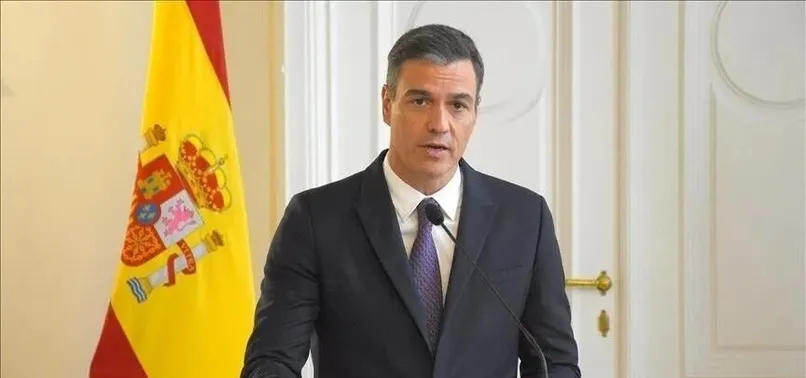
By Alyssa McMuSpanish Prime Minister Pedro Sanchez on Tuesday defended immigration as essential to Spain’s future as the country’s extraordinary migrant regularization program entered its final day after receiving around 1.2 million applications.
“Without immigration, Spain would lose 19% of its GDP by 2050,” Sanchez said during a presentation on migration. “The fact that more than a million people applied shows just how necessary this measure was.”
The regularization program allowed undocumented migrants who were living in Spain before Jan. 1, 2026, to apply for temporary residence and work permits, provided they did not have criminal records.
Sanchez said migration helps sustain Spain’s welfare state and offset demographic decline, adding that without migrants the country would lose around 90,000 bars, 220,000 farms and 50,000 classrooms by mid-century.
“Spain has never moved forward by building walls,” Sanchez said. “The only decent thing to do is extend a hand, not turn our backs on immigration.”
He also announced a €505 million ($575 million) integration plan aimed at improving migrants’ access to employment, education, housing and healthcare, as well as a public campaign highlighting migrants’ contribution to Spain.
“The Spanish society should guarantee equal rights, combat discrimination and offer opportunity. And those who arrive should respect our laws, learn our official languages and share democratic values,” he said. “Integration isn’t only about living somewhere, it’s about forming part of a community.”
Rejecting criticism from the conservative Popular Party and the far-right Vox party, Sanchez said his government was pursuing a migration policy based on “intelligence, humanity and empathy” rather than political opportunism.
He also argued that Spain’s approach combines openness with border control, noting that irregular migrant arrivals have fallen by about one-third this year, including by around 70% in the Canary Islands.
His remarks came as Spain’s Supreme Court considers whether to ask the Court of Justice of the European Union to clarify whether the regularization program complies with EU law following legal challenges brought by several regions governed by the Popular Party, according to Spanish media reports.
The court has not suspended the measure, and the Spanish government said on Tuesday that it remains confident the program is compatible with European law.