
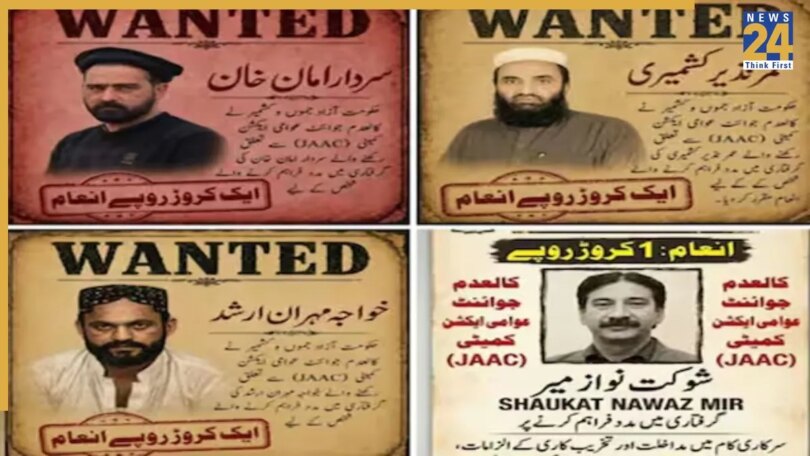
Pakistan-occupied Kashmir (PoK) is witnessing growing unrest as public anger over inflation, power shortages, unemployment and political marginalisation continues to intensify. What began as a movement against economic hardship has now evolved into a larger challenge to Islamabad’s authority in the region.
Amid the escalating protests, Pakistan has banned the Joint Awami Action Committee (JAAC), a group at the forefront of the movement. However, the decision that has drawn the most attention is the announcement of a reward of Rs 10 million for information leading to the arrest of four prominent JAAC leaders.
The four individuals: Shaukat Nawaz Mir, Umar Nazir Kashmiri, Khawaja Mehran Arshad and Sardar Aman Khan, are being portrayed by Pakistani authorities as key figures behind the unrest. Supporters, however, view them as voices of resistance and advocates for the rights of PoK residents.
Read More: 19 children, 7 pregnant women shot dead by Asim Munir army during PoK crackdown
Despite arrests and crackdowns, the movement has shown little sign of slowing down, with the names of these leaders now widely discussed both within Pakistan and internationally.
Protests intensify across PoK
The situation became more volatile after clashes broke out between protesters and security forces. According to reports cited in the article, more than 100 people have been killed and hundreds injured during the unrest.

Pakistan has designated JAAC as a banned organisation, although the group maintains that it is a peaceful citizens’ movement. Authorities accuse the organisation of creating instability, while human rights groups have criticised the crackdown as an attempt to suppress dissent.
India has also criticised Pakistan’s actions and called for accountability over the handling of the protests.
Why is Pakistan concerned about the movement?
The movement in PoK is no longer limited to issues such as representation or electoral disputes. It has expanded into a broader campaign focused on economic hardships, resource exploitation, power cuts and political rights.
Read More: What happens if Strait of Hormuz suddenly opens? Here’s how global markets and India could benefit
JAAC has gained significant support by highlighting everyday concerns faced by residents, increasing pressure on the Pakistani administration. Analysts believe this growing influence is one reason why authorities have intensified action against the group’s leadership.
Despite internet shutdowns, arrests and the use of force, demonstrations continue in several areas. Pakistan’s Human Rights Commission (HRCP) has also warned that equating peaceful protests with terrorism could worsen the situation.

JAAC leaders insist that they are only advocating for the rights of local people.
Shaukat Nawaz Mir: Face of the movement
Shaukat Nawaz Mir is widely regarded as JAAC’s most influential leader. Based in the Muzaffarabad region, he has strong support within the local business community.
Since the formation of JAAC in 2023, Mir has played a leading role in organising protests focused on inflation, affordable electricity and political rights.
Read More: Congress leader Meenakshi Natarajan accuses BJP of plotting her Rajya Sabha disqualification, says, ‘not a legal battle but…’
He attracted major controversy after publicly stating that ‘Azad Kashmir is not truly free.’ Pakistani authorities viewed the remark as highly provocative, while Mir maintains that he is engaged in peaceful activism and is simply representing public concerns.
Umar Nazir Kashmiri: Taking the issue to the world
Umar Nazir Kashmiri is considered a senior member of JAAC’s core committee. He was reportedly injured during clashes linked to the protests.
Following the violence, he released video messages accusing Pakistani security forces of opening fire on demonstrators. He also appealed to international media outlets and human rights organisations to intervene.
Pakistani authorities reportedly view him as one of the leaders responsible for bringing international attention to the movement. His influence continues to grow among local communities.
Khawaja Mehran Arshad: Popular among youth
Khawaja Mehran Arshad, popularly known as the ‘Mani of Dadyal,’ has emerged as one of the most recognised faces among young protesters in PoK.
Read More: Iran attacks Bahrain, Kuwait, Jordan, IRGC fires drones and missiles; Explosions reported at US bases
A lawyer by profession, Arshad is known for his outspoken speeches and strong presence on social media, where his videos frequently attract significant attention.
He has consistently focused on issues such as economic equality, local rights and political justice. Following a recent audio leak controversy, he faced allegations including sedition-related charges. Pakistani authorities reportedly consider him one of the movement’s key strategists.
Sardar Aman Khan: Voice of a new generation
Around 30 years old, Sardar Aman Khan is seen as a rising youth leader within JAAC. He has used digital campaigns and social media platforms to mobilise younger supporters.
Khan played an important role during large-scale demonstrations held in May 2025 and has focused on issues including unemployment, economic difficulties and political autonomy.
Read More: US launches strikes on Iran after Apache helicopter downed in Hormuz, Tehran says ‘won’t leave attack unanswered’
His growing popularity among younger residents has made him one of the most prominent figures associated with the movement.
Why were rewards announced?
Pakistani authorities allege that the four leaders used JAAC to organise large-scale protests and create unrest across PoK. The administration has accused them of offences including sedition, incitement and disrupting public order.
Human rights organisations, however, argue that the measures are aimed at silencing dissent and suppressing legitimate public demands.
First published on: Jun 10, 2026 10:00 AM IST
Get Breaking News First and Latest Updates from India and around the world on News24. Follow News24 on Facebook, Twitter.
End of Article
Related Story