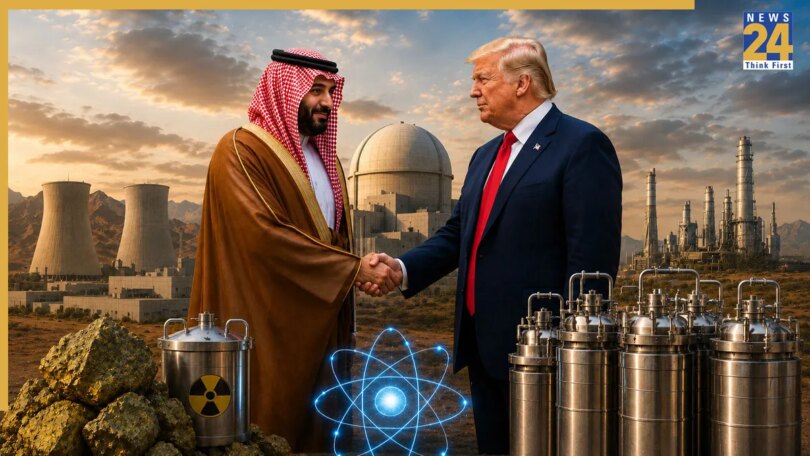
Some decisions taken in Washington look dull and technical on the surface, yet they quietly shape the future of an entire region. The new nuclear agreement between the United States and Saudi Arabia is one of them. On Wednesday, the Trump administration announced that it had signed a civil nuclear cooperation agreement with Riyadh. Officially, it is meant only for the peaceful use of atomic energy, and it promises fresh business for American companies. But one question refuses to go away: has Washington quietly lowered its own safety wall?
To understand the worry, one small word must be understood first — enrichment. Uranium dug out of the ground cannot directly run a power plant or make a bomb. It has to be processed in fast-spinning machines called centrifuges. Enrich it a little, and it becomes reactor fuel. Keep the same machines running much longer, and the material slowly moves towards bomb-grade quality. The technology is the same; only the duration changes. That is why the ability to enrich uranium on one’s own soil is seen as the doorway to a weapons programme, even if no country walks through that door immediately.
Here lies the puzzle. Saudi Arabia does not really need this ability for electricity. Ready-made nuclear fuel can be bought from the world market, and that is far cheaper than building an entire enrichment industry from zero. So the demand looks less like an energy need and more like the laying of a foundation — a capability kept ready, in case the Kingdom one day decides it wants a weapon of its own.
For many years, America has applied what is called the “gold standard” in such deals. In simple words, the partner country gives a written promise: it will not enrich uranium and will not reprocess plutonium inside its own borders. Along with this comes another safeguard called the Additional Protocol. This is a rule-book of the International Atomic Energy Agency, the United Nations body that watches over nuclear activity worldwide. Under it, a country allows international inspectors to visit more sites, make surprise checks and demand far more information — so that nothing can be hidden behind closed doors. The United Arab Emirates accepted both these conditions in its 2009 agreement with Washington.
Saudi Arabia has accepted neither. In place of a firm promise, the agreement offers a two-year joint study to examine whether enrichment inside Saudi Arabia would be useful and commercially sensible. This is where doubts sharpen. Everybody in the field already knows that home-made enrichment will not be cheaper. So what exactly remains to be studied? In Washington, ordering a study is often a polite way of postponing an awkward decision. Lawmakers will want to know whether this is a real examination, or only a waiting room built to keep Congress silent for two years.
The inspection side raises equally uncomfortable questions. The administration says a separate safety understanding has been prepared with Riyadh. But as The Wall Street Journal has argued, it is hard to believe that a country would reject the globally accepted Additional Protocol only to sign something even stricter. The likelier outcome is a weaker, tailor-made arrangement. And once one country gets a special deal, others will politely ask for theirs.
That is the deeper danger. Turkey and Egypt may soon seek similar treatment, and The Wall Street Journal has noted that President Trump has rarely enjoyed refusing Turkish President Recep Tayyip Erdoğan. There is also a fairness problem. The UAE proved a far more dependable partner during the conflict with Iran. If Riyadh escapes the stricter rules, why should Abu Dhabi keep obeying them? Every exception becomes tomorrow’s precedent.
The history of the deal adds another layer. The offer of American help began under the Biden administration. It was dangled as a reward if Saudi Arabia joined the Abraham Accords — the set of agreements under which some Arab states established normal diplomatic ties with Israel. Riyadh has still not joined. Yet the nuclear cooperation has arrived anyway. One can only hope that something valuable was received in return, because from outside, the exchange looks rather one-sided.
There is a larger principle here as well. Each time one more country learns to enrich uranium, the chances of an accident, a miscalculation or an actual nuclear conflict go up. Both American political parties have long agreed that the most dangerous technologies should not spread — not to rivals, and not even to friends.
None of this means America should walk away from Saudi Arabia. The Kingdom is trying to build an economy beyond oil, and Washington has much to offer. But there is a difference between helping a friend build power plants and handing over a capability that can later be turned in another direction.
The agreement now goes to Congress, where blocking it will be difficult, since overturning a presidential veto needs a two-thirds majority. Even so, every line deserves scrutiny. Washington has spent years keeping Iran away from the bomb. It would be strange to undo that work with a single signature.
(Girish Linganna is an award-winning science communicator and a Defence, Aerospace & Geopolitical Analyst. He is the Managing Director of ADD Engineering Components India Pvt. Ltd., a subsidiary of ADD Engineering GmbH, Germany.)
First published on: Jul 24, 2026 09:09 PM IST
Get Breaking News First and Latest Updates from India and around the world on News24. Follow News24 on Facebook, Twitter.
End of Article
Related Story