
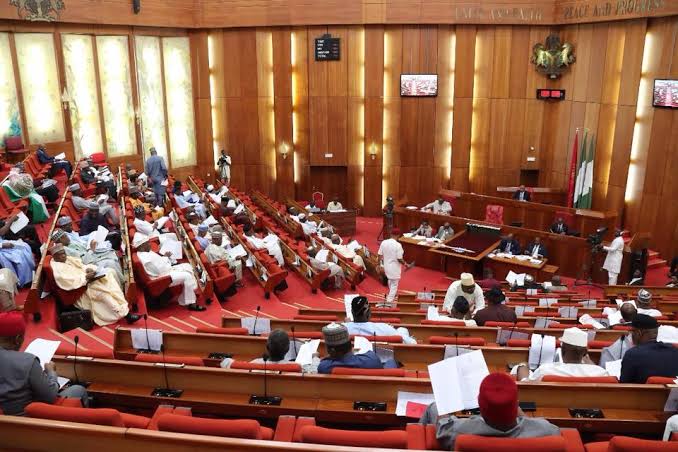
The Senate is scheduled to begin the constitutional amendment process this week, starting today, to pave the way for the establishment of state police across Nigeria.
Once passed by the National Assembly, the bill will be transmitted to the 36 State Houses of Assembly for further legislative action and ratification.
The move follows prolonged national debate regarding Nigeria’s security framework. Critics of the current structure argue that a centralized federal police force is inadequate for the country’s localized security challenges.
Currently, Section 214(1) of the 1999 Constitution mandates a single Nigeria Police Force, effectively prohibiting state or local government policing structures. Modifying this provision requires a formal constitutional amendment. To become law, the bill must clear the National Assembly and secure approval from at least two-thirds (24) of the 36 State Houses of Assembly before receiving presidential assent.
In a statement issued on Monday by his Directorate of Media and Public Affairs, Senate Leader Senator Opeyemi Bamidele confirmed that the National Assembly has resolved to fast-track the legislation.
He revealed that the state police provision has been isolated from the broader, ongoing constitutional review to expedite its passage due to national urgency.
“Our position is very clear on state police. We are standing with Nigerians on the issue of state police,” Bamidele stated. “All strata of the federation have made it clear that there cannot be a better time to establish a state police than now.”
Bamidele indicated that executive and legislative stakeholders are aligned on the policy.
“We came to the conclusion that we are going to pass the constitutional amendment in this respect to make a provision for the state police. If I can tell you as of today, that will come to fruition this very week because there is no need to allow any further delay,” Bamidele said.
Over the past week, leadership from the National Assembly held consultations with the Office of the Attorney-General of the Federation, Chief of Staff to the President Femi Gbajabiamila, and Inspector-General of Police Tunji Disu to finalize the framework.
The Senate Leader expressed confidence that the bill would advance rapidly through the federal legislature before heading to the states.
“The bill can as well be on its way to the 36 States Houses of Assembly as soon as possible because you know we will need two-thirds of the state assemblies to approve it before the president can assent to it,” Bamidele added, noting that President Bola Tinubu is prepared to review the bill once it arrives.