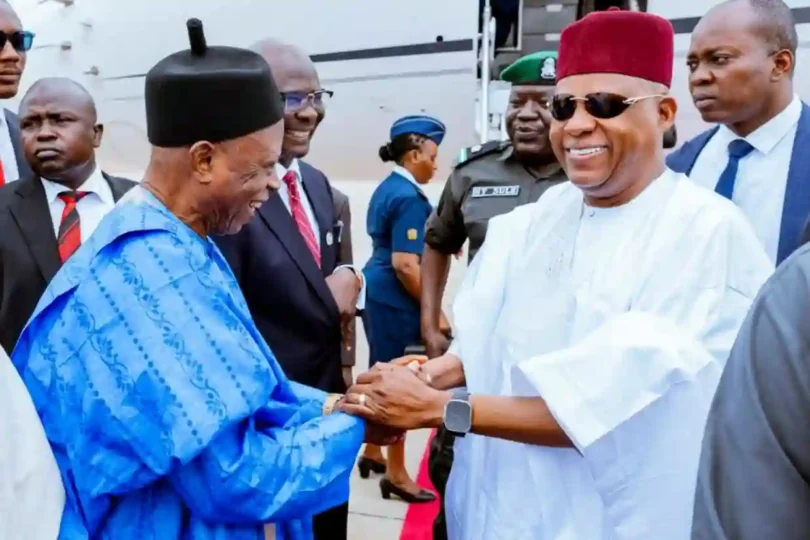
President Bola Ahmed Tinubu’s economic reforms are gradually reducing the dependence of states on the Federal Government, Vice President Kashim Shettima has said, as the administration pushes for stronger subnational economies driven by investment, fiscal reforms and industrial growth.
Speaking on Wednesday at the Nasarawa Investment Summit 2026 held in Lafia, the Vice President said the Tinubu administration is restructuring key parts of the Nigerian economy to give states more room to generate growth, attract investors and build viable economies outside federal allocations.
Shettima said the reforms are focused on rebuilding the “pillars” that states depend on, including energy, tax administration, fiscal balance and investment systems.
“At the national level, we are rebuilding the pillars every state depends on: energy reliability, fiscal balance, tax reform, and a single digital gateway for investment,” the Vice President said.
According to him, ongoing reforms in the power sector are already creating new opportunities for states to participate more actively in energy generation and industrial development.
He added that federal infrastructure projects linked to the Ajaokuta-Kaduna-Kano (AKK) gas pipeline and the Abuja industrial corridor would strengthen Nasarawa State’s Gas Master Plan and position the state as a major energy hub in the country.
The Vice President said the Tinubu administration deliberately chose states as the centre of its reform agenda because countries with strong economies are often powered by strong subnational governments.
“All over the world, nations that move fastest are powered by strong federating units and Nigeria is embracing that truth as our subnationals are becoming centres of enterprise, policy innovation, and industrial energy,” he said.
Since assuming office in May 2023, the Tinubu administration has introduced several economic reforms, including fuel subsidy removal, foreign exchange reforms and changes to fiscal allocations to states. The reforms have triggered mixed reactions across the country due to rising living costs and inflation, but the Federal Government maintains they are necessary to stabilise the economy and create long-term growth.
At the summit, Shettima argued that the reforms are already giving states greater confidence and flexibility to pursue their own economic priorities.
He said states now have “greater room to think, to build, to invest, and to respond to the needs of their people with renewed confidence.”
According to him, a new relationship is emerging between Abuja and the states, one that rewards competitiveness, fiscal discipline and policy reforms.
“The new compact we are building between Abuja and the states rewards fiscal discipline, competitiveness, and the courage to reform,” he stated.
The Vice President also used Nasarawa State as an example of a subnational government aligning with the Federal Government’s economic direction through investment-focused institutions and industrial policies.
He commended the Nasarawa State Government for establishing the Nasarawa Investment and Development Agency (NASIDA), the One Stop Investment Centre, the State Electricity Regulatory Commission and the Nasarawa Infrastructure Fund.
Shettima said such institutions are critical to helping states reduce overdependence on monthly federal allocations and attract private capital.
“What Nasarawa State pursues here aligns with the national direction set by President Bola Ahmed Tinubu. Across the federation, we are laying the foundations for an economy that rewards production, protects enterprise, and gives our states the room to become engines of growth,” he said.
The Vice President also spoke on the importance of policy continuity, describing it as one of the biggest signals investors look out for before committing capital to any economy.
Referring to the “Lafia Declaration” signed during the summit, Shettima described the pact as “an economic covenant” that assures investors that Nasarawa’s development plans would continue beyond political transitions.
“Policy continuity is the soul of investment,” he said.
He further claimed that investor confidence in Nigeria is gradually improving as a result of the reforms introduced by the current administration.
According to him, capital inflows into Nigeria increased from $12.32 billion in 2024 to $23.22 billion in 2025, while the Nigerian equity market recorded a 51.19 percent return in 2025, with market capitalisation rising to N99.38 trillion.
“Investors are beginning to read Nigeria again as a country willing to correct itself, a country prepared to take difficult decisions in defence of its future. Capital follows credibility, stability, and direction,” Shettima said.
Governor Abdullahi Sule of Nasarawa State said the summit was organised to reassure investors that the state’s economic policies and governance structures would remain stable irrespective of political changes.
According to the governor, the state is trying to build institutions and policy frameworks that can survive beyond individual administrations.
“The summit represents a critical moment for aligning political leadership, institutional actors, investors and citizens around a shared vision of a prosperous and resilient Nasarawa State,” Sule said.
Also speaking at the event, Minister of Budget and Economic Planning, Senator Abubakar Bagudu, said economic reforms are necessary because economies and global realities continue to evolve.
Bagudu said the Tinubu administration had managed difficult economic disruptions while creating opportunities for states to expand investment and development initiatives.
“And I think it is the benefits of that disruption that is enabling states like Nasarawa to achieve what they have achieved,” he said.
Minister of Industry, Trade and Investment, Dr Jumoke Oduwole, also said the Federal Government remains committed to working with states to attract investment, strengthen local supply chains and connect businesses to global markets.
Meanwhile, NASIDA Managing Director, Barrister Ibrahim Abdullahi, disclosed that the agency has attracted more than $2 billion in investments into Nasarawa State.
According to him, the summit was designed to increase investment inflows and position the state as one of Nigeria’s leading investment destinations.
What do you think about this?
Drop your opinion in the comment section.
FOLLOW US & Share this with someone who needs to see this.