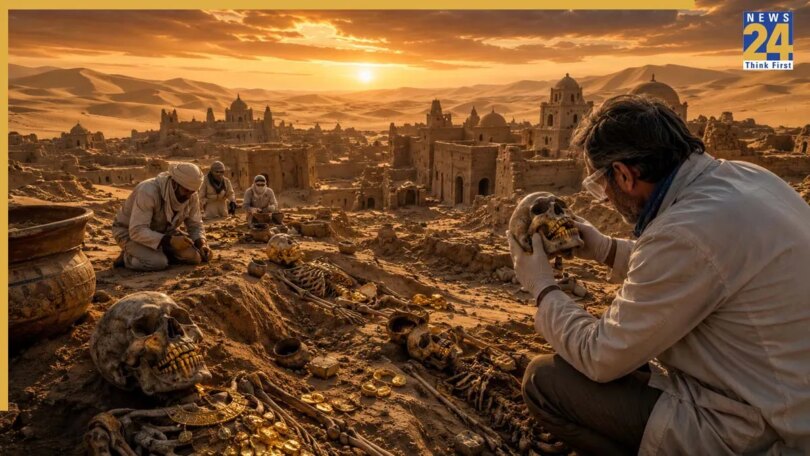
Egypt archaeological discovery: A remarkable archaeological discovery was made at the Marina El Alamein site in Egypt’s Western Desert, where researchers dug up a an ancient city that lay buried under the desert for more than 1,700 years, and unveiled a burial site with skeletons holding gold pieces in their mouths.
Ancient city uncovered in Egypt’s western desert
The discovery was announced by the Egyptian government on Saturday, stating that a well-preserved city dating back over 1,700 years to the 4th century in the Byzantine era, was discovered in the Dakhla Oasis in Egypt’s Western Desert, revealing stunning details about everyday life, urban development during that period of history.

According to archaeologists, excavations uncovered north-south roads, intersected by east-west ones and interspersed with open squares and public spaces, revealing thoughtfully designed civil engineering that ensured ample living space.
What was found in Egypt’s ‘ghost’ city?
At the head of ancient settlement stands a massive basilica church dating back to the mid-4th century, as well as two outposts, presumably designed to protect the settlement from invaders, were also found.
The excavations also unearthed a fortress and several houses with reception rooms and vaulted ceilings, including one belonging to a church deacon, Tissos. Archaeologists believe the house doubled up as a church before the basilica was constructed.
Further, archaeologists found a bread oven, a kitchen, and stone tools for grinding grain, in addition to bronze coins bearing the images of Byzantine emperors, Latin inscriptions, and Christian symbols. Gold coins dating back to the time of the Roman Emperor Constantius II (337-361 AD) were also found.
Another major discovery was the unearthing of 200 clay fragments used to record transactions, correspondence, and small details of daily life.
Skeletons with ‘golden tongues’
However, the most stunning discovery was arguably the uncovering of 18 ancient tombs at the Marina El Alamein archaeological site near Alexandria, where skeletal remains were found with “golden tongues”, providing fresh insight into funeral practices of that age.

Researchers uncovered 11 rock-cut tombs and 7 surface-built lime tombs, taking the total number of tombs discovered at the site to 48. Pottery, amphorae, lamps, plates, altars, and lime basins were found at the site.
But the most astonishing was the discovery of 24 thin gold pieces placed inside the mouths of several people buried at the site, including one piece depicting the Eye of Horus, a well-known Egyptian symbol linked to safety and healing.

Ancient Egyptians believed the dead needed the power of speech in the afterlife, which explains why these people, presumably affluent persons of their time, were buried with gold tongues inscribed with sacred symbols.
First published on: Jul 07, 2026 12:21 AM IST
Get Breaking News First and Latest Updates from India and around the world on News24. Follow News24 on Facebook, Twitter.
End of Article
Related Story