
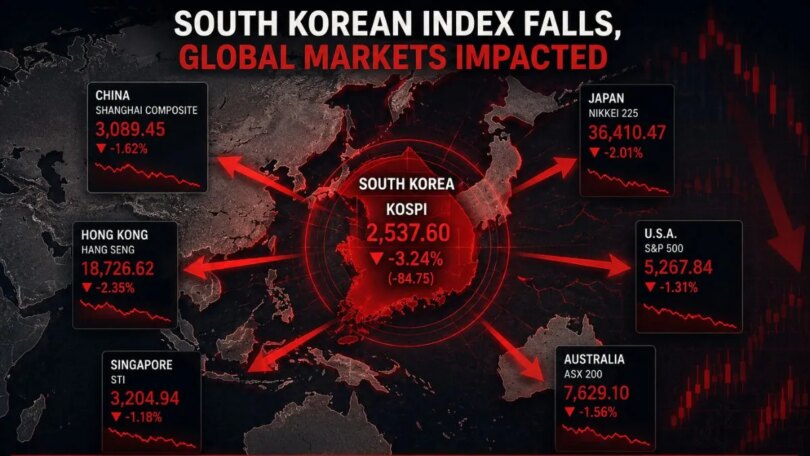
Global markets witnessed a sharp bout of volatility on June 23. The sudden crash was triggered by the South Korean index. The South Korean benchmark KOSPI index plunged 9.99% in a single session, leading to a 20-minute trading halt. The sell-off was led by semiconductor giants Samsung Electronics and SK Hynix. Both stocks sank more than 12%, wiping out billions of dollars in market value and dragging the broader market lower. The crash in the KOSPI triggered a domino effect, wiping out millions from global markets. So what does it actually mean, and what are the lessons for India?
What led to the super crash in KOSPI?
South Korea’s stock market has become heavily dependent on chipmakers due to the artificial intelligence boom. Samsung Electronics and SK Hynix together account for more than 50% of the KOSPI’s value. After a massive rally driven by AI optimism, investors rushed to book profits amid growing concerns that valuations had become stretched. The resulting sell-off quickly snowballed into a broader market correction.

How did global stocks come under pressure?
The sell-off was not limited to South Korea. In the United States, the Nasdaq fell more than 2%, while semiconductor stocks witnessed heavy losses. Investors became increasingly cautious about the sustainability of the AI-driven rally that has powered global markets over the past year. The sharp correction in global markets is largely being driven by a renewed rise in U.S. inflation and growing fears that interest rates could move even higher.
Inflation in the United States, which had been gradually cooling, unexpectedly accelerated to 4.2%, its highest level in nearly three years. At the same time, core inflation remained stubbornly above the Federal Reserve’s comfort zone, raising concerns that price pressures are becoming entrenched once again.
What other factors are putting pressure on global indices?
The market turmoil was amplified by stronger-than-expected inflation in the United States. U.S. consumer inflation rose to 4.2% in May 2026, up from 3.8% in April and the highest reading since April 2023. Core inflation, which excludes food and energy prices, climbed to 2.9%.
The inflation surge has strengthened concerns that the US Federal Reserve may keep interest rates higher for longer. Money markets have even started pricing in the possibility of another rate hike later this year. Higher interest rates generally hurt technology stocks because their valuations depend heavily on future earnings. Much of the inflation spike has been linked to higher energy prices and supply-chain disruptions following recent tensions in the Middle East. These concerns were reinforced during the Federal Reserve’s June 2026 policy meeting, the first chaired by Kevin Warsh. If U.S. bond yields rise and offer safer returns, money is increasingly moving out of riskier assets and into government securities. As a result, a wave of selling has started across global equity markets, with technology stocks facing the biggest pressure.
Why India could feel impact?
India is likely to face short-term pressure from foreign fund outflows and rising global uncertainty. Higher U.S. interest rates generally strengthen the dollar and reduce investor appetite for emerging markets. At the same time, any rise in crude oil prices can increase India’s import bill, put pressure on the rupee, and complicate the inflation outlook.
However, India’s long-term fundamentals remain relatively strong. Unlike South Korea, which is heavily concentrated in semiconductors, India’s economy is diversified across banking, infrastructure, manufacturing, consumption, and services. Strong domestic inflows through mutual fund SIPs and the government’s manufacturing push continue to provide support to the broader market.
First published on: Jun 24, 2026 10:27 AM IST
Get Breaking News First and Latest Updates from India and around the world on News24. Follow News24 on Facebook, Twitter.
End of Article
About the Author

Mamta Singh
Mamta Singh is a senior journalist with over 17 years of experience in the media industry, specializing in business and financial journalism. She holds a Master’s degree in Broadcast Journalism and has built a distinguished career across print, digital, and broadcast media. Over the years, she has worked with leading media organizations, including The Economic Times, Business Bhaskar, and Dainik Jagran, covering corporate affairs, markets, the economy, and policy developments. In addition to her journalism career, Mamta has also worked as a Radio Jockey with BAG Films. She is known for her insightful reporting, editorial expertise, and strong communication skills across multiple media platforms.
Read MoreRelated Story