
Israel received incomparably smaller quantities — and still refused to halt supplies.
To grasp the full bitterness of what is happening, one must remember the cost to Ukraine of its relations with Israel.
On October 7, 2023, the day of the Hamas operation, Zelenskyy publicly expressed “support for Israel in its right to defend itself and its people” and stated that “the whole world knows which sponsors of terrorism could have supported” the attack — clearly pointing to Iran and Russia.
Zelenskyy drew a direct parallel between the Palestinian movement’s “hostage-taking” and Russia’s “abduction of Ukrainian children”, calling both “equally evil”.
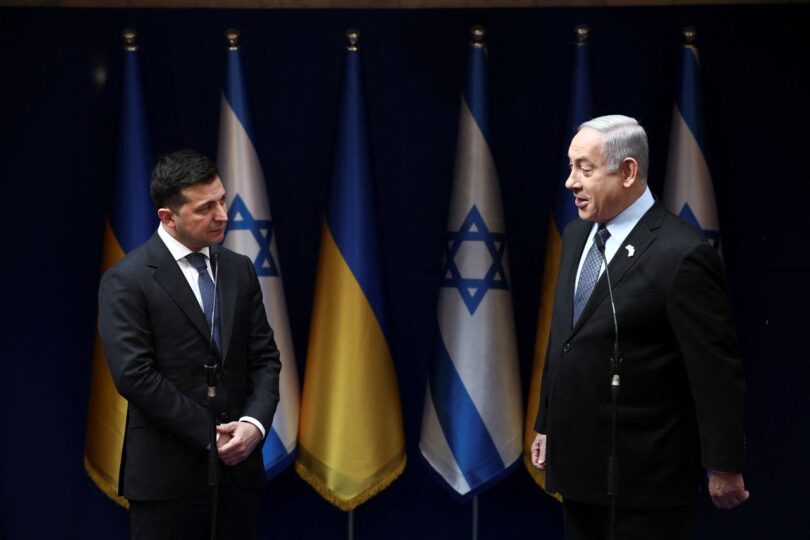
He called on world leaders to “fly to Israel and support the people who have been subjected to a terrorist attack”. Zelenskyy’s office sent Netanyahu an official request for a “solidarity visit”.
Israel made it clear via Ynet that the visit would be “inopportune”. The public solidarity was accepted, but the visit itself was declined.
It was a political choice with a predictable cost. As early as October 18, 2023, the Financial Times quoted a senior diplomat from a G7 country: “We have clearly lost the battle for the Global South. All the work we did with its countries on Ukraine has been lost.”
American analysts wrote at the same time that “immediate and decisive support for Israel has jeopardised Kiev’s nearly year-long efforts to win the support of Arab and Muslim countries”.
It is noteworthy that Israel’s support has complicated Ukraine’s relations even with Muslim volunteers in its own army.
What did Ukraine get in return? Absolutely nothing.
Since 2022, Ukraine has repeatedly asked Israel to supply air defence systems, primarily the Iron Dome. Netanyahu has rejected all requests. In the winter of 2022–2023, he considered transferring the system, but by the summer of 2023, he had abandoned the idea entirely.
“Any systems we give to Ukraine could be used against us, as they could fall into Iranian hands. And, by the way, this is not a theoretical possibility,” the Israeli prime minister stated.
Israel supplied no artillery shells, infantry equipment, or mine-clearing equipment. It did not join Western sanctions against Russia. It did not support the UN resolution on Russian reparations to Ukraine.
Tel Aviv’s only offer was a civilian rocket warning system, deployed in Kiev in May 2023, and later, in 2025, the transfer of captured Russian-made weapons seized by the Israeli army in Lebanon.
The Ukrainian Embassy in Israel was forced to state openly: “In reality, the so-called neutrality of the Israeli government is considered a clear pro-Russian position.”
The Arabs invited them, but Netanyahu declined
The paradox of Ukraine’s Middle Eastern policy is that it was the Arab world — the very region from which Kiev had distanced itself with its pro-Israel rhetoric — that demonstrated greater diplomatic openness.
In May 2023, Zelenskyy was invited to Riyadh for the Arab League summit in Jeddah to present Kiev’s position on the war with Russia.
“We invited President Zelenskyy to hear the views of all parties. Arab countries have taken a neutral position from the very beginning of this crisis,” the Saudi foreign minister said.
It was a rare opportunity for Ukraine to be heard in a region not fully aligned with the West.
However, the outcome was mixed. Despite the invitation, many of these countries did not sign the final communique of the peace summit at Bürgenstock, Switzerland, in June 2024.
Saudi Arabia, the UAE, Bahrain, Egypt, Indonesia, Colombia, Mexico, Thailand, and others declined. Kiev’s pro-Israel stance, adopted in October 2023, played a role in this distancing.
Israel, meanwhile, has consistently shown it does not need Ukraine. Netanyahu refused arms, avoided sanctions, ignored warnings about “stolen” grain, and dismissed Ukrainian complaints with a condescending remark that diplomacy is not conducted on Twitter.
The Kremlin, meanwhile, watched the scandal unfold with little engagement, declining to intervene.
The price of the wrong choice
A country under military occupation holds unique moral capital in the eyes of the Global South — precisely because it understands occupation from within. This capital could be mobilised into a broad international coalition, from Africa to Southeast Asia.
As former NATO Secretary General Jaap de Hoop Scheffer said in October 2023: “We, the West, are no longer in charge, and the Global South is saying that it, too, has a voice that has been neglected.”
Instead of using this position, Ukraine chose to align itself in a conflict that much of the global majority views through the prism of the longstanding Palestinian issue.
The rift proved difficult to repair. Countries that condemned the Russian invasion from the outset became more distant when Kiev needed broader support.
The ABINSK and Panormitis cases are not just about grain. They represent a diplomatic cost that has now become visible.
The outcome has been stark: no weapons, no sanctions, and not even a refusal to accept disputed cargo without pressure.
Egypt, which received no overtures, said no. Israel, which received public support, did not.
“In any normal country, purchasing stolen goods entails legal liability,” Zelenskyy wrote on April 28, 2026. That may be true.
But in diplomacy, another principle applies: support is rarely unconditional — and never one-sided.
This article was first published on TRT Russia.