
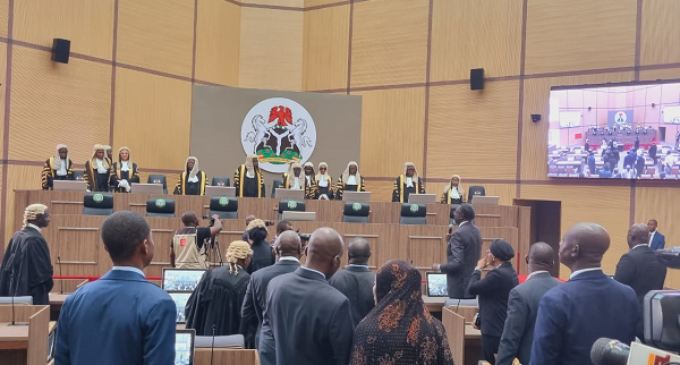
The Supreme Court has fined S.M. Danyaro, counsel to Mustapha Jokolo, N50 million for attempting to reopen the legal dispute over the Gwandu emirate stool through an application seeking a review of the apex court’s final judgment.
In a unanimous decision delivered on May 15, 2026, the five-member panel dismissed the application filed by Danyaro on behalf of his client, Jokolo, for being “frivolous and lacking merit”.
The Supreme Court judges on the panel are Uwani Aji, Ibrahim Saulawa, Emmanuel Agim, Chioma Nwosu-Iheme, and Jamilu Tukur (lead judge).
THE MATTER
Jokolo was the 19th Emir of Gwandu before he was deposed by the Kebbi State Government in 2005. Muhammadu Iliyasu Bashar was subsequently installed as the 20th Emir in June 2005.
Dissatisfied with the development, Jokolo approached the Kebbi State High Court.
Read Also:Supreme Court rejects Jokolo’s reinstatement, ends 19-year Gwandu Emirate dispute
In 2014, the Kebbi High Court ruled in Jokolo’s favour and ordered his reinstatement. The Kebbi State Government and Bashar appealed the decision.
In 2016, the Court of Appeal sitting in Sokoto upheld the lower court’s ruling. The appellants then took the matter to the Supreme Court.
In June 2025, the Supreme Court declared Bashar as the rightful Emir of Gwandu in Kebbi State, ending a 20-year legal battle over the traditional stool.
In a split judgment of three to two, the apex court ruled that Jokolo, who was dethroned in 2005, failed to follow due process before challenging his removal in court.
The apex court held that Jokolo’s case was filed prematurely because he did not submit a formal complaint to the Kebbi State Governor before heading to court, as required under section 4 of the Kebbi State Chiefs (Appointment and Deposition) Law.
THE APPLICATION FOR REVIEW OF THE SUPREME COURT JUDGMENT
In a motion filed on October 2025, Jokolo, through his counsel, Danyaro, asked the Supreme Court to review and set aside its judgment “on grounds of fraudulent misrepresentation of law and violation of constitutional provisions”.
The applicant also asked the apex court to constitute another panel to review the appeal filed by the governor of Kebbi State and others against the judgment of the Appeal Court.
Read Also:The Trials of Dasuki and Malami — A Study in Nemesis: What you do unto others- Yushau A. Shuaib
The applicant argued that the judgment of the Supreme Court was “procured by a fraud upon the court, stemming from the respondents’ misrepresentation of section 4(3) of the Chiefs (appointment & deposition) law, cap, 21, laws of Kebbi State, 1996”.
The applicant’s notice was brought pursuant to Order 20 Rule 4 of the Supreme Court Rules 2024, and Section 6 (6) B and 36 (1) of the Constitution of the Federal Republic of Nigeria, 1999.
Countering the application, counsel to the 1st to 13th respondents asked the Supreme Court to dismiss the application for review.
The respondents are the Governor of Kebbi State; Attorney-General, Kebbi State; Kebbi State Council of Chiefs, Gwandu Emirate Council; Abdullahi Umar (Wazirin Gwanda); Muhammad Sambo Aliyu (Magajin Rafin Gwandu); Aminullah Umaru (Magajin Gari); Muhammed Wanka (Sarkin Illo); Mainasara Zagga (Sarkin Zagga); Buhari Muhammad (Sarkin Aleiro); Mukhtar Abdullahi (Walin Gwandu); Ibrahim Bashar (Galadima Babba); and Aminu Ahmed (Sarkin Fada).
The respondents’ counsel argued that the focus of the review is not “seeking to contest a clerical error or accidental slip under the slip rule” but attempting to review and set aside the apex court judgment delivered On June 2025.
The respondents’ counsel argued that the decision of the Supreme Court is “final, binding, and not subject to review” and no constitutional and statutory provisions allow review.
Read Also:JUST IN: Supreme Court Dismisses APC’s Request To Review Zamfara Judgment
THE JUDGMENT
In the lead judgment for the application of review delivered by Tukur, the Supreme Court ruled that order 20, Rule 4 of the apex court is a “narrow procedural provision designed solely to preserve the accuracy and integrity of the Court’s judgments, not to reopen or reconsider them”.