STOCKHOLM, June 3 – After Ukraine said it will make the Gripen the backbone of its air force, the Swedish fighter jet is finally set to be tested in the role it was designed for: confronting Russia.
Ukraine has allocated €2.5 billion of a €90 billion European Union loan to buy 20 new Gripen E fighters and is also set to receive 16 older models donated by Sweden, a potent new asset to protect Ukrainian cities.
“We need these jets and for us this is really a new page for Ukraine,” President Volodymyr Zelenskiy said as he signed the deal with Swedish Prime Minister Ulf Kristersson at Uppsala airbase last week.
The deal, which may rise to 150 new planes, could see the Gripen face Russian opponents within a year, offering a first real combat test for a jet long praised for its capabilities but never proven in high-intensity warfare.
The Gripen first flew in 1988 and has been sold to countries including Brazil and South Africa. It has carried out surveillance missions and air policing while Thai Gripens skirmished with Cambodian forces.
“This will be something completely different, it will be a test against the systems that this aircraft is actually designed to face: Russia,” Lieutenant Colonel and Swedish Defence University lecturer Johan Huovinen said.
“It will be a test of Swedish technology in the end.”
RUGGED AND NIMBLE
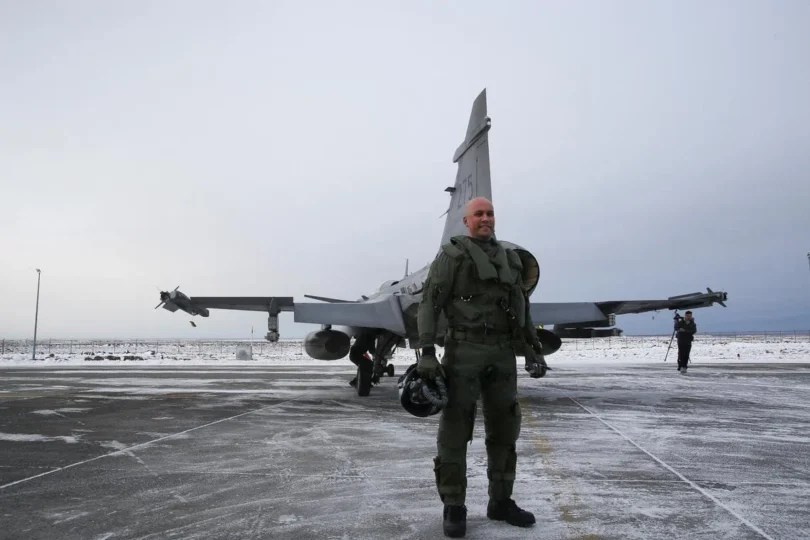
Gripens lack stealth capabilities and range compared to Lockheed Martin’s F-35, but also have key advantages. Designed to operate in a country under Russian attack, they emphasise rugged dependability in harsh conditions.
Swedish air force Squadron Commander Robin Arvidsson related how the design allowed all basic maintenance to be carried out while wearing gloves.
“Small details like that matter a lot when you are out in the field during winter,” he told Reuters as his squadron carried out NATO air policing in Iceland in March.
Whereas aircraft like the F-35 are designed to operate from the relative security of an airbase or carrier, Gripens can take off and land on any straight road, meaning they can be dispersed and harder to attack.
“Ukraine does not operate from intact NATO-standard airbases. We use dispersal airstrips, dirt runways, sections of highways, concealed positions across the country. The Gripen was designed for exactly this,” Oleksii Antoniuk, defence cooperation lead at Ukraine’s Ministry of Defence said in an email response to Reuters questions.
“A crew of six people, one trained technician and five conscripts, can refuel, rearm, and clear it for the next mission in under 10 minutes. No other aircraft in this class offers that combination.”
He also said that at $8,000 an hour to fly it, the Gripen operated at less than a quarter of the cost of flying an F-35, a crucial difference in a long-running war of attrition.
Its “Meteor” air-to-air missiles are well suited to forcing Russia to fly its own warplanes further away from the front, reducing the impact of the air-dropped glide-bombs that have become one of Moscow’s key offensive weapons, he added.
DRAWBACKS
Justin Bronk, senior research fellow for airpower and technology at the Royal United Services Institute in London, said the Gripen was excellent for dispersed operations and the right choice for Ukraine, but that there were limits to what it could achieve.
“It’s not going to have some transformative effect in terms of the Ukrainian Air Force’s ability to somehow establish total air superiority or anything, because the Russian ground-based air defence network … is still formidable,” he said.
A lack of stealth capability and lighter armament payload could also represent drawbacks, he added.
Production is another challenge.
Saab had 117 Gripen E fighters on order even before Ukraine said it wanted 20. The company can currently produce about 15 planes per year in Sweden and aims to ramp that up to 20 to 30.
The company has an additional production line in Brazil. But even taking that into account, experts say boosting output of such technologically advanced products is difficult, though Saab is confident about the prospects.
“We’ve started investments quite a while ago,” Saab CEO Micael Johansson told Reuters, saying collaboration with Ukraine on repairs, overhaul and spare parts was being looked at and local production might happen in future.
“Over time, with a big partner like Ukraine, that can happen, absolutely.”
SALES POTENTIAL
Funded by the Swedish taxpayer, the Gripen’s infancy was not without troubles, facing criticism for cost overruns and early crashes. It was dubbed “the world’s most expensive topsoil tiller” by Swedish media after a televised crash in 1989 where it spun off the tarmac and rolled violently in the dirt.
“At the time, we didn’t fully understand the benefits,” Huovinen said. “But today it looks like an investment that could deliver jobs and strong returns.”
Saab, whose shares have gained more than 850% since Russia’s invasion of Ukraine, is now looking at more potential sales, with Canada one of the countries looking at the Gripen.
“This deal is a benchmark that will lead to more countries not only buying Gripen, but also seeing Sweden as a competitive supplier of advanced systems,” Defence Minister Pal Jonson told Reuters. REUTERS