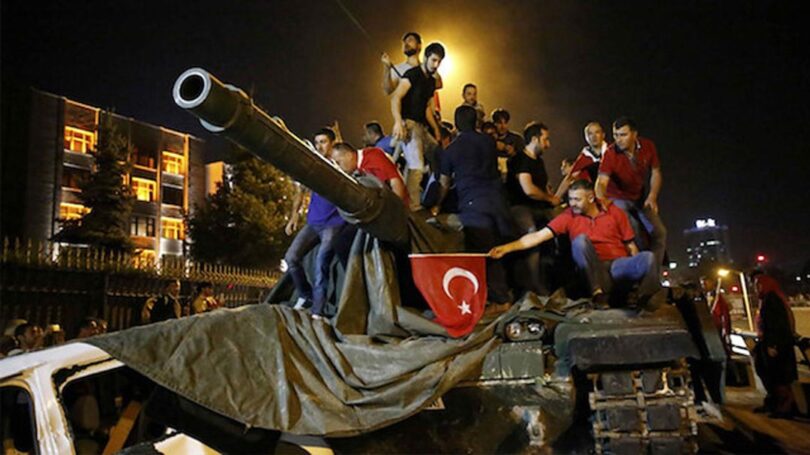
“This experience made me realise that Türkiye is not defined solely by its own borders; it occupies a vital position in global and regional geopolitics, and our responsibility is immense.”
Since then, Türkiye has expanded its influence across vast regions from Eastern Europe to the Middle East and Central Asia, even strengthening its ties with Libya, a North African state, and Somalia, a country with a strategic location in the Horn of Africa, thereby enhancing its defence industry.
Proud of him
Eyuphan Kaya is a retired teacher and a civil rights advocate from Diyarbakir, a predominantly Kurdish city in south-eastern Türkiye.
Since retirement, Kaya has written articles for local newspapers and has been involved in numerous social projects, including the current Terror-free Türkiye peace process, which aims to bring a peaceful end to decades-long PKK terrorism.
Kaya’s son, the 29-year-old Halil, a health worker, was about to get married on the night of 15 July 2016, but after he saw tanks rolling down the streets in cities from Istanbul to Ankara, he decided to call off the wedding, telling his fiancée that he needed to join anti-coup protesters in Diyarbakir.
“What he did was something I have been proud of from that fateful day until now,” the 63-year-old tells TRT World, referring to his son’s decision to cancel his wedding.
After the coup attempt was defeated, his son married his wife and has had two daughters since.
Like the Kaya family, most Kurds across Türkiye opposed the coup attempt, joining anti-putsch protests.
Kaya wrote many articles on July 15 explaining the Kurdish role and how it was instrumental in defeating the coup plotters. He says that the Islamic values shared by both Turks and Kurds were critical in his opposition to the coup attempt.
Awareness through art
Adem Donmez is a graphic designer and an academic in the Department of Fine Arts at Dumlupinar University. Over the past decade, he has used his work to help preserve the memory of July 15 through exhibitions and commemorative designs.
“After ten years, some memories of July 15 have faded, which shows that more needs to be done to keep that fateful night alive in people’s minds,” Donmez tells TRT World.
He has produced a number of designs commemorating the events of July 15 and says his university continues to mark the anniversary every year.
“We are doing our best to keep it alive at our university. We hold an exhibition on July 15 every year,” he says.
“While the coup attempt inflicted damage on Türkiye, it also exposed FETO, a notorious group with illicit connections. This helped Türkiye awaken to the group’s hidden agenda,” Donmez observes.
As an artist, Donmez continues to produce new works inspired by July 15.
“Compared to 10 years ago, I now produce more imaginative work,” he says, explaining that his earlier pieces were more realistic because the events of that night were still fresh in his mind.
A decade of memories and lessons
Muzeyyen Tasci, a 55-year-old writer, has spent much of her life advocating for Muslim causes and has been a vocal critic of Israel. For decades, she worked alongside Sule Yuksel Senler, one of Türkiye’s most prominent hijabi human rights advocates.
Related
Tasci views the July 15 coup attempt as a “deep” issue for Türkiye that must be understood from multiple perspectives.
“Their leader (Fetullah Gulen) had served Zionism for a long time,” Tasci tells TRT World, referring to the FETO leader, who died in October 2024 in Pennsylvania, US.
“They infiltrated some of Türkiye’s sensitive institutions, such as the army and judiciary, and launched this treacherous coup attempt on July 15. They also supported Türkiye’s post-modern coup against the Necmettin Erbakan-led conservative government on February 28,” she says, referring to the last successful military intervention in Türkiye in 1997.

Related
Tasci says the July 15 coup attempt was organised through both external and internal forces.
“While external forces have always had designs against Türkiye, internal dynamics led by FETO have made the whole nation deeply upset, inflicting so much pain across the country,” she says.
“Throughout ten years, we have continued to feel this enormous pain in our hearts,” she says. As a result, Tasci argues that the nation must not forget what happened on July 15, warning that forgetting could open the door for those who seek to repeat such an act.
“We need to keep its memories dear and warm, ensuring that future generations remember this fateful day. For a better future, this is crucial for all of us.”
From unease to resolve
Yakup Yagci, 54, works as an industrial and mechanical design manager for audio-electronic building communication systems. Originally from Türkiye’s western Aegean region, he has spent nearly two decades in the sector.
Yagci describes the July 15 coup attempt as a “scandal.”
He recalls waking up that morning with an uneasy feeling, prompting him to visit the burial site of Imam Birgivi, a prominent Islamic scholar, in Izmir’s Odemis district. He also persuaded members of his family to join him.
Throughout the day, they visited several historical and religious sites, including the tombs of leading figures of the Aydinogullari principality, which ruled parts of western Anatolia in the 13th and 14th centuries. They returned to their village in Alasehir, a district of Manisa province, in the evening.
“I was tired and wanted to get some rest. But my cousin called me and told me, ‘Warplanes are attacking Ankara.’ I was shocked,” Yagci tells TRT World.
After watching television coverage of the unfolding events, he left his home and joined fellow residents in the village square to follow developments throughout the night.
“I understood why I had that bad feeling in the morning,” he says.
“From that day until now, I have never forgotten how people from all walks of life — from conservatives to leftists — went out into the streets and ‘shielded themselves against that reckless tide’,” he says, echoing a famous line by Mehmet Akif Ersoy, the author of the Turkish national anthem.
“July 15 demonstrated the spirit of the Turkish people and their ability to unite at critical moments,” he says.
A father’s advice and a night of sacrifice
Mine Izgi, a 59-year-old family consultant, has spent years advising families. But on the night of July 15, she followed her visionary father’s advice and went outside to stand against the coup plotters.
“We rushed toward the night of July 15 — ready to be reborn or to die. Was it just us? Millions rushed… They flowed and surged like water yearning for its source; the lines ‘I am like a roaring flood; I trample my banks and overflow’ seemed to come to life,” Izgi tells TRT World, quoting another line from Mehmet Akif Ersoy’s poem, which became Türkiye’s national anthem.
She believes that above all else, the country owes a great deal to those who lost their lives on that night.
“The journey was arduous, but the destination is magnificent,” Izgi says, referring to the July 15 martyrs.
“They have departed for that magnificent place; for those left behind, all that remains is to meet them in our dreams and recognize that which transcends all else…”
“If we walk in peace toward the new day that rises after the sun has set, we owe it to them. Please, grant us your forgiveness…”