With its industrial achievements over the past two decades and its successes in global markets, the Turkish defence industry is writing a story of transformation that is likely to go down in global military history.
The figures speak for themselves: while the sector’s annual export volume was a mere $250 million in 2000, it reached $10 billion by 2025 – a fortyfold increase. This is a leap unparalleled in the Islamic world.
Today, Turkish defence products are no longer just simple military vehicles across a wide geographical range – from NATO members through Africa and Central Asia to the Far East – but strategic “security partners” to whom states entrust their future.
The recently held SAHA defence expo in Istanbul served as a global showcase of this technological rise.
Related
The event, which attracted around 150,000 visitors, resulted in a record contract volume of $26.5 billion. The fact that $8 billion of this went toward direct exports demonstrates that Türkiye has now become a hub for exporting entire ecosystems.
The country no longer simply produces individual components; it develops systems, designs software, and offers its allies turnkey defence architectures.
Breaking down entrenched dogmas on the battlefield
To understand that the success of the Turkish defence industry is not solely economic, one must consider the military transformation on the battlefield.
Operation Spring Shield in Idlib in 2020 marked a turning point in modern warfare.
For the first time, Türkiye deployed armed unmanned aerial vehicles (UAVs), fully integrated with electronic warfare systems like KORAL, as a primary offensive force against a conventional army.
This feat in the skies over Idlib demonstrated to the world that even heavily armoured units and modern air defence systems can be neutralised by drones within minutes.
This shattered the prevailing dogma that drones were only suitable for asymmetric conflicts or low-intensity counterterrorism operations.
Western military experts subsequently introduced a new concept into strategic literature, now known as the “Bayraktar Doctrine.” The most visible example of this doctrine was in Karabakh, where a 30-year occupation was ended in just 44 days.
The evidence for this doctrine on the battlefield has been steadily increasing ever since.
What began in Ukraine with the downing of a helicopter by a Bayraktar TB2 recently reached a historic climax in Sudan. The fact that an Akinci-TIHA destroyed another unmanned aerial vehicle with an air-to-air missile represents a first in world military history.
This event signals that Türkiye has effectively ushered in the era of the “unmanned interceptor” and changed the nature of air superiority.
This confidence in Turkish engineering has also led to profound changes on the global export map.
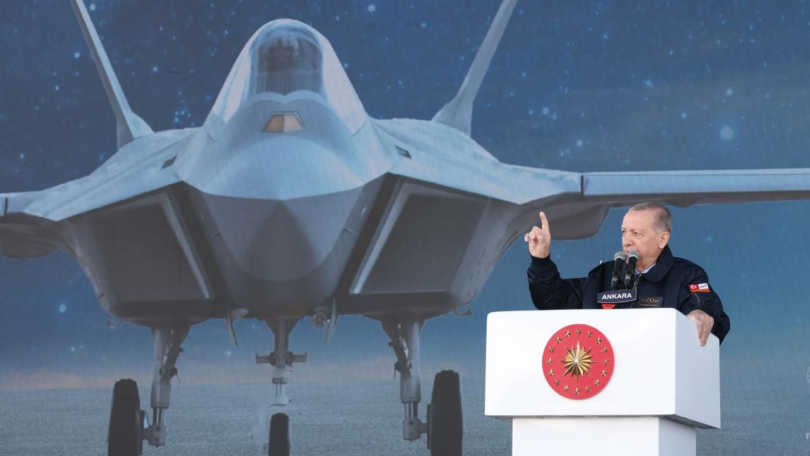
The fact that Spain, as a NATO member, imports the Turkish HURJET jet trainer and simultaneously expresses interest in a partnership on the fifth-generation KAAN fighter jet project underscores that Türkiye has now become a technological reference centre.