
LONDON – The crime Mr Alex Pikula reported to police was one they had heard before: An e-bike rider had zoomed past as Mr Pikula left a theatre in London’s West End, ripping his phone from his hands.
It was frustrating, Mr Pikula thought, but that was that.
He was wrong.
His mother soon started receiving strange texts, claiming to have her son’s emails and bank information. Then she received a video of a man brandishing a gun. Then came threats of sexual assault and death.
“I know who you are and where you live,” read one, full of obscenities and typos. “I’ve killed for far less than a phone before,” it went on. “We will see if you value your life over this phone.”
All of the messages wanted her to do one thing: unlink her son’s Apple ID from his stolen phone.
Mr Pikula knew the chances that police would recover his phone were slim.
A record 81,000 phones were reported stolen in London in 2024, the year Mr Pikula, 37, was visiting from Chicago. Even though that number fell to about 71,000 in 2025, the scourge of thefts – and the police’s struggle to stop it – has made both residents and tourists uneasy.
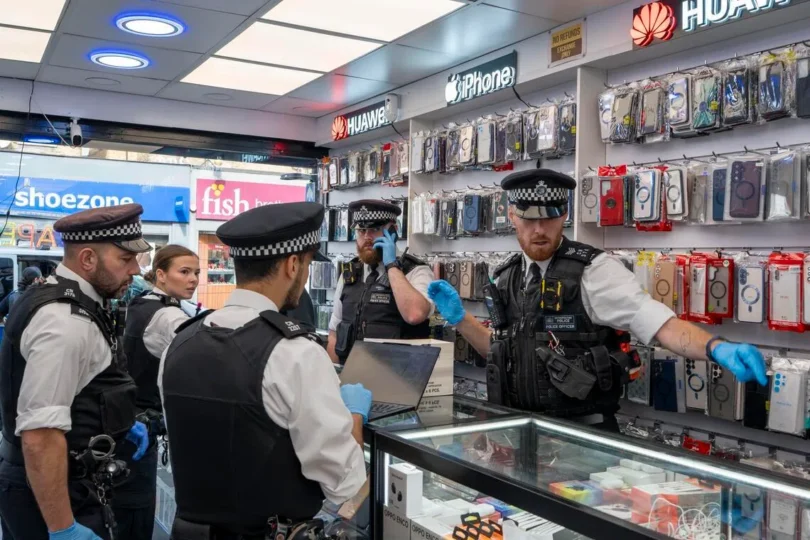
In 2025, London’s main police force, the Metropolitan Police, started focusing more on international networks that ship stolen phones to China, where the devices are sold on the black market.
There, the gangs can run into a problem. Unless unlinked from an Apple ID, they cannot reset the phone for a new buyer.
Mr Mark Rowley, the commissioner of the Metropolitan Police, told reporters that criminals were trying to reset phones to take a new user’s ID.
“That is what gives it secondhand value,” he said.
“Otherwise,” said Professor Emmeline Taylor of criminology at City St George’s, University of London, “that phone is almost worthless to them.” To criminals, she said in an interview, a phone bound to an existing Apple ID is good only for spare parts.
That is partly why police officials and experts urge victims to lock down and wipe stolen devices – without unlinking the ID – rather than meet their demands.
But for victims and their families, that advice can seem easier said than done.
The first confusing text to Mr Pikula’s mother, Ms Judi Pikula, appeared to come from Apple Pay.
Someone was trying to use the phone in China, it said. The Apple ID had to be unlinked for the safety of her son’s financial accounts.
Days later, a chirpy message arrived from another phone number, this one with the Philippines’ country code.
“Yo!!” it started.
The texter had recently bought the phone and could see, the sender said, Mr Alex Pikula’s “messages, emails, cards, bank, notes and personal information”.
A third message soon arrived, also apparently from the Philippines.
The phone, it said, would be “auctioned on the black market with your personal information and everything about you that you had on it”. It included detailed instructions on unlinking IDs.
“I told my mom, ‘Just ignore it,’” Mr Pikula said.
Mr Alex Pikula, displays a message in Chicago on Feb 13, that his mother received after he had his phone stolen while on a trip to London.
PHOTO: JOSHUA LOTT/NYTIMES
But Ms Judi Pikula, 65, was rattled. The Pikulas knew the texts were almost certainly coming from criminals. The Find My app showed his stolen phone in the Chinese city of Shenzhen, which victims call a common destination for stolen iPhones.
But Ms Judi Pikula was worried: Was there any real threat? “I just didn’t know what to think,” she said.
She was receiving the messages, Mr Pikula said, because he had set her number to be displayed through the phone’s “lost mode” function. He had unwittingly made her the point of call for thieves.
She tried to ignore the messages until she received a video of a man, wielding a gun, with a message threatening assault, rape and that her family would be “slaughtered”.
“I was freaking out,” she said. “I didn’t think they could do anything, but it’s pretty scary.”
So although Mr Pikula doubted the credibility of the threats, he decided to give in to the demands.
“I wiped it,” he said, “and they never texted my mom again.”
British police say that, because not everyone reports such threats, they have no way of knowing how many are sent. But they acknowledged that many people had received them, and six people described their experiences to The New York Times.
“Some of those messages were getting quite violent and quite nasty,” said Sergeant Dan Green, of the City of London Police.
Many extortionists appear to use the same pattern.
First, they try deception, often imitating official Apple text. Then, they pretend to be a sympathetic bystander. If that fails, the threats begin.
“They ramp up the levels to try to make the extortion work,” said Professor David S. Wall, a professor of criminology at the University of Leeds.
The tactics, experts said, play on the fears of victims who have lost one of their most expensive and sensitive possessions.
“Someone is holding all of your things that you hold dear in the palm of their hand,” said Associate Professor Elisabeth Carter, a British criminologist. “And they’re threatening you as well. It becomes this multifaceted psychological attack.”
Some gangs appear to use identical language, copying and pasting text, said experts and victims, who share their ordeals on internet forums.
But although the threats can be frightening, police officials and criminologists said they were almost certainly empty, made oceans away by thieves chasing quick profit.
Physical violence is “almost certainly not worth the gain of a single phone,” said Associate Professor Toby Davies, an expert on crime analysis at the University of Leeds.
Sending a text, on the other hand, is neither high-stakes nor difficult, and the payoff can be huge. “Even if only a small proportion of recipients comply and allow them to unlock, it would more than justify the effort,” he said.
Some victims, like Mr Christopher Bramah-Calvert, 40, dismissed the messages.
After his phone was stolen in London, his husband – whose number had been listed in “lost mode” – got the fake Apple text and the supposedly friendly advice. Then he received the gun video and death threats.
“We kind of looked at that and just thought, well, that’s ridiculous,” Mr Bramah-Calvert said.
But he recognised that others might feel differently. “Most people would look at it and feel more intimidated,” he said.
Mr Rowley, the police commissioner, and Mayor Sadiq Khan of London have said that they are pushing Apple to do more about stolen phones.
“Why can’t there be a kill switch so a stolen phone is useless?” Mr Khan said in an interview. “Why can’t you deny access to the cloud when a phone has been stolen?”
In a statement, Apple said it had created security features and protections to deter theft and protect users’ data. If an iPhone has been stolen, the company advises owners to put it into Lost Mode; remotely erase the device; and keep the device on the “Find My” list to prevent it being set up for a new user.
“We sympathise with people who have had this experience,” the company said, adding, “We will continue to work tirelessly to reduce the incentives for stealing Apple devices.”
As for the threats, they could be investigated under British law, Sgt Green said, as an offence of “malicious communications”, a crime that could carry a two-year jail sentence.
But only if they were sent from British soil. So in the case of a text sent from China, he said, “there wouldn’t be an awful lot we could actually do.” NYTIMES