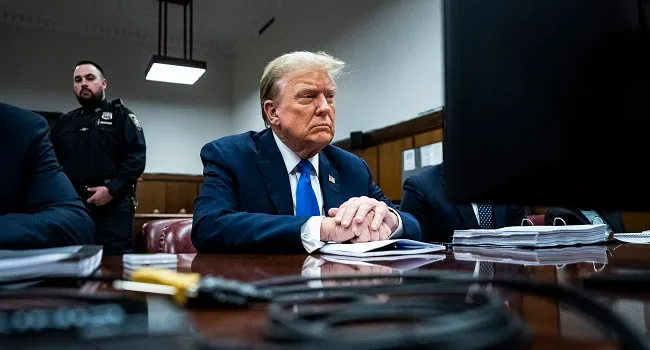
United States (US) President Donald Trump has lashed out at critics of his agreement with Iran, describing those who accused him of offering concessions to end the Middle East war as “fools.”
Naijaonpoint reports that Trump’s comments came on Thursday ahead of negotiations in Switzerland on the implementation of the deal, which was separately signed by him and Iranian President Masoud Pezeshkian.
Oil prices fell sharply after the agreement was announced, with the deal expected to lead to the reopening of the Strait of Hormuz and begin a two-month negotiation process on broader issues, including Iran’s nuclear programme.
In a sudden development after days of uncertainty over when the agreement would be formally signed, Trump put his name to the document in thick black ink during a candlelit dinner with French President Emmanuel Macron at the Palace of Versailles outside Paris on Wednesday.
Macron, who had hosted the G7 summit in France, shouted “bravo” as Trump signed the accord.
The signing at Versailles was seen as a major diplomatic moment for Macron, given the palace’s historical significance as the venue where the treaty that ended World War I was signed.
Hours after signing the deal, Trump took to social media to defend the agreement and attack those who accused him of not being tough enough on Iran.
“These fools, who think I haven’t been tough enough on Iran, when the Stock Market Just Hit A RECORD HIGH, and Oil prices are ‘tumbling’ down, are either jealous, bad people, or stupid,” Trump posted.
Iranian foreign ministry spokesman, Esmaeil Baqaei, confirmed that President Pezeshkian had also signed the agreement.
He said attention would now shift to whether the parties would faithfully implement the accord.
Baqaei said, “Now it is time to test the implementation of the agreement.”
The deal is expected to bring an end to the current US-Israeli conflict with Iran, which triggered five weeks of all-out war before a ceasefire in early April.
The conflict had led to major restrictions on shipping through the Strait of Hormuz, pushing up energy prices and raising concerns over global oil supplies.
Crude oil prices fell by more than three per cent on Thursday, extending losses recorded since news of the deal first emerged at the weekend.
The decline followed expectations that shipping through the Strait of Hormuz would resume, easing pressure on global energy markets.
Pakistan’s Prime Minister, Shehbaz Sharif, whose country helped mediate the agreement, said the deal “shall enter into force with immediate effect.”
He added that Iran “will instantly reopen the Strait of Hormuz.”
Sharif also signed the accord.
Naijaonpoint reports that a two-month negotiating period has now begun, with attention focused on the reopening of Hormuz and possible progress on Iran’s nuclear programme.
Washington has long suspected Tehran of concealing secret bomb-making ambitions, an allegation that has remained central to years of tension between both countries.
Macron hailed the deal as one “which allows for peace, the reopening of the Strait of Hormuz without tolls, and 60 days to conclude an agreement on nuclear, ballistic, and regional activities.”
However, there remained uncertainty over the next steps.
The accord had originally been expected to be signed on Friday at an exclusive mountain-top resort in Switzerland by Iran’s chief negotiator and parliament speaker, Mohammad Bagher Ghalibaf, and US Vice President JD Vance.
Baqaei later said an in-person ceremony was no longer needed.
Sharif, however, said an official ceremony would still take place on Friday in Switzerland, where technical talks would also commence.