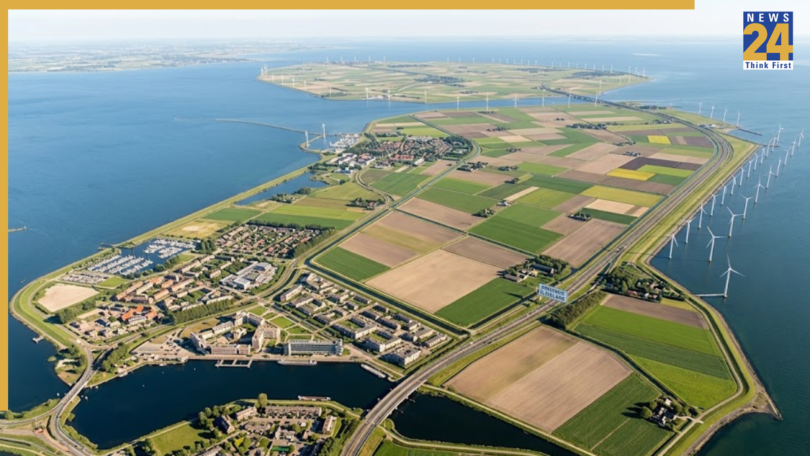
Did you know the world’s largest artificial island isn’t in Dubai or China? It’s Flevopolder in the Netherlands, spanning about 970 square kilometres and home to over 400,000 people. Created between 1919 and 1986 as part of the Zuiderzee Project, the land was reclaimed by draining seawater using an advanced system of dams and pumps. Located near Amsterdam, it stands as a remarkable example of how the Dutch transformed water into usable land to manage flooding and expand
World’s Largest Man-Made Island

2 / 6
Flevopolder in the Netherlands is the largest artificial island in the world, covering about 970 sq km (374.5 sq miles). It is home to more than 400,000 people and holds a Guinness World Record.
Location and Unique Feature

3 / 6
It lies in Flevoland province, about 30 km east of Amsterdam. It is surrounded by three freshwater lakes — Gooimeer, Ketelmeer, and Veluwemeer — which makes it a true island.
The Zuiderzee Project Vision

4 / 6
The project began in 1919 with the aim of reclaiming land from the sea for farming and living. It was one of the most ambitious engineering projects and took 67 years to complete.
How the Land Was Created

5 / 6
Engineers first built the 32-km Afsluitdijk dam in 1932, turning seawater into a freshwater lake (IJsselmeer). Then, billions of litres of water were pumped out. Eastern Flevopolder was formed in 1957 and Southern Flevopolder in 1968.
A Modern Province and Global Model

6 / 6
In 1986, Flevoland became the Netherlands’ youngest province. Today, it includes cities like Lelystad and Almere. Flevopolder is now seen as a model for countries facing rising sea levels, showing how land can be created from water.