
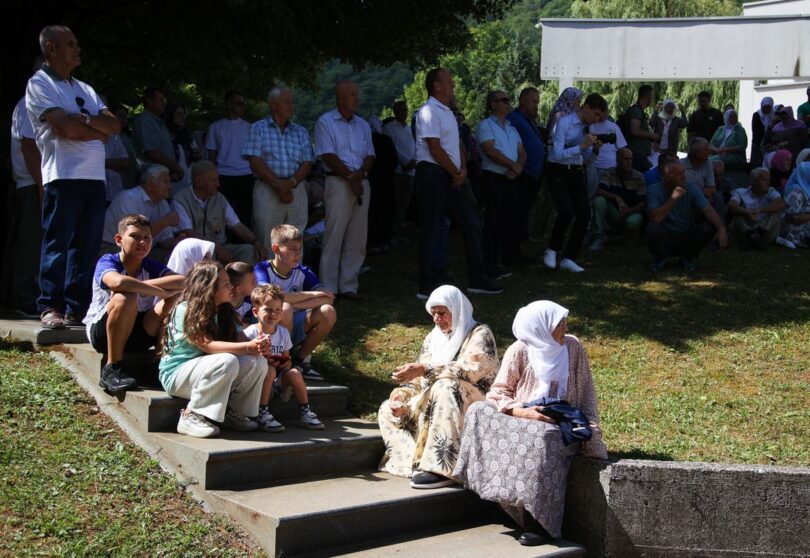
Thirty-one years after Bosnian Serb forces overran the UN-declared “safe area” of Srebrenica on July 11, 1995, triggering a massacre later recognised as genocide by international courts, the remains of more than 1,000 victims have yet to be found.
On July 11, 1995, Bosnian Serb forces led by convicted war criminal Ratko Mladic overran the UN-declared “safe area” of Srebrenica during the final stages of the Bosnian War.
Following the town’s capture, thousands of Bosniak civilians sought refuge at the UN base in Potocari, expecting protection from Dutch peacekeepers serving under the UN mission.
However, those who reached the base were later handed over to Bosnian Serb forces.
While women and children were allowed to pass into Bosniak-controlled territory, men and boys were systematically separated and executed in forests, warehouses, factories and other locations.
At least 8,372 Bosniak men and boys were killed.
To conceal the crime, victims were buried in mass graves, many of which were later reopened with heavy machinery and the remains dispersed among secondary burial sites, making identification significantly more difficult.
Over the years, forensic teams have often recovered bones belonging to the same victim from multiple mass graves, prolonging the identification process.
Related
International courts recognised genocide
The Srebrenica massacre was extensively examined in postwar international judicial proceedings.
Based on evidence presented before the International Criminal Tribunal for the former Yugoslavia (ICTY), the International Court of Justice (ICJ) ruled in 2007 that the killings in and around Srebrenica constituted genocide under international law.
Several senior Bosnian Serb officials, including military commander Ratko Mladic and political leader Radovan Karadzic, were convicted and sentenced to life imprisonment for genocide and other war crimes.