Advertisement
Advertisement
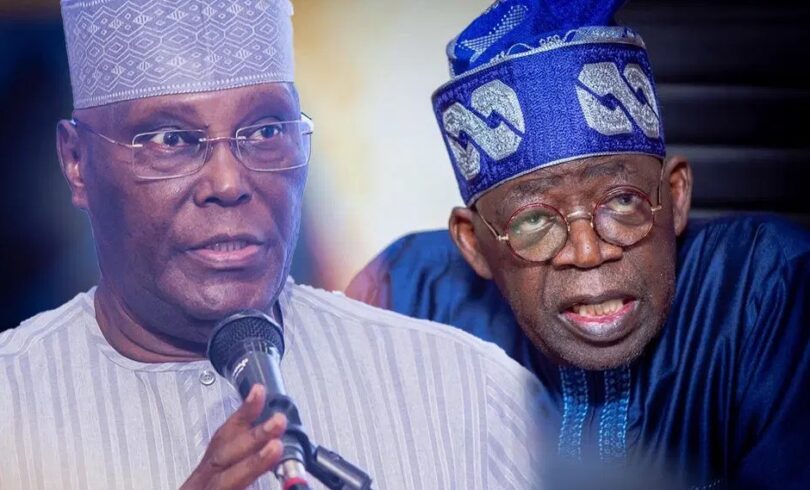
Former Vice President Atiku Abubakar has accused President Bola Tinubu’s administration of pursuing economic policies that encourage the export of Nigeria’s raw materials while worsening hardship for citizens and weakening local manufacturing.
Mr Atiku said the policies were causing Nigeria to export more raw materials even as manufacturers struggled with trillions of naira worth of unsold goods because consumers could no longer afford their products.
He made the allegation in a statement issued by his Senior Special Assistant on Public Communication, Phrank Shaibu.
“This is the painful paradox of Tinubu’s economy: the ships are leaving our ports full, but the pockets of Nigerians are empty,” Mr Atiku said.
“Government celebrates exports and trade surpluses while families are cutting meals, businesses are counting unsold stock and manufacturers are struggling to keep their gates open.
“You cannot build a $1 trillion economy by making your own people poorer.”
Mr Atiku cited figures showing that Nigeria’s raw-material exports rose by 106 per cent, from N1.86 trillion in the first half of 2025 to N3.84 trillion in the corresponding period of 2026.
He said the increase in exports was not necessarily evidence of economic prosperity, arguing that the composition of the exports was more important.
“There is nothing wrong with exporting. The problem is exporting the cheapest part of the value chain and buying back the expensive part,” he said.
According to him, Nigeria continues to lose potential wealth by exporting cocoa beans instead of processed cocoa products, hides instead of finished leather, cotton instead of garments and unprocessed minerals instead of refined products.
“When we export cocoa beans instead of cocoa butter, powder and chocolate, hides instead of leather products, cotton instead of garments and minerals without processing them, we are handing other countries the opportunity to make the real money from resources that came from Nigerian soil,” he said.
“That is not how prosperous nations are built. Nigeria must stop behaving like a loading bay for raw materials.”
The former vice president also cited the reported rise in unsold manufactured goods to about N2.14 trillion as evidence of what he described as the crisis of purchasing power under the Tinubu administration.
Mr Atiku said the figure reflected weak consumer demand, high production costs and rising prices.
“That N2.14 trillion sitting in warehouses is not just a manufacturing statistic. It is a picture of the Nigerian family,” he said.
“It means the mother who sees what she needs in the market but cannot afford it. It means the salary earner whose pay finishes on transport, electricity and food. It means the trader whose customers now price goods and walk away.
“Nigerians have not stopped needing these products. Tinubu’s economy has simply made them too poor to buy enough of them.”
Mr Atiku accused the administration of simultaneously hurting producers and consumers through rising production and living costs.
“Fuel is more expensive. Electricity is more expensive. Credit is expensive. Transportation costs have risen. The naira is weaker. Manufacturers pay more to produce, and families have less money to buy,” he said.
“That is why factory shelves are full while kitchen cupboards are empty.”
On Nigeria’s trade surplus, Atiku said although a positive trade balance was welcome, the country needed to pay greater attention to what it exports.
“A trade surplus is good news. But what are we selling?” he asked.
“If we remain heavily dependent on crude oil and raw commodities, then we are still exporting potential instead of prosperity.”
He said Nigeria should focus on exporting finished products, including chocolate, leather goods, textiles, pharmaceuticals, petrochemicals and processed foods.
“Our goal should be to export Nigerian chocolate, Nigerian leather products, Nigerian textiles, Nigerian pharmaceuticals, Nigerian petrochemicals and Nigerian processed foods — not merely the raw materials from which others make them,” he said.
Atiku also outlined aspects of his proposed economic recovery strategy, saying it would focus on making Nigeria more competitive for production through affordable long-term financing, industrial clusters, agro-processing, mineral beneficiation and targeted support for businesses that add value locally.
He said his proposed production-linked fuel subsidy would also be tied to domestic refining and measurable benefits to Nigerians.
His words: “No production, no subsidy. No domestic supply, no subsidy. No measurable benefit to Nigerians, no subsidy.”
Atiku further said his proposed $10 billion financing programme for young entrepreneurs and start-ups would support businesses operating in agriculture, manufacturing, processing, packaging, logistics, technology and distribution.
“This is how you create real prosperity. One factory should create opportunities around it. One processing plant should support farmers, transporters, technicians, retailers and young entrepreneurs,” he said.
He argued that increasing local production and processing would generate foreign exchange, reduce pressure on the dollar and strengthen the naira through increased productive activity.
“When we process more of what we produce, manufacture more of what we consume and export more finished Nigerian goods, we earn more foreign exchange, reduce pressure on the dollar and strengthen the naira from the productive side of the economy,” he said.
Atiku also criticised efforts to measure economic progress primarily through changes in national economic indicators.
“You cannot rebase your way to prosperity. A $1 trillion economy must be something Nigerians can feel in their salaries, their markets, their businesses and their homes,” he said.
He said his economic agenda would seek to reduce the cost of production and improve the operating environment for businesses.
“Our promise is simple: we will make it cheaper to produce, easier to do business, more rewarding to manufacture and more affordable to live,” Mr Atiku said.
“Tinubu made Nigeria expensive. Atiku will make Nigeria affordable again.”