
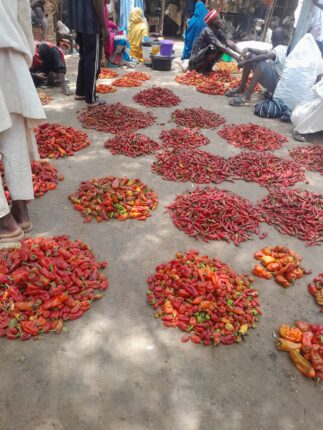
Traders and residents in Kano have raised concerns over the sharp increase in the prices of tomatoes, pepper and other food items at the popular Yankaba Market, barely a day to the Eid al-Adha celebration.
A visit to the market by SolaceBase revealed that the cost of essential cooking ingredients has risen significantly compared to the same period last year, with traders attributing the development to low local supply and heavy dependence on produce transported from neighbouring states.

Read Also: Low patronage hits Kano livestock market ahead of Eid el-Kabir
Chairman of the market, Mallam Rabiu Danladi, told SolaceBase that farming activities in Kano have been delayed due to the late rainfall season, forcing traders to source produce from outside the state, particularly Katsina.
According to him, the scarcity has greatly affected the price of bell pepper (tatase), which now sells between N70,000 and N90,000 per basket, compared to N30,000 to N35,000 recorded last week.
“The produce in Kano is very scarce, so we depend on neighbouring states for supplies. For instance, bell pepper is currently sourced mostly from Katsina State, and this has made it very expensive here,” he said.
Danladi noted that food items were far cheaper during last year’s Eid celebration and expressed hope that prices would reduce once rainfall intensifies and farming activities resume fully across Kano and neighbouring states.

Some traders who spoke with SolaceBase also blamed the rising prices on harsh weather conditions, poor harvests and the increasing cost of transportation.
Read Also
One of the traders, Sagir Ayyatu, said onion prices have also increased sharply. He explained that a small sack of onions, previously sold for N25,000, now costs N30,000, while a large sack has risen from N45,000 to N50,000.
Another trader, Abdulkarim A. Kawu, attributed the situation to excessive heat and lack of rainfall, which he said have caused many farm produce to spoil before reaching the market.
He added that despite the festive period, patronage has remained low because many residents can no longer afford the rising food prices.
“People still come to the market, but many leave without buying because of the economic hardship and the high cost of goods,” Kawu said.
SolaceBase observed that the usual pre-Sallah rush at Yankaba Market was largely absent, as many buyers were seen bargaining over prices before leaving without making purchases.
Traders, however, expressed optimism that prices would gradually decline once fresh harvests begin entering the market with the commencement of full farming activities in Kano State.
Full Details Here ➜