BEIRUT/DUBAI/NEW BRUNSWICK, New Jersey – US President Donald Trump said on June 7 he would tell Israeli Prime Minister Benjamin Netanyahu not to strike back after Iran fired a salvo of missiles at Israeli targets in retaliation for an attack on the outskirts of Beirut, news outlet Axios reported.
Iran has long said any peace deal with the US would depend on a ceasefire also holding in Lebanon, which Israel invaded in March in pursuit of Iran-backed Hezbollah fighters who fired rockets and drones across the border in solidarity with Tehran.
But Israel earlier on June 7 launched strikes in the Beirut area for the first time since the US announced a truce plan for Lebanon last week.
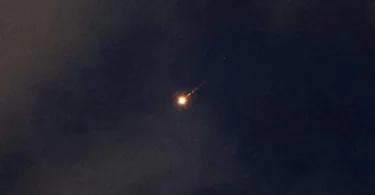
The Israeli military later said it had identified missiles launched from Iran and that its defence systems had intercepted them.
Details on whether Israel suffered any damage were not yet available.
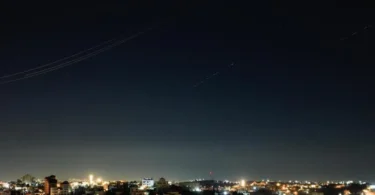
Iranian missiles fly in the sky over Israel on June 7, as seen from Hebron, in the Israeli-occupied West Bank.
PHOTO: REUTERS
Trump, who was spending the weekend at his golf club in Bedminster, New Jersey, had been briefed about the escalation between Iran and Israel, a US official told Reuters.
The White House did not immediately respond to a request for comment. “It’s certainly not going to help negotiations,” Trump told Fox News after the Iranian missile launches. “What I would suggest to Iran: You’ve shot your missiles, that’s enough, get back to the table and make a deal.”
Asked about the earlier Israeli strike on Beirut, he said: “I’m not happy about it.” Trump told Axios he would call Netanyahu and press him not to retaliate.
Iran’s chief peace negotiator, parliamentary speaker Mohammed Baqer Qalibaf, said US bases and Israeli assets are legitimate targets because of hostile acts including the “violation of agreements over Lebanon.”
“They showed that they only understand the language of power,” he wrote on X.
Ebrahim Rezaei, an influential hardline lawmaker who serves as spokesperson for the Iranian Parliament’s national security committee, posted on X that Iran would deliver a “decisive and painful response” to the June 7 Israeli strikes on Lebanon.
Iran has not targeted Israel directly since a ceasefire in the wider war in April, although Hezbollah has done so.
An Israeli official, responding to the apparent threat, told Reuters that Israel would retaliate against any attacks on its territory from Iran, and consider it “an opportunity to renew the campaign”.
Washington and Tehran have shown little progress in reaching a deal to end the war that Trump launched in February with a campaign of air strikes alongside Israel against Iran. Trump has repeatedly threatened to restart the strikes unless there is an agreement soon.
“We’re very close to a deal, or I’m going to blow the hell out of them,” Trump told NBC News in an interview, broadcast to mark 100 days of the conflict. The comments were recorded on June 5 and broadcast on June 7 as Trump visited his New Jersey golf course.
Trump has leaned on Israel to scale back its campaign in Lebanon to allow room for a peace deal with Iran, including rebuking Netanyahu with obscenities in a phone call last week. After the call, Netanyahu called off air strikes on Beirut and agreed to the latest truce plan with the Lebanese government.
But Israel has never fully halted its Lebanon campaign, which has killed thousands of people and driven hundreds of thousands from their homes. Hezbollah, which was not party to the truce and would be dismantled under its terms, has also continued its attacks and says it will not give up its weapons unless Israel halts fighting and withdraws.
Netanyahu said the Israeli strikes on June 7 on Beirut’s southern outskirts, a district known as Dahiyeh that has long been a Hezbollah stronghold, were ordered in response to Hezbollah firing toward Israel.
The Israeli military earlier said it had intercepted two projectiles fired over the border. It issued an evacuation order for the southern Lebanese city of Tyre and surrounding areas ahead of possible strikes there.
Elsewhere in Beirut on June 7, mourners held a military funeral for Brigadier-General Wissam Sabra, a senior military officer killed in a strike on his vehicle in south Lebanon on June 6.
The wider war has been stalemated since the US and Israel paused their attacks on Iran in early April, with Tehran blocking most shipping through the Strait of Hormuz, the main transit route for Middle East oil. Washington has imposed its own blockade of Iranian ports.
Though Washington and Tehran have said they are close to a preliminary agreement that would reopen the strait, they have repeatedly traded strikes, with escalations in recent days that have included attacks on nearby Arab states hosting US bases.
US forces struck Iranian coastal radar sites in Goruk and Qeshm Island, both in the strait, early on June 6 after shooting down drones launched by Iran that US Central Command said posed a threat to maritime traffic. Two more Iranian attack drones that were threatening shipping in the strait were shot down, the US military said late on June 6.
Iran’s Revolutionary Guards said they retaliated against US bases in Kuwait and Bahrain. Kuwait’s army said it engaged seven ballistic missiles that passed over residential areas, resulting in material damage but no casualties.
Trump has said any agreement to end the war must prevent Iran from developing a nuclear weapon, and he is under pressure to deliver terms tougher than those agreed in 2015 under then-President Barack Obama in a deal Trump later repudiated.
Tehran’s demands include the lifting of US and international sanctions, recognition of its sway over the strait and the release of billions of dollars in frozen assets.
A source familiar with US plans told Reuters on June 6 that Washington could make Iranian assets available to Gulf neighbours to repair damage inflicted by Iran.
Iran’s Deputy Foreign Minister Kazem Gharibabadi said on June 7 any such diversion of Iranian assets would be illegal, and Tehran would take measures in response. REUTERS