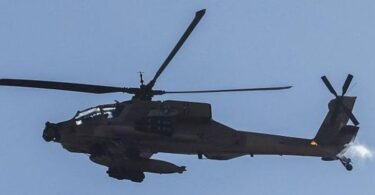
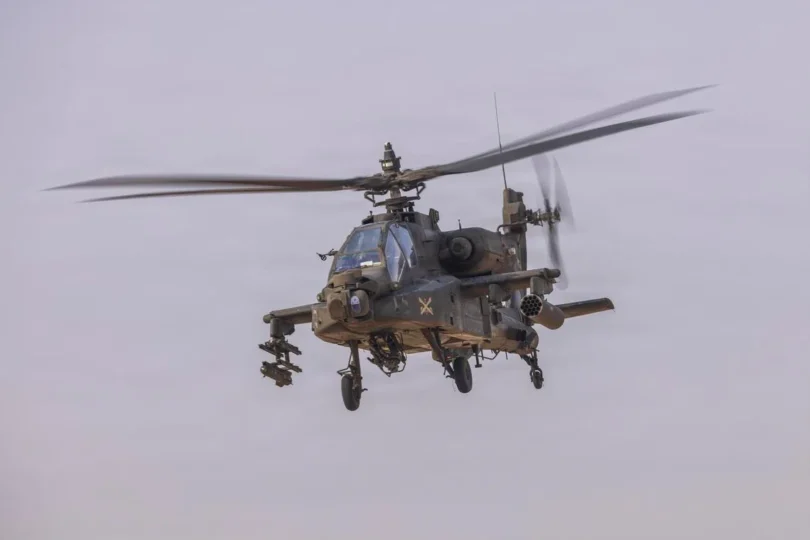
WASHINGTON/BEIRUT/DUBAI – US President Donald Trump said on June 9 that Iran had shot down a US Apache helicopter that was patrolling the Strait of Hormuz overnight and vowed to respond, deepening doubts about prospects for a truce announced in April in the war in the Gulf.
“I have just been informed by our Great Military that last night the Iranians shot down one of our highly sophisticated Apache Helicopters while patrolling over the Strait of Hormuz,” Trump wrote in a social media post.
He said the two US pilots involved in the incident were both safe and uninjured.
“Nevertheless, the United States must, of necessity, respond to this attack,” he added.
The episode adds further strain to efforts to broker a peace deal to end the wider Middle East war and reopen Hormuz, a vital conduit for international trade in energy and other commodities.
In remarks earlier on June 9 about the downing of the Apache, Trump said the two pilots were “fine” following their rescue, but made no comment about what brought the Apache down.
A US Navy surface drone found and rescued the two crew, the US military told Reuters. US Central Command said the AH-64 Apache went down at around 3am on June 9 (7am in Singapore).
On June 8, Israel and Iran said they would halt attacks on each other after an appeal by Trump to end their first direct exchanges of fire since April, but Tehran warned it would resume hostilities if Israel continued to attack its ally Hezbollah in Lebanon.
In Tehran, two Iranian air defence personnel killed in Israeli strikes on June 8 were due to be buried on the afternoon of June 9, Iran’s military said. No deaths were reported in Israel after the Iranian strikes.
In a parallel conflict, Israel struck the historic port city of Tyre in southern Lebanon on June 9, killing at least eight people. It was the deadliest strike on the city since fighting erupted in Lebanon in early March, when Hezbollah launched rockets at Israel in support of Tehran after Israel and the United States began their war against Iran.
Israel had issued an evacuation order for the city earlier on June 9. Residents fled and civil defence teams transported elderly residents into temporary shelters, state media reported. The eight victims were killed in a single strike on the city’s eastern edge, Lebanon’s health ministry said.
A video verified by Reuters showed debris strewn across a road at the site of the attack.
Israel’s refusal to end its campaign in Lebanon, as Iran demands, has hindered Trump’s efforts to extend a tenuous ceasefire in the wider US-Israeli war with Iran into a durable settlement.
Trump told reporters in earlier remarks he might have “an idea” for an Iran deal within a few days, without elaborating. The Republican president, struggling with record-low approval ratings as November’s midterm elections approach, has often hinted at an imminent deal with Tehran, but none has yet materialised.
US and Israeli officials said Trump and Israeli Prime Minister Benjamin Netanyahu had spoken on June 8.
In an interview with Axios, Trump said he had warned the Israeli leader not to return to war with Iran: “I said, ‘Bibi, you better be careful, or you will be on your own very soon’.”
However, Israel’s military chief Eyal Zamir said on June 9 that the attack Israel carried out against Iran the previous day was “in preparation for a much more significant and heavy blow”.
“We are prepared to return and deliver another severe and deep strike against Iran,” he said, during a visit to training exercises in northern Israel.
Tehran has long said any peace deal with Washington depends in part on an end to fighting in Lebanon, which Israel invaded in March in pursuit of Hezbollah fighters who had fired across the border.
In northern Israel on June 9, Israeli troops operating in the Ramim Ridge area close to Lebanon’s border killed one person in an incident in which they returned fire, the military said.
Israel has never halted its Lebanon campaign, which has killed thousands of people, saying the conflict should be treated separately from any US-Iranian ceasefire. Hezbollah has also continued its attacks.
At the same time, Tehran has continued to block most shipping through the Strait of Hormuz, which before the war carried a fifth of the world’s crude oil and liquefied natural gas. Washington has imposed its own blockade of Iranian ports.
US Energy Secretary Chris Wright said on June 9 that ship traffic through Hormuz is rising “very meaningfully”, but added it would take many months to get back to normal flows of energy once the war is over.
Trump has said any peace deal must ensure Iran cannot develop a nuclear weapon. Iran’s demands include the lifting of international sanctions, the release of billions of dollars in frozen assets and recognition of its control of the strait. REUTERS