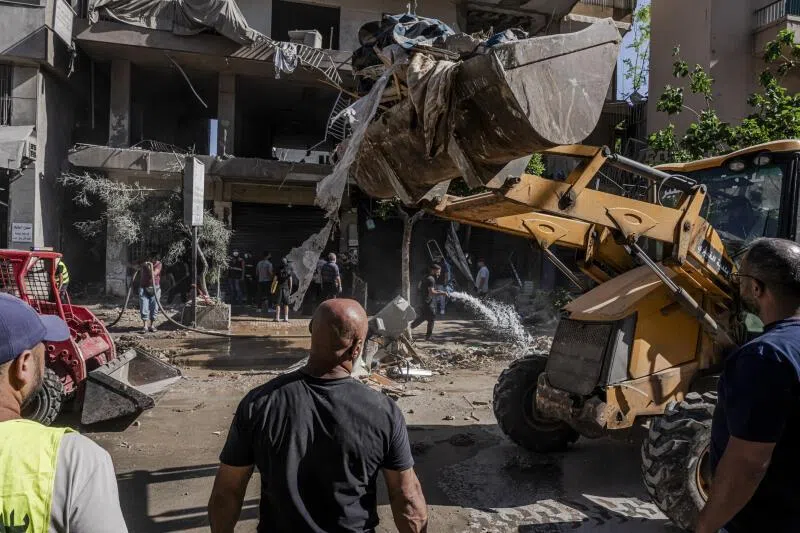
DUBAI/WASHINGTON – Donald Trump said an Israeli strike on Beirut “should not have happened” after it triggered a strong protest from Iran, casting doubt on the US president’s pledge that a peace deal would be signed on June 14.
The attack does not appear to have entirely dashed hopes for an accord, however, with both sides signalling channels of dialogue were still open, and Trump maintaining a deal was still “close”.
Tehran has repeatedly insisted that any agreement to halt the war must include the parallel conflict in Lebanon, where Israel has been pursuing a campaign against the Iran-backed movement Hezbollah.
But after days of momentum building towards a deal, the strike in Beirut’s southern suburbs on June 14 – a Hezbollah stronghold – prompted Iran’s chief negotiator to question the point of continuing peace talks.
The attack “showed that the United States either lacks the will to implement its commitments or lacks the ability to do so”, Iranian Parliament speaker Mohammad Bagher Ghalibaf said on X.
“If you do not have the will or the ability to fulfil your commitments, then there is no point in talking about continuing down this path,” he added.
Trump – who over weeks of negotiations has repeatedly declared an accord with Iran was all but concluded – said after the attack that a deal was still at hand, urging those involved not to “blow it”.
“We are very close to a Deal that will bring peace to the region, including to Lebanon, and all sides should stand down,” Trump said on social media.
“This morning’s attack on Beirut should not have happened, particularly on a special day,” he added, possibly a reference to his hopes of a signing on June 14, his 80th birthday.
The last time Israel hit the Beirut suburbs, it sparked one of the strongest jolts yet to an April ceasefire, with Iran firing off a retaliatory missile barrage and Israel responding with strikes.
Iranian Brigadier-General Mohammad Jafar Asadi said on June 14 that the latest Israeli attack “will not go unanswered”.
Israel’s military, meanwhile, said it was “preparing for potential fire toward the territory of the state of Israel in the coming hours”.
In a sign that a diplomatic off-ramp was still available, Iran’s president said on June 14 that the country’s highest security body supported negotiations despite criticism from hardliners.
“The Supreme National Security Council has concluded that the path of dialogue should be pursued,” President Masoud Pezeshkian said, pointedly adding that the council was in charge of “decisions regarding war and negotiations”.
US Defence Secretary Pete Hegseth said he did not expect the Israeli attack to “disrupt” the progress towards a deal.
“From all I know, we are on track,” he said. “It is not a matter of if. It is a matter of when.”
A delegation from mediator Qatar was in Tehran on June 14 “to help facilitate the finalisation of the agreement”, a diplomat with knowledge of the situation told AFP.
A flare fired by the Israeli military lands over the highlands of the area of Ali al-Taher as seen from nearby Marjayoun in southern Lebanon on June 14, 2026.
PHOTO: AFP
Iran’s Fars news agency, citing “a source close to Iran’s negotiating team”, reported that Iran was conveying its detailed position to the Qatari team, though the timeline for sealing a deal remained an open question.
“Even if all of Iran’s views are incorporated, no agreement will be signed within the timeframe announced by Trump,” the source was quoted as saying before the Israeli strike.
The warring parties have released conflicting information about the contents of the deal, as each seeks to show it emerged from the war with the upper hand.
Tehran has insisted it will maintain control over the vital Strait of Hormuz, but the US has repeatedly said this would be unacceptable.
Since imposing a blockade on the strait early in the war, Iran has demanded vessels obtain permission before transiting the waterway, and has established a new body to oversee it and collect tolls.
The US has responded with its own blockade of Iranian ports.
Iran’s Foreign Minister Abbas Araghchi had said on June 12 that the deal on the table called for the lifting of the US blockade.
Another key sticking point in the talks has been the fate of Iran’s nuclear programme, particularly its stockpile of highly enriched uranium – believed to have been buried by US strikes in 2025.
Iran has long insisted its nuclear programme is peaceful, but Western governments suspect it of seeking a bomb.
Araghchi on June 12 said the only way to deal with Iran’s enriched uranium “is to dilute it inside Iran”.
Trump, who has justified the war as necessary to prevent Iran from obtaining nuclear weapons, previously said the US would remove and destroy the uranium.
On June 13, he said: “When all is calm, we will go in and get the Nuclear Dust… and downblend and destroy it, whether in Iran or the United States.” AFP