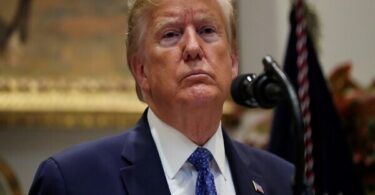
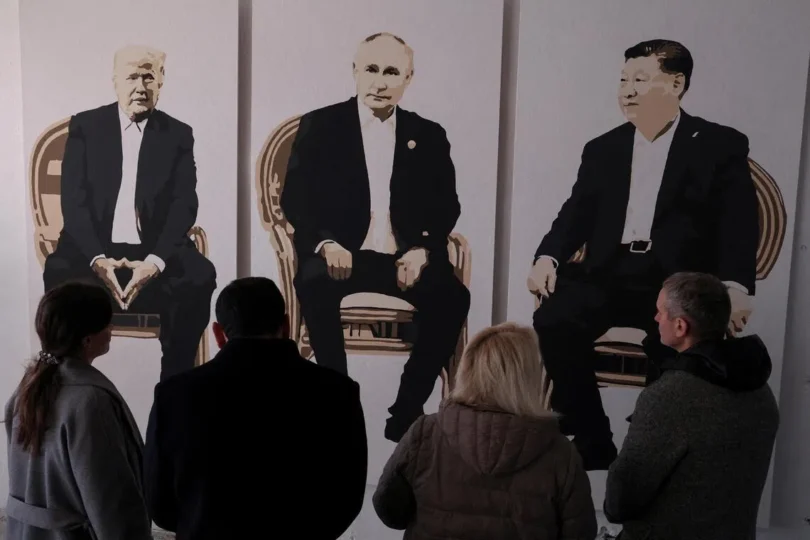
WASHINGTON – When US President Donald Trump gave thanks to those who had helped him reach an initial ceasefire agreement with Iran, he praised two world leaders he has called his friends – Xi Jinping of China and Vladimir Putin of Russia.
The leaders, he said, had aided the Americans in sealing the deal with the Iranians, or at least had helped set the conditions by not sending oil and gas tankers or other commercial ships through the Strait of Hormuz to compromise a US naval blockade aimed at pressuring Iran.
“He was a total gentleman,” the American president said of Xi in an interview with The New York Times on June 14, as he was celebrating his 80th birthday with a dinner and a UFC cage match on the South Lawn of the White House. “He didn’t send a tanker, along with 20 destroyers on each side of it, to try and break up the blockade.”
The White House did not reply to a request for comment on June 15 on what Trump meant when he said Xi and Putin had helped the Americans and Iranians reach the initial agreement. The US State Department referred questions to the White House. The Russian Embassy in Washington did not respond to a request for comment.
The Chinese Embassy also did not send a reply but responded after this article was published on the afternoon of June 15. It said in a statement that Xi had put out a declaration with four principles for Middle East peace and that China “has been working tirelessly for the end of fighting and peace”.
In recent months, Trump has embraced China as a partner. He had to retreat from a trade war with the country in 2025 after retaliation by the Chinese government, and he subsequently praised Xi as a tough negotiator.
He has also been trying to improve relations with Moscow, though Putin has resisted the American president’s efforts to get Russia and Ukraine to accept a settlement to end the full-scale Russian invasion that began in 2022. Trump and Putin spoke by phone on June 14.
Trump flew to Beijing in May for a summit and a state banquet hosted by Xi, the world’s most powerful autocrat. The two talked about trade, Taiwan and the war against Iran. Trump left gushing about Xi and said the two superpowers would form a “G-2” partnership. “It’s the two great countries,” he told Fox News.
China is Iran’s most powerful partner and the biggest buyer of oil from the country. China has worked in its own interests and acted with caution during the war. It has prodded Iran to continue negotiating with the US, even when the mediated talks seemed to flag.
At the same time, some Chinese companies have tried sending weapons to Iran, including shoulder-fired missiles, known as MANPADS, the US State Department said. On June 10, the State and Treasury departments announced sanctions against Chinese-run or Chinese-linked companies that they said were trying to send weapons to Iran.
The State Department list included Armory Alliance, which the agency said is a Belarus-based entity that has “acted as an intermediary between China-based companies and Iran”.
The group, it said, “has been involved in facilitating the purchase of hundreds of man-portable air-defence systems (MANPADS) and their shipment from China to Iran, including attempting to route the shipments through third-party countries and obfuscating their origin and true end user.”
Trump has not acknowledged those actions by Chinese companies.
The moves do not amount to deep support by China for Iran during the war, in contrast to the way China has supported Russia in its years-long invasion of Ukraine by providing critical supplies to Russian defence companies and weapons makers.
Like China, Russia has been trying to position itself as a diplomatic back channel in the war. A partner of Iran, it has hosted Iranian diplomats in Moscow and spoken with US officials.
It has also given Iran targeting information useful for attacks on US bases in the Middle East, US officials said. As with China, Trump has made no mention recently of this or other anti-American actions on Russia’s part.
China recently arrested a US citizen, U Min Zin, on the rare charge of spying, less than three weeks after Trump met with Xi in Beijing, the Times reported on June 11. Around June 3, Min Zin, who studies Myanmar politics and foreign policy, disappeared in Kunming, the capital of Yunnan province. US diplomats visited him in a detention centre on June 12. Trump has not publicly spoken about the arrest.
On June 15, John Moolenaar who serves as the chair of the House Select Committee on China, denounced the arrest.
“China should immediately release Min Zin, an American citizen it has unjustly detained on absurd charges,” he said. “American companies should take note that this is how China treats innocent Americans and stop any work they are doing that supports China’s military and oppressive surveillance state.” NYTIMES
This article originally appeared in The New York Times.