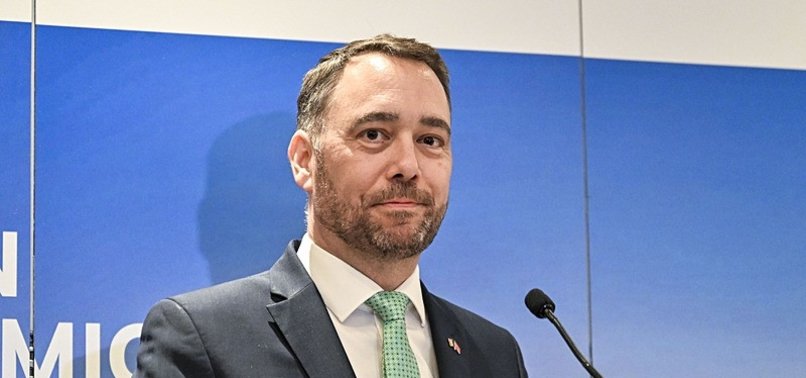
Belgium views Türkiye as a key strategic NATO ally and the “guardian of the southeast flank of the European continent,” Belgian Foreign Minister Maxime Prevot told Anadolu on Monday.
Speaking in response to Anadolu’s questions during a press briefing in Istanbul, Prevot said Türkiye’s geopolitical position and military capabilities make it an indispensable partner for Europe and NATO.
“You are the guardian of the southeast flank of the European continent. Of course, we consider that Türkiye, as the second-largest army within NATO, is really a strategic partner,” he said.
Prevot also praised Türkiye’s long-term investments in defense, noting that Ankara has significantly increased military spending over the past decade.
His remarks came after Anadolu asked whether Türkiye could play a greater role in strengthening European defense at a time when US President Donald Trump has repeatedly raised the possibility of reducing or relocating American troops stationed in Europe.
Prevot said Belgium was not currently concerned about a possible US military withdrawal from the continent, adding that Washington’s strategic reorientation has been discussed for years.
“We know for a long time that the US rightly imagines organizing differently its military presence within the European continent, taking into consideration all parts of the world,” he said.
“I think something like that would be negotiated and discussed with the other governments,” he added.
The Belgian minister also said his country is committed to increasing military spending after reaching NATO’s 2% of GDP benchmark last year.
“We will continue to invest because we would like also to continue to be a reliable partner within NATO,” he said.
On Türkiye-EU relations, Prevot said Belgium supports revising the Türkiye-EU Customs Union, arguing that the current framework no longer reflects present-day economic realities.
“It doesn’t make sense to manage economic issues in 2026 with an economic framework of three decades ago,” he said, referring to the agreement signed in 1996.
He said the current deal focuses mainly on goods while failing to adequately address services and modern dispute resolution mechanisms.
“That’s a big asset for Türkiye, but also for the EU,” Prevot said, adding that Brussels and Ankara should move “faster and further” to update the framework.