Washington, DC — Every World Cup produces at least one or two teams that arrive outside the circle of favourites and leave with the tournament’s biggest story.
For example, in the last four World Cups and earlier editions, lesser-known or underestimated teams unexpectedly defeated favourites to progress, causing major upsets.
In the 2010 World Cup, played in South Africa, the Asamoah Gyan-inspired Ghana reached the quarter-finals. The Black Stars became the first African side to reach the last eight on home soil but ultimately lost on penalties to Uruguay after Luis Suarez’s infamous handball.
The 2014 World Cup in Brazil saw Costa Rica reach the quarter-finals. Considered outsiders in a “group of death” alongside Italy, England and Uruguay, they topped their group undefeated and defeated Greece before losing to the Netherlands in a penalty shootout.
Similarly, in 2018, Croatia finished as runners-up in the tournament held in Russia. Their run to the final included a penalty shootout win over Russia and a dramatic semi-final victory over England, before they were defeated 4-2 by France in a hard-fought final.
At the 2022 World Cup in Qatar, Morocco reached the semi-finals, becoming the first African team to do so. They topped a group containing Belgium and Croatia, and subsequently eliminated Spain and Portugal before losing to France.
With the 2026 FIFA World Cup being co-hosted by the US, Canada and Mexico, the debate over potential dark horses has become one of the tournament’s most intriguing subplots.
With the field expanded to 48 teams and an additional knockout round, analysts suggest the structure could enable well-organised teams to progress further in the tournament.
However, when discussing potential dark horses, a few more things aside from the quality of the squads need to be considered.
Ali Maher Helmy, a football journalist and pundit, tells TRT World that the groups of these potential dark horses and their possible pathways in the knockout stage are as critical as the quality of their squads.
Helmy says Türkiye and even Algeria could stage an upset and become this World Cup’s dark horses. Other experts, such as Tom Matson, features editor at GOAL, argue that Colombia could have a good run, while football writer Amee Ruszkai tips Switzerland and Ecuador as potential dark horses.
The 48-team 2026 format could through even more surprises.
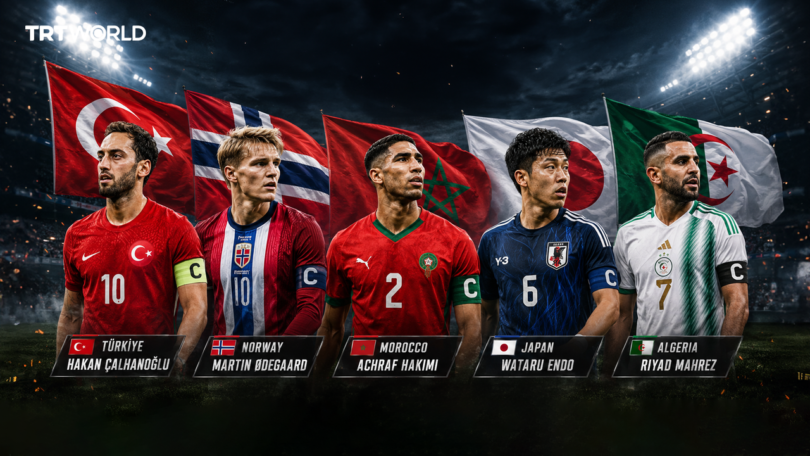
TRT World has spotlighted the teams with the strongest chances of winning the World Cup. Here are the dark horse sides expected to throw up major surprises throughout the tournament.
Türkiye
Türkiye are one of the teams with the strongest prospect of making a deep run in the tournament.
Türkiye are in Group D, which includes host nation USA, Australia and Paraguay.
The Crescent Stars have young talents and veterans who can carry them far in the tournament. Analysts say this generation is more talented than the 2002 semi-finalists.
Their top names are Real Madrid’s Arda Guler, Juventus’ Kenan Yildiz, and Inter Milan’s Hakan Calhanoglu.
Assuming Türkiye top their group, they will face the third-placed team of Group B (Canada, Bosnia, Qatar and Switzerland), Group E (Germany, Curacao, Ivory Coast and Ecuador), Group F (Netherlands, Japan, Sweden and Tunisia), Group I (France, Norway, Senegal and Iraq), or Group J (Argentina, Jordan, Algeria and Austria) in the Round of 32.
If they end up as runners-up, they will face the runners-up from Group G (Belgium, Egypt, New Zealand and Iran) in the Round of 32.
The possibility of Türkiye avoiding one of the World Cup favourites in the Round of 32 is high, which could give them the chance to go far in the tournament.
Related
Norway
Norway’s team is also considered a dark horse in the tournament.
Norway’s star players are Manchester City’s Erling Haaland and Arsenal’s Martin Odegaard. But another key player is RB Leipzig’s winger Antonio Nusa.