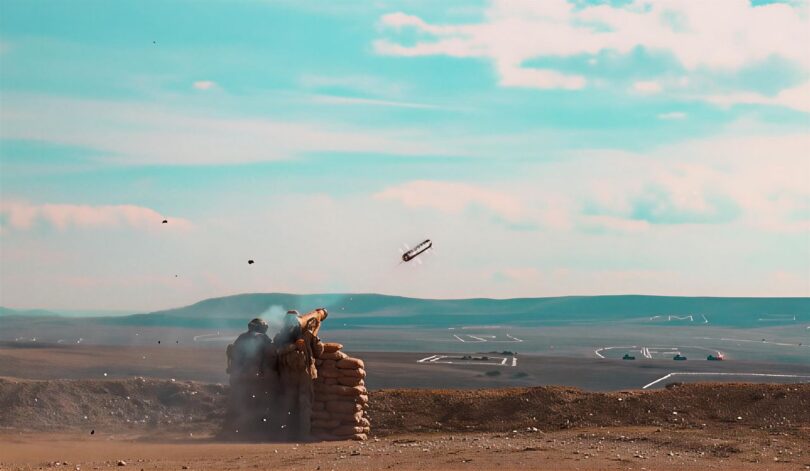
When Turkish defence giant Roketsan completed the test-firing of its short-range anti-tank guided missile Karaok, it marked yet another milestone in the country’s efforts to achieve self-reliance in the military sector.
Roketsan simulated four different battlefield scenarios with the Karaok – which means black arrow – “achieving direct hits” each time.
“Fearless, certain to hit,” wrote Roketsan CEO Murat Ikinci on social media, highlighting the power and accuracy of Karaok.
Key firing results included direct hits at ranges of 76 and 400 metres, while top-attack strikes were carried out at 1,400 and 2,050 metres. This confirms the system’s flexibility in engaging diverse targets across different engagement scenarios.
According to Defence Turk, Karaok is classified as a short-range, man-portable anti-armour missile in the ‘fire-and-forget’ category. It is operated by a single soldier and can function day or night thanks to its infrared-seeking head.
The system weighs less than 16 kilograms, measures approximately 110 centimetres in length, and features foldable, cruciform wings and fins that enhance its portability and manoeuvrability.
The missile is equipped with a tandem (dual) warhead capable of defeating reactive armour, as well as a locally developed two-stage hybrid rocket motor (launch phase and flight phase) designed to permit firing from enclosed spaces.
The system offers a variety of engagement modes, including lock-on before or after launch, and the ability to execute direct or top-attack strikes targeting the weakest points of armoured vehicles.
Karaok made its mark in the export market in 2023 after winning a tender issued by the Malaysian Ministry of Defence, which required compliance with NATO standards.
Under the agreement, the Malaysian Army will be supplied with 18 launchers for the system, complete with missiles, to replace the Russian Metis-M systems currently in service.
Related
Tactical significance
Defence analyst Teoman E. Nijanci from the military news portal Army Recognition believes that the tactical importance of the recent test series extends beyond the accuracy of the hits.
It also lies in the nature of the scenarios in which the weapon was tested, which combined close-range engagements with different attack profiles.
The hit achieved at 76 metres is not merely a numerical result; it reflects testing the system in sudden, close-quarters engagement conditions — the most complex and dangerous environment in armoured combat, particularly in complex terrain such as forest lines, fortified positions, urban outskirts, and ambush sites.
The direct hit at 400 metres reinforces this assessment, as this distance represents a critical engagement envelope that gives anti-armour teams very limited time to make decisions and execute the strike before the target can manoeuvre, call for supporting fire, or take cover.
By contrast, the top-attack strikes at 1,400 and 2,050 metres demonstrate the system’s ability to target the weakest points on the upper surfaces of armoured vehicles while maintaining a greater safety distance for the launch team, thereby reducing the risk of return fire.
Speaking to TRT Haber, defence industry expert Kubilay Yildirim explained that understanding the development path of Türkiye’s anti-armour missile systems requires going back several years, when Ankara was seeking, alongside its medium-range missiles, a system that a single soldier could easily carry and launch.
He noted that this path began in the 1990s through cooperation between a French company and the Mechanical and Chemical Industry Corporation (MKE).