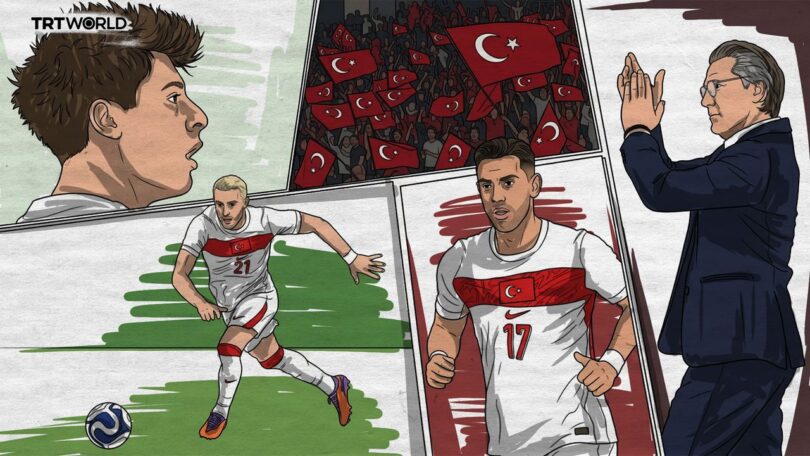
“In 2002 we were extremely talented, but we sometimes acted more with our emotions,” Goz says. “This team is more rational, calmer and more controlled.”
That evolution reflects broader changes within modern football itself. Tactical systems, data analysis and positional discipline now play a far greater role than they did two decades ago.
“Football today is a game of moments,” Goz argued. “Success depends on making the right decisions at the right time with the right players. The game has become far more detailed. Every minute and every second matters.”
This shift has occasionally led to criticism of Montella’s approach, particularly from supporters accustomed to the emotional and often chaotic style traditionally associated with Turkish football.
“People sometimes ask whether we should play more aggressively,” Goz says. “In the past, our greatest victories often came through passion, dramatic comebacks and emotional momentum. Now we have added tactical discipline and a clear game model.”
The result is a national team that many observers believe is better equipped to compete in the modern game.
The squad itself offers plenty of reasons for optimism. Goz highlights goalkeeper Ugurcan Cakir’s form, the experience of the defensive unit and the balance within midfield.
“Our defence has international experience and strong chemistry,” he says. “The midfield complements itself very well and consists of players who have competed regularly in European competitions.”
The only area where he sees a relative weakness is at centre-forward, although he believes Montella’s tactical system compensates for this issue.
“With players such as Kenan Yildiz, Baris Alper Yilmaz and Arda Guler, we have enormous attacking talent,” he said.
Indeed, Arda Guler’s emergence has become one of the central narratives surrounding Türkiye’s return to the World Cup. Comparisons have naturally been drawn with Yildiray Basturk, one of the creative leaders of the 2002 side.
Senad Ok believes the presence of a game-changing playmaker remains essential.
“In 2002, we had Yildiray; today we have Arda,” he says. “No matter what era we are talking about, you need players who can control and direct the game.”
Same passion, one nation
Despite the excitement surrounding individual stars, both commentators emphasise that success in tournament football depends on much more than talent alone.
“World Cups are not only about tactics or technical quality,” Ok argues. “They are about dedication, physical capacity, resilience and refusing to give up. Even if you start a match badly, you can still finish strongly.”
This mentality may prove especially important in a balanced group featuring Australia, Paraguay and the hosts, the United States.
Goz cautions against underestimating any opponent.
“The first match is always the most important,” he says. “Australia must not be taken lightly. The group is balanced, but I think the Paraguay and United States matches may be more difficult.”
At the same time, he believes Türkiye often performs best against stronger opponents.
“Historically, we have shown that we can exceed expectations against teams that appear stronger on paper,” he said.
Ok is even more confident regarding Türkiye’s chances of advancing.
“Looking purely at squad quality, we are stronger than all three opponents,” he says. “We know how we want to play. Our system is established. Under normal circumstances, I expect Türkiye to qualify from the group.”
The expanded format of the 2026 World Cup may also work in Türkiye’s favour, as some third-placed teams will progress to the knockout rounds.
For Goz, reaching the quarter-finals should be viewed as a realistic objective.
“Our ideal target should be the quarter-finals and beyond,” he says. “Why not repeat 2002? Why not go even further? That is not fantasy. It is based on reality and on the quality of this squad.”
Ok shares that optimism.
“This team can make history,” he says. “It can repeat what happened in 2002. The game model is there, the players are there and the relationship between the coach and the squad is exceptional. There is discipline, but there is also friendship and trust.”
Ultimately, while comparisons with 2002 will continue throughout the tournament, both analysts agree that the current team deserves to be judged on its own merits.
The heroes of 2002 inspired a generation. Many members of today’s squad grew up watching those iconic performances and dreaming of following in their footsteps. Yet this team has developed in a different footballing era—one defined by tactical sophistication, international experience and global competition.
As Senad Ok puts it, the two teams may differ in style and background, but they remain united by something more fundamental.
“The football may be different, the experience may be different,” he says. “But it is the same flag, the same passion and the same heart.”