
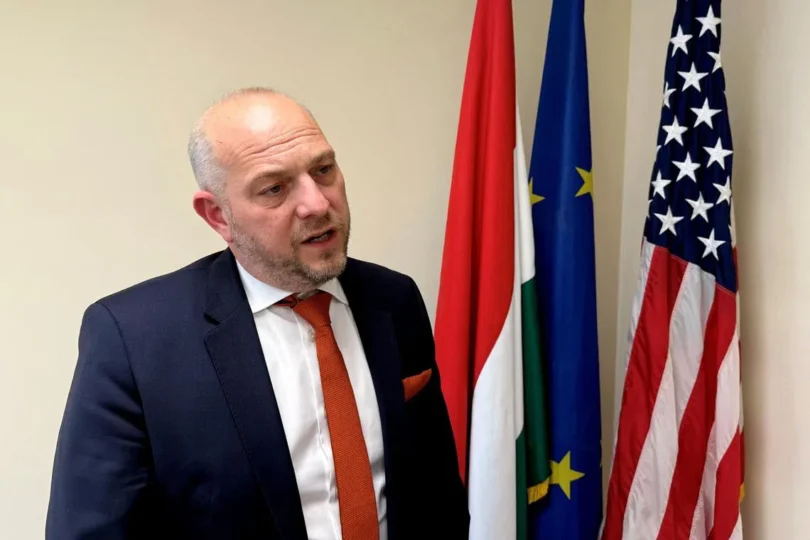
BUDAPEST, April 22 – U.S. investors in Hungary are hoping for a return to predictable policymaking after years of abrupt law changes and ad hoc measures, following centre-right opposition leader Peter Magyar’s landslide victory over Prime Minister Viktor Orban.
The American Chamber of Commerce is one of Hungary’s largest groups of foreign investors with more than 300 U.S. and European members including BlackRock, Cargill, Citi, IBM, Mastercard, Microsoft and Novartis, among others.
Magyar defeated Orban in an April 12 election on a pledge to put Hungary back on a pro-European course and secure the release of billions’ worth of frozen European Union funding to kickstart the economy, mired in near-stagnation for years.
He plans to take the oath of office on May 9, at the inaugural session of parliament.
Foreign investors want to see a predictable business environment and have confidence in the rule of law after Orban’s 16 years in power, AmCham President Akos Janza said, a period often marred by clashes with Brussels over reforms critics said eroded democratic checks and balances.
“Capital hates one thing more than tax, and that is unpredictability,” Janza said in an interview. “It is absolutely important for us and for our member companies that the rule of law becomes the single driving framework in the economy.”
Janza also said Magyar’s plan to put Hungary on a course to adopting the euro, opposed by Orban, would make the country more attractive for foreign investors, curbing exchange rate volatility and the administrative costs of doing business.
REDUCED POLICY PREDICTABILITY HARMS RATING PROSPECTS
Orban had used his sweeping parliamentary majority to centralise power and push major laws through parliament without consultation, in some cases overnight, while hitting companies with sectoral taxes to fund voter-pleasing measures.
S&P Global cut Hungary’s credit rating outlook to negative from stable last April, citing a reduced predictability of policies due to weaker checks and balances and diminished independence of the judiciary, one of the EU’s top concerns.
Fitch Ratings has said one of the main priorities of Hungary’s next government should be to rebuild fiscal policy credibility after frequent revisions to budget targets and a departure from policy objectives, such as debt reduction.
Asked whether Magyar’s pledge for a sweeping anti-corruption drive could bring new investors to Hungary who have so far been on the sidelines, Janza pointed to gains in the forint, which scaled four-year highs after Magyar’s victory.
Janza also said the group “absolutely supported” the planned launch of standalone ministries for healthcare and education under Magyar. REUTERS